Most brokerages do not fail because a market moved against them. They fail because nobody was watching the exposure that built up while the desk was busy with everything else.
Risk management gets discussed as a compliance line item — a policy document, an annual audit, a box to check before a license renewal. That framing is backwards. Risk management is the mechanism that determines whether a brokerage’s revenue is real or borrowed against a blowup that hasn’t happened yet.
The Financial Impact of Getting This Wrong
Consider a mid-sized broker running 4,000 active accounts with average client equity of $3,200 and a hybrid book: 60% of flow routed A-book, 40% retained B-book. On a normal trading day, the B-book generates roughly $38,000 in net revenue from the statistical edge that comes with retail losing over time.
Now consider a single concentrated event — a surprise central bank decision, a flash move in an illiquid pair — where 15% of the B-book turns out to be correlated in the same direction, unhedged, because nobody flagged the concentration in time. On a $1.28M B-book notional exposure, a 15% concentrated move in the wrong direction can erase two to three months of that daily edge in under an hour. The number that matters is not the average day. It’s the tail day, and how fast the desk saw it coming.
This is the economics that risk management actually protects: not the theoretical worst case, but the gap between what a well-monitored book earns and what a blind book eventually gives back.
Exposure You Can’t See Yet
Is your risk desk finding concentration before or after it costs you?
Real-time exposure · Client classification · Automated hedging triggers
Why Most Brokers Miss It
The root cause is rarely a lack of knowledge. Most risk desks know, in theory, what they should be tracking. The failure is architectural: exposure data lives in three or four disconnected systems — the trading platform, the CRM, a spreadsheet someone maintains for hedging, and whatever the LP relationship manager tells them on a call. By the time all of that reconciles into a single picture, the market has already moved.
A second, quieter cause is classification drift. A client who was correctly B-booked as a low-skill retail account six months ago may now be trading with a consistency that suggests something has changed — a strategy shift, a mentor, access to better information. Static client segmentation, reviewed quarterly instead of continuously, misses this until the account has already extracted meaningful value from the wrong side of the book.
The brokers who get this right treat risk management as infrastructure, not oversight. Exposure visibility, client classification, and hedging execution sit in one system, updating in real time, rather than being reconstructed after the fact.
There’s also a staffing dimension most brokers underweight. Manual risk review scales linearly with account count — twice the clients means twice the review workload, assuming the same headcount can even keep pace. That math breaks down well before a broker reaches meaningful scale, which is why growing brokerages so often describe risk management as “something we’ll fix once we hire more people” rather than recognizing that the review process itself, not the headcount, is the bottleneck. Automating the continuous parts of classification and exposure tracking doesn’t eliminate the need for a risk desk; it changes the ratio, letting a small team oversee a much larger book without the review lag that manual processes inevitably introduce as volume grows.
Reframing Risk as a Margin Lever
Once exposure is visible in real time, risk management stops being purely defensive. It becomes a tool for actively shaping which flow gets internalized and which gets routed out — and that decision, done well, is one of the highest-margin levers a broker controls.
A broker that can confidently identify profitable, low-toxicity flow can afford to route more of it externally with tight markups, protecting the relationship while eliminating tail risk. The same broker can identify genuinely unprofitable retail flow with high confidence and retain more of it B-book, where the statistical edge is real and durable. Brokers running on gut-feel classification tend to do the opposite by accident — retaining exactly the flow that will eventually hurt them, and routing out flow that would have been safely profitable to keep.
This is the difference between a risk desk that reacts to drawdowns and one that shapes the P&L before the drawdown happens.
Practical Breakdown: What a Modern Risk Desk Actually Tracks
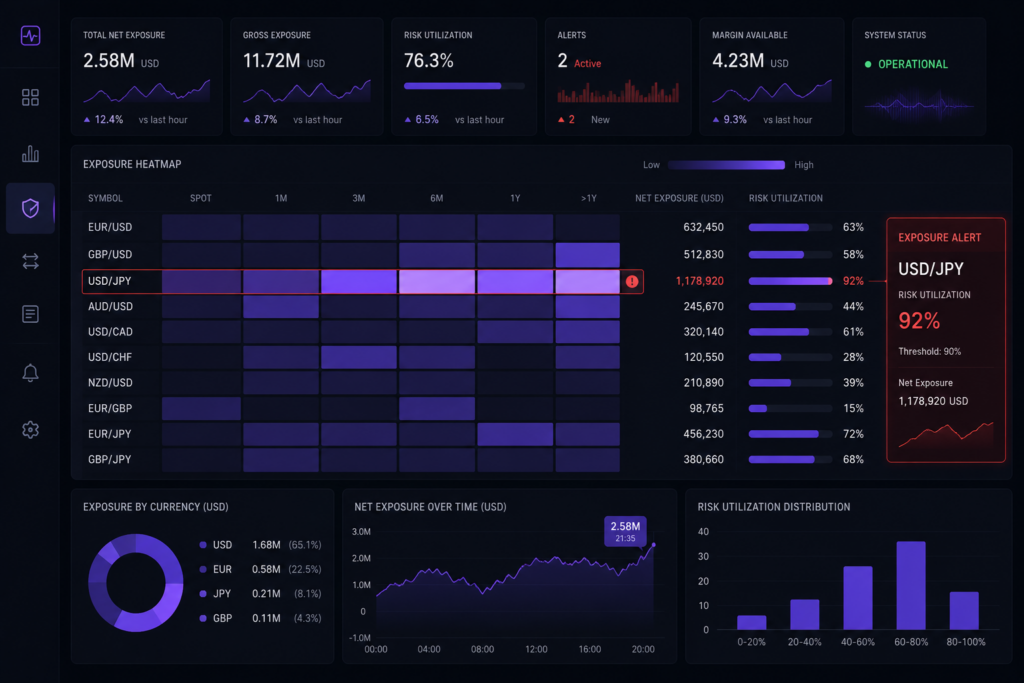
1. Net exposure per instrument, updated in real time. Not end-of-day. Not hourly. A risk engine should show aggregated directional exposure across every open position, symbol by symbol, continuously — and flag when a single instrument crosses a defined threshold as a percentage of the book.
2. Client classification that updates, not a one-time tag. New accounts start in a default bucket. As trading behavior accumulates — win rate, average hold time, correlation with adverse market moves, latency-sensitive entry patterns — the classification should shift automatically, with a human reviewing edge cases rather than reviewing every account.
3. Correlation across accounts, not just within them. A single account 2% over its normal size is noise. Forty seemingly unrelated accounts all opening the same directional position within minutes of each other, following a signal from a shared source, is a structural risk that per-account monitoring alone will never catch.
4. Hedging thresholds tied to automated triggers. Manual hedging decisions are too slow for fast markets. A defined policy — hedge externally once net exposure on a symbol crosses X% of the book, adjust markup once rejection rates on an LP exceed Y% — removes the lag between “someone notices” and “the desk acts.”
5. Margin call and liquidation logic that protects both sides. Automated margin call workflows that trigger consistently, without manual override delays, protect the broker from counterparty risk while giving clients fair, predictable treatment — which matters for retention and for regulatory scrutiny alike.
6. An audit trail for every routing and hedging decision. Regulators increasingly want to see not just that a broker manages risk, but that routing decisions are systematic and defensible rather than arbitrary. A clean, timestamped decision log is now a compliance requirement in most serious jurisdictions, not an optional nicety.
7. Execution quality feedback loops back into the risk model. Rejection rates, requote frequency, and slippage on externally routed flow aren’t just an operations metric — they’re a risk input. If an LP’s execution quality degrades during volatile windows, exposure that was assumed to be safely hedged externally may not be hedged as cleanly as the routing logic expects. A risk desk that never looks at execution quality is working from a model that quietly drifts out of sync with reality over time.
Where the Infrastructure Fits
None of this works as a patchwork of a spreadsheet, a CRM export, and a Slack alert from someone watching a dashboard. It requires a risk layer that sits natively across the trading platform, the bridge, and client data — not bolted on after the fact.
SpencerLogic’s Risk Management Suite centralizes exactly this: real-time P&L, A-book/B-book routing controls, and configurable risk parameters across every connected platform in a single interface, with the AI Risk Management layer adding continuous, automated classification on top for brokers who want the desk making decisions in milliseconds rather than end-of-day. Combined with the rest of the SpencerLogic stack — liquidity aggregation, MT4/MT5 bridging, and client portals — it functions as an all-in-one white label brokerage solution, so risk visibility doesn’t live in a silo separate from execution and liquidity. This is the same risk layer that underpins how prop trading firms structure their risk desks on SpencerLogic infrastructure, and it’s built on the same MT4/MT5 bridging foundation that carries exposure data back into the risk engine in real time. Brokers deploying the Risk Management Suite into an existing MT4/MT5 environment are typically live within days to two weeks; a from-scratch infrastructure build, by contrast, runs considerably longer — which is exactly why most operators layer risk management onto existing rails rather than rebuilding around it.
Ready to see where your current setup has blind spots? Book a demo and we’ll map your exposure gaps in 30 minutes.
Getting Started Without Overhauling Everything
The instinct, once the gaps are visible, is to rebuild the entire risk function at once. Resist it. The brokers who successfully modernize risk management start with the single highest-impact gap — usually real-time exposure visibility — get that live and trusted, then layer in classification automation, then hedging triggers. Each stage is independently valuable, and none of them requires ripping out the existing platform or CRM.
Start with visibility. Everything else compounds from there.
FAQ
What’s the difference between A-book, B-book, and hybrid risk management? A-book routes client orders to external liquidity providers, transferring market risk away from the broker in exchange for markup or commission revenue. B-book internalizes trades, with the broker taking the opposite side and earning from the statistical edge of retail losses, but carrying real market risk. Hybrid models route dynamically based on client classification, combining both revenue models under one risk framework.
How often should client risk classification be reviewed? Continuously, not on a fixed schedule. Trading behavior that indicates a shift in client profile — win rate, position sizing, correlation with adverse moves — should trigger reclassification automatically rather than waiting for a quarterly review, which can leave a broker exposed for months.
What’s the single biggest risk management mistake new brokers make? Treating risk management as a compliance checkbox rather than live infrastructure. A written risk policy that isn’t backed by real-time exposure monitoring and automated hedging triggers provides documentation, not protection.
Does AI-based risk management replace a human risk desk? No. It changes what the desk spends time on. Automated classification and hedging triggers handle the continuous, high-volume decisions; the human desk focuses on edge cases, policy calibration, and the structural judgment calls automation shouldn’t make alone.
How does risk management connect to liquidity provider selection? LP rejection rates, fill quality, and slippage are risk inputs, not separate from the risk conversation. A broker with poor LP performance data can’t accurately assess whether a bad trading day came from client behavior or from execution quality — which is why exposure monitoring and LP benchmarking need to sit in the same view.
What regulatory requirements typically apply to broker risk management? This varies significantly by jurisdiction, but most serious regulators now expect documented, systematic routing and hedging logic with an auditable decision trail — not just a static risk policy document. Brokers should confirm specific requirements with counsel in their licensing jurisdiction.
Can a small or newly launched broker realistically run institutional-grade risk management? Yes, when the infrastructure is white-label rather than built in-house. The gap between a small broker’s risk capability and a large institution’s used to be a capital and engineering-team problem. With modular risk infrastructure available as a deployable layer, that gap is now mostly a decision to adopt it, not a multi-year build.