The Prop Firm Model Has an Infrastructure Problem Most Founders Ignore
A funded trader program sounds simple from the outside: collect challenge fees, allocate capital to passing traders, take a profit split. The economics are attractive. The operational reality — platform integration, risk isolation, payout automation, regulatory exposure, and LP access — is where most founders discover they have built a business with no back-office.
The prop trading industry grew to an estimated $9 billion in challenge fee revenue globally by 2025. That growth attracted thousands of new operators, many of whom launched on third-party dashboards without understanding the technology layer underneath them. When challenge volumes scale, the gaps show: execution latency discrepancies between challenge and live accounts, manual payout queues, risk desks that can’t segment funded book exposure from house capital, and no leverage over the underlying platform.
Building a durable prop trading firm requires making infrastructure decisions before launch day — not after the first payout dispute.
The Financial Architecture of a Prop Trading Operation
A prop firm’s P&L structure differs significantly from a traditional brokerage. Revenue is front-loaded through challenge fees; costs are back-loaded through funded trader payouts, platform licensing, and LP fees.
Consider an illustrative mid-scale firm with 2,000 active challenge accounts at an average fee of $150 per cycle. Monthly challenge fee gross: $300,000. Assuming a 15% pass rate and 70/30 profit split on funded accounts, monthly payout obligation scales directly with funded account performance. A cohort of 300 funded traders averaging $2,000 monthly profit each generates $420,000 in payout obligations — more than the monthly challenge gross.
The business becomes sustainable only when the funded book generates net positive spread revenue. That requires A-book routing for live funded accounts, real liquidity access through a credible prime-of-prime or LP arrangement, and a risk architecture that separates challenge simulation accounts from live execution environments.
Firms that run challenge accounts on simulated execution with no real LP backing can absorb losses on the challenge side indefinitely. The moment they move to live funded capital, that model breaks unless the execution infrastructure is already in place.
The infrastructure question is not cosmetic. It determines whether the funded model is solvent.
The Root Problem: Platform vs. Infrastructure Conflation
Most prop firm technology providers sell a dashboard and call it infrastructure. The dashboard handles challenge rules, drawdown tracking, and trader-facing UI. What it does not handle — unless explicitly engineered — is execution routing, LP connectivity, risk book segregation, and multi-account position management.
A firm that licenses a challenge dashboard from a SaaS provider and connects it to a generic MT5 server has a retail brokerage architecture with a prop-flavored UI. That is adequate for a challenge business. It is inadequate for a live funded trading business at scale.
The distinction matters because prop trading firms operating live funded accounts are, operationally, running a brokerage. They are allocating real capital to traders executing in real markets. The risk exposures are brokerage exposures: LP rejection events, slippage on volatile instruments, aggregated directional exposure across a funded cohort that happens to be correlated because they all passed the same challenge.
Operators who treat the funded account layer as a marketing layer, rather than a risk management layer, discover this problem the first time a news event causes 200 funded traders to go long EURUSD simultaneously.
The Technology Stack a Prop Firm Actually Needs
A production-ready prop trading operation requires the following components:
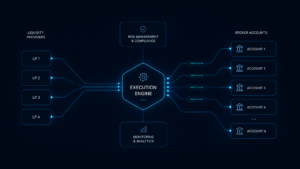
1. Trading Platform with Multi-Group Architecture MT4 and MT5 both support server-side account groups. Challenge accounts, funded accounts, and house capital should operate in separate groups with distinct execution routing rules. Challenge groups typically run on internal liquidity with simulated fills. Funded groups route to external LPs via A-book. Hybrid routing — internalizing small lots, externalizing above threshold — reduces LP fee drag on micro-lot activity.
2. Liquidity Access and Bridging Live funded accounts require access to real market liquidity. A prop firm cannot sustain a live funded book on simulated execution without accumulating inventory risk that has nowhere to go. Access to a prime-of-prime LP — either directly or through an aggregation layer — is the prerequisite for a compliant, sustainable funded program.
A liquidity aggregation layer allows the firm to source from multiple LPs, improving fill rates and reducing rejection events on high-volume instruments. The MT4/MT5 bridge connects platform execution to external LP feeds, supporting A-book routing at the account group level.
3. Risk Management Infrastructure A funded book of 300 traders is not 300 independent accounts. It is a portfolio with correlated risk exposure. The risk desk needs to see aggregate directional exposure by instrument in real time — not individual account P&L.
The Risk Management Suite provides exposure aggregation across accounts, threshold alerts for directional concentration, and automated hedging triggers. AI risk management adds flow toxicity detection: identifying funded accounts exhibiting latency arbitrage, news trading outside permitted windows, or statistical patterns inconsistent with the firm’s risk parameters.
4. Price Engine Challenge accounts and funded accounts must receive identical pricing to avoid disputes. A price engine that distributes uniform tick data across all account groups — with configurable markup tiers for funded vs. challenge groups — eliminates the execution discrepancy complaints that damage funded firm reputations.
5. Client Portal and Back-Office Traders need real-time access to account statistics, payout history, and drawdown metrics. The broker client portal handles trader-facing dashboards, KYC document collection, and account status tracking without requiring manual intervention at the operations layer.
Regulatory Exposure: What Prop Firms Actually Need to Know
Prop trading regulation varies significantly by jurisdiction and operating model. Three frameworks matter most for founders evaluating launch structure:
Challenge-only model (no live capital): In most jurisdictions, a firm that only runs challenge accounts — where traders trade simulated capital against internal liquidity — does not require a securities license. The firm is selling a performance evaluation service, not financial products. This model is the lightest regulatory footprint and is how the majority of offshore prop firms operate.
Live funded model (real capital allocation): A firm allocating real capital to traders and routing their orders through an LP is operating as a principal in financial markets. This activity typically requires a broker-dealer, investment firm, or similar license depending on jurisdiction. SVG, Vanuatu, and offshore structures are commonly used to minimize licensing friction while maintaining LP access.
Hybrid model: Most scaling prop firms operate both legs: a challenge product (no license required) and a live funded product (license required, typically held through a regulated entity or LP partnership). The funded trading layer is often structured through a licensed entity that acts as the principal, with the prop firm acting as a referral or technology partner.
Tax treatment of challenge fees, profit sharing, and LP costs also varies. Founders should confirm treatment with qualified advisors in their operating jurisdiction before launch.
The Practical Launch Sequence
A realistic launch sequence for a prop trading firm targeting $500K in first-year challenge revenue:
Phase 1 — Infrastructure setup (weeks 1–4): Select and license MT4 or MT5 server. Configure account groups for challenge, funded, and house. Establish LP relationship through a prime-of-prime. Deploy bridge and liquidity aggregation. Integrate risk management suite.
Phase 2 — Challenge product build (weeks 3–6): Define challenge rules: profit targets, daily drawdown, max drawdown, time limits, restricted instruments. Configure challenge dashboard (third-party or proprietary). Set pricing: standard industry range is $100–$500 for account sizes of $10,000–$200,000. Build payout automation or workflow.
Phase 3 — Compliance and payment infrastructure (weeks 4–8): Establish KYC/AML workflow for funded account holders. Configure payment processing (crypto and card). Define jurisdiction and entity structure. Obtain legal review of challenge terms, particularly disclaimers around simulated vs. live execution.
Phase 4 — Go-live and risk calibration (weeks 8–12): Launch with challenge accounts only. Monitor execution quality, fill rates, and drawdown distribution. Calibrate risk parameters before enabling live funded accounts.
SpencerLogic as Infrastructure, Not Overhead
An all-in-one white label brokerage solution removes the Phase 1 and Phase 2 infrastructure build from the critical path. SpencerLogic’s modular stack — platform, bridge, liquidity, risk, portal — can be deployed and integrated in days rather than months. A prop firm operator engaging the full stack does not need to source LP access, configure a bridge independently, or build a price distribution layer from scratch.
The architecture is the same whether the operator is building a traditional retail brokerage or a funded trading program. The platform groups, routing rules, and risk parameters are configured to match the prop model — challenge simulation on one group, A-book live execution on another, with unified monitoring across both.
Operators who want to start with challenge-only infrastructure and layer in live funded accounts at a later stage can do so without re-platforming. The infrastructure scales to the business model, not the other way around.
The SpencerLogic blog covers execution model decisions, risk management architecture, and LP access strategies relevant to operators at the infrastructure planning stage.
Conclusion: Build the Back-Office Before the Brand
The prop trading model is compelling. The failure rate among prop firms in their first two years is high, and most failures trace to the same cause: challenge fee revenue was treated as product-market fit validation before the live funded infrastructure was ready. The business scaled into a risk architecture it had not built.
The practical advice for founders: treat Phase 1 infrastructure setup as a precondition for launch, not a post-launch optimization. LP access, execution routing, and risk segregation are not features to add when the firm becomes profitable. They are prerequisites for the firm to be solvent when it does.
Book a technical walkthrough at SpencerLogic to review your platform architecture, LP access requirements, and risk configuration before the first challenge goes live.
FAQ
What technology does a prop trading firm need to operate live funded accounts?
A production-ready prop firm operating live funded accounts needs a licensed trading platform (MT4 or MT5) with separate account groups for challenge and funded tiers, an external LP connection through a bridge and aggregation layer, a risk management system that monitors aggregate exposure across the funded book, a price engine for uniform tick distribution, and a client portal for trader-facing account management. Challenge-only operations can run on lighter infrastructure, but firms planning a live funded program should build the full stack before activation.
Do prop trading firms need a financial license?
It depends on the operating model. Firms running challenge accounts on simulated capital in most jurisdictions do not require a securities license — the service is classified as a performance evaluation product. Firms allocating and routing real capital on behalf of funded traders are typically conducting regulated financial activity and require a broker-dealer, investment firm, or equivalent license. Most scaling prop firms hold a license for the live funded entity and run the challenge business separately.
What is the difference between a challenge account and a funded account from an infrastructure perspective?
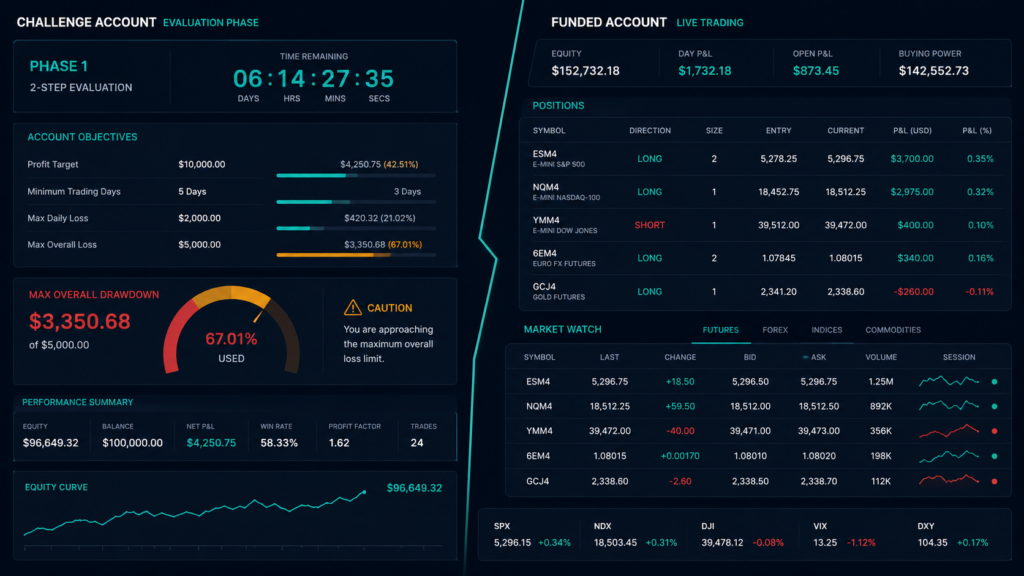
A challenge account routes orders through internal or simulated liquidity — traders are trading against a model, not live markets. A funded account routes orders through an external LP via A-book execution. The distinction matters because the infrastructure requirements, capital exposure, and regulatory treatment differ between the two. Operators often run challenge accounts on one MT5 server group and funded accounts on a separate group with different routing rules and LP connectivity.
How much capital does a prop trading firm need to launch?
Challenge-only operations can launch with minimal working capital — primary costs are platform licensing, dashboard development or licensing, payment processing, and legal setup. A realistic budget for a challenge-only launch ranges from $30,000 to $100,000 depending on technology vendor choices. Live funded programs require allocated trading capital proportional to the funded account sizes offered, plus LP minimum relationship requirements. Funded programs typically require $250,000–$1,000,000 in accessible capital to support initial cohorts.
How do prop trading firms manage the risk of correlated funded trader positions?
Funded trader cohorts often exhibit correlated directional exposure — particularly around news events or during trending market conditions — because they passed the same evaluation and tend to trade similar instruments with similar risk parameters. Risk management infrastructure needs to aggregate positions across all funded accounts by instrument in real time, not just at the individual account level. Threshold-based hedging triggers allow the risk desk to offset aggregate exposure before concentration levels create firm-level risk.
What LP arrangement do prop trading firms typically use?
Most prop trading firms access liquidity through a prime-of-prime (PoP) arrangement rather than direct prime brokerage, which requires institutional minimums most funded programs cannot meet at launch. A PoP provides access to tier-1 LP feeds, aggregated pricing, and credit intermediation. As funded account volume grows, firms with sufficient notional throughput may negotiate direct LP relationships.
How long does it take to launch a prop trading firm?
A challenge-only prop firm can launch in 4–6 weeks with third-party dashboard licensing and an existing MT5 server arrangement. A firm building toward a live funded program should allow 10–16 weeks for full infrastructure setup: LP onboarding, bridge configuration, risk management integration, compliance setup, and platform testing. Firms using a white-label infrastructure stack compress this timeline significantly by eliminating independent vendor sourcing and integration work.