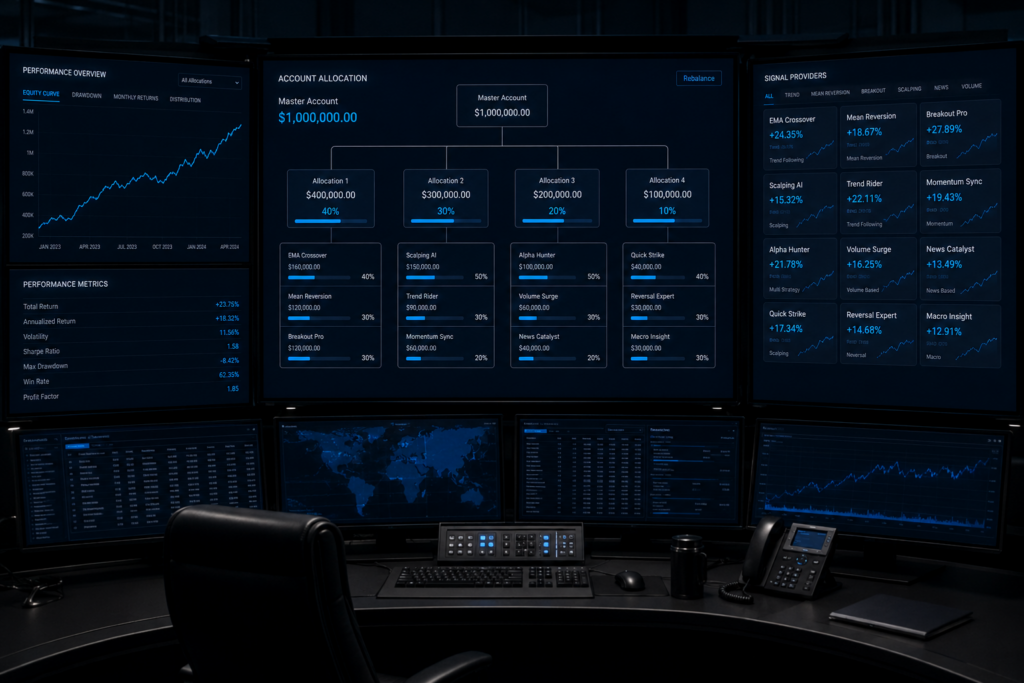
The Revenue Channel Most Brokers Overlook
Retail traders follow. That instinct drives billions in monthly volume through copy trading platforms that brokers did not build. When your traders leave your platform to copy signals on a third-party app, the spread, the commission, and the relationship leave with them.
Copy trading is not a feature brokers add. It is a retention infrastructure decision. The brokers capturing that volume have integrated PAMM/MAMM allocation engines, performance fee mechanics, and risk-segregated sub-accounts directly into their stack. The brokers losing it have not.
The gap between those two groups is closing. Building or integrating a copy trading platform for brokers in 2026 is a defined technical process with known cost and timeline benchmarks. This guide covers it step by step.
The Cost of Not Having One: A Broker Scenario
Consider a mid-size brokerage running 4,000 active retail accounts. Industry research consistently places copy trading consumption rates among retail traders at 20–25%. For this broker, that is 800–1,000 traders who will seek a copy platform if one is not available in-house.
If those traders migrate to a third-party copy app that routes execution to an external broker, the original brokerage loses:
- Spread revenue on 800 accounts. At an illustrative $35/lot and 3 lots per account per month, that is approximately $84,000 in monthly spread.
- Behavioral and transactional data on those clients — the foundation of any upsell or retention strategy.
- The AUM growth those traders drive by attracting new followers to the platform.
That $84,000 figure does not account for performance fee revenue, referral compounding, or the cost of re-acquiring those clients later. A native copy trading infrastructure keeps all of it inside the brokerage.
Why Most Brokers Delay
Three recurring blockers explain why established brokerages defer copy trading builds:
Complexity overestimation. Many operators assume copy trading requires a bespoke development project. It does not. White-label PAMM/MAMM allocation engines integrate via API into existing trading environments without requiring platform rebuilds.
Incorrect sequencing. Brokers typically treat copy trading as a phase 3 or 4 initiative — after CRM, IB programs, and back-office automation. In practice, copy trading drives both acquisition and retention from day one. It belongs earlier in the roadmap.
Risk management anxiety. When a master account takes a drawdown, all mirrored sub-accounts move in parallel. Without prior PAMM/MAMM experience, operators worry about liability exposure. This concern is solvable with proper allocation limits and automated drawdown triggers — not by avoiding the product.
Copy Trading as a Margin Lever
The revenue model for a broker running a native copy trading platform stacks differently than a standard retail book:
- Spread and commission on all copied trades, identical to standard account activity — the base layer.
- Performance fee clip — the platform takes a share of the signal provider’s performance fee (typically 15–25% of what signal providers charge followers).
- AUM growth without incremental acquisition cost — successful signal providers attract new depositors organically. A five-star signal provider with an audited 18-month track record is a marketing asset that costs nothing to distribute.
- Premium tier conversion — verified signal providers with transparent drawdown histories justify managed account products or premium subscription tiers at higher margin.
An illustrative scenario: a broker with 50 active signal providers, each managing 20 followers at an average follower equity of $2,000, oversees $2,000,000 in mirrored AUM. If signal providers charge a 20% monthly performance fee on profitable months and the platform clips 20% of that fee, a 3% net monthly return generates $9,000 in signal provider earnings — $1,800 of which flows to the platform before any spread revenue is counted. At scale, this compounds.
Technical Architecture: What You Are Actually Building
A copy trading platform has six functional components. Each can be built natively, licensed from a vendor, or integrated via API.
1. Trade Allocation Engine (PAMM vs. MAMM)
PAMM (Percentage Allocation Management Module) distributes copied trades proportionally based on each follower’s account balance relative to the master. A follower holding 10% of the master’s AUM receives 0.1 lot for every 1 lot the master executes.
MAMM (Multi-Account Management Module) allows the master — or the follower — to set a fixed lot multiplier independent of balance ratio. A follower can request 2× exposure regardless of their equity position.
Both models require execution inside your platform, not via external API mirroring, to achieve sub-100ms fill parity between master and follower accounts. Fill latency above that threshold produces material slippage divergence — the most common follower complaint in early copy trading deployments.
2. Signal Provider Verification Layer
Not every trader qualifies to offer public signals. The platform requires automated logic for:
- Minimum live trading history (30–90 days recommended, exchange for demo or backtested results creates adverse selection)
- Maximum drawdown thresholds as a listing prerequisite
- Real account requirement — live, audited performance only
- KYC completion before public marketplace access
Verification logic should be automated and produce an auditable compliance record per signal provider. Manual verification does not scale past 30–40 providers.
3. Follower Risk Controls
Each follower account needs configurable protective parameters independent of the master’s own risk tolerance. Standard controls include:
- Equity drawdown threshold (auto-pause copying at, for example, 15% account loss)
- Maximum lot size per copied trade (protects under-funded followers from full-size allocation)
- Instrument exclusions (a follower may want FX exposure but not crypto)
- Pause and resume controls accessible through the client portal without closing positions
Without per-follower drawdown limits, a single master blowup cascades across all mirrored accounts simultaneously — a regulatory and reputational problem that takes months to recover from.
4. Performance Dashboard and Automated Fee Settlement
Signal providers need a real-time dashboard that shows follower count, total AUM under management, cumulative returns, maximum drawdown, and accrued but unsettled performance fees. Opaque dashboards produce provider churn — the most capable traders will leave a platform they cannot monitor in real time.
Fee settlement must be automated: calculate fees per settlement period, deduct from follower accounts, apply the platform clip, transfer the balance to the signal provider, and post all entries to the back-office ledger. Manual settlement becomes error-prone at 20+ providers and creates month-end compliance exposure.
5. Signal Provider Discovery Marketplace
Followers need structured criteria to evaluate signal providers before committing capital. The marketplace must surface:
- Verified trading history — auditable, not self-reported
- Drawdown depth and recovery characteristics
- Monthly return distribution (not just peak headline performance)
- Follower count and average follower tenure — a retention signal that separates genuinely performing providers from short-term attention spikes
- Fee structure per provider
Ranking algorithms that surface verified quality over recency produce better follower outcomes and reduce first-month churn. A follower who copies a deteriorating strategy and loses capital will not return.
6. Back-Office Integration
Copy trading allocation data — lot sizes, performance fees, follower equity movements — must post to the broker’s back-office in real time. This includes:
- Account-level P&L attribution by signal provider
- Regulatory reporting (copy trading is classified as a managed account activity in several jurisdictions)
- IB commission calculation — copy trade volume is typically referral-attributable and should generate IB commissions at the same rate as self-directed volume
Disconnected back-office records create a material compliance risk in regulated jurisdictions and make audits significantly more costly.
Integration Path for Existing Brokerages
Most established operators integrate copy trading in three sequential phases:
Phase 1 — Infrastructure Readiness (Weeks 1–2)
Audit current platform capacity: execution latency, sub-account architecture, API throughput, and liquidity aggregation layer performance. PAMM/MAMM allocation engines require consistent sub-100ms execution parity between master and follower fills. If the current aggregation layer introduces latency above that threshold, optimize at the liquidity layer before deploying allocation logic.
Phase 2 — Allocation Engine and Risk Layer (Weeks 3)
Deploy the PAMM module, the MAMM module, or both — market demand typically warrants offering the choice. Configure per-follower risk controls and defaults. Integrate performance fee settlement into the back-office through the bridging layer. Before opening to live accounts, stress-test allocation accuracy at volume: 50 simultaneous follower fills, then 200, then 500. Allocation errors caught in testing are recoverable; errors caught in live trading are not.
Phase 3 — Marketplace and Client Portal (Weeks 3-4)
Build or deploy the signal provider discovery interface. Connect it to the client portal so followers can subscribe, adjust risk parameters, and monitor performance from a single authenticated session. Enable admin-side tools for signal provider verification workflows, compliance review, and manual override for edge cases.
The total timeline for a broker integrating a white-label allocation engine into a mature existing stack is 3-4 weeks. Greenfield platform builds take longer. Brokers with pre-integrated infrastructure take less.
Platform Considerations
The trading terminal your brokerage operates determines which copy trading infrastructure paths are available natively. MT5 via Spencer Trader supports sub-account architecture and has native PAMM/MAMM compatibility — the most common and lowest-friction integration path for brokers running MetaQuotes infrastructure.
Proprietary platforms require either custom allocation engine development or API-based mirroring, the latter of which introduces fill latency risk that must be explicitly managed.
If you are running a multi-platform environment or adding social investing capabilities alongside standard copy trading, the product requirements diverge. Social investing — strategy sharing, portfolio transparency, community commentary — extends beyond trade mirroring into a distinct product with its own UX and retention mechanics. Plan for separate product tracks if both use cases are in scope.
Where the Risk Desk Fits
Copy trading volume creates a secondary exposure layer that the risk desk must monitor in parallel with the standard book. Consolidated real-time exposure visibility — master account positions plus all mirrored follower positions by instrument — is not optional in a compliant operation.
The risk management suite is built to handle this: aggregated position data from copy trading allocation is visible on the same desk interface as self-directed client flow. Copy trading does not create blind spots in the risk desk’s view; it appears as its own labeled category inside an integrated position map.
This is the architecture of an all-in-one white label brokerage solution — modular components that extend what a live brokerage already operates without requiring a platform rebuild or a separate risk monitoring system.
Starting Without a Full Launch
Copy trading does not require a full-scale product launch to generate value. A controlled beta — 10 verified signal providers, 50–100 followers, one fee settlement cycle — gives the risk desk, back-office, and compliance team enough live data to calibrate the system before scaling. Problems found in a 50-follower beta are recoverable. Problems found at 1,000 followers are a liability event.
The brokers who defer copy trading do so until a competitor captures their most engaged clients. At that point, the cost of launching includes the cost of winning them back — a significantly higher number.
Book a technical walkthrough at spencerlogic.com/demo to review integration requirements against your current stack.
FAQ
What is the difference between PAMM and MAMM in a broker copy trading platform?
PAMM (Percentage Allocation Management Module) distributes copied trades proportionally based on each follower’s account balance relative to the master. MAMM (Multi-Account Management Module) lets the manager or follower set a fixed lot multiplier independent of balance ratio. Brokers with professional or high-net-worth client segments often offer both, since MAMM suits clients who want defined leverage exposure rather than proportional mirroring.
How long does it take to integrate a copy trading platform into an existing brokerage?
For a broker integrating a white-label PAMM/MAMM engine into a mature MT5 environment with a clean API-accessible back-office, 3-4 weeks is a realistic delivery range. Greenfield platform builds take longer. The highest-risk phase is stress-testing allocation accuracy under simulated volume load before opening live accounts.
What execution latency is acceptable between master and follower fills?
Fill latency between master and follower accounts should stay below 100 milliseconds under normal market conditions to prevent material slippage divergence. At higher latency, fast-moving markets produce fill discrepancies that disadvantage followers and generate support volume. Allocation engines operating inside the broker’s server environment consistently achieve lower latency than external API-mirroring architectures.
Is copy trading regulated differently from standard retail trading in major jurisdictions?
In many jurisdictions, copy trading platforms are classified as managed account or portfolio management activity, triggering licensing requirements beyond a standard retail forex license. FCA, CySEC, and ASIC each treat copy trading differently. Brokers should obtain a jurisdiction-specific compliance opinion before launching copy trading to clients in regulated markets. Offshore jurisdictions typically have lighter requirements.
How do brokers handle a master account drawdown that affects all followers simultaneously?
The correct control is per-follower drawdown limits configured independently of the master’s risk tolerance. When a follower’s equity loss reaches the set threshold — for example, 15% — the platform automatically pauses copying for that account and notifies the client. Some platforms add a platform-level circuit breaker that removes a signal provider’s public listing if drawdown breaches compliance thresholds. Both controls should be in place.
Can copy trading volume be attributed to introducing brokers for commission purposes?
Yes. Most copy trading implementations maintain the IB attribution at the follower account level. Volume from copied trades generates IB commission at the same rate as self-directed volume. Some operators also structure IB compensation on the performance fee the platform clips — incentivizing IBs to recruit high-quality signal providers rather than maximizing follower headcount.
How many signal providers does a broker need before launch?
A marketplace with fewer than 6–8 active signal providers does not offer enough choice to retain follower interest past the first 30 days. A controlled launch targeting 10–20 verified providers with at least 60 days of live track record gives followers meaningful selection without overwhelming the back-office’s capacity to monitor, audit, and settle. Provider quality matters significantly more than quantity in the first 90 days.