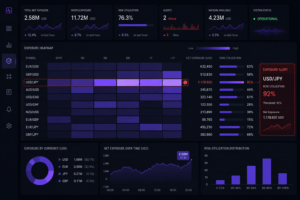
A retail forex broker running a hybrid book knows the problem exists. A cohort of accounts systematically extracts from the B-book before any human risk manager can respond. By the time a manual review surfaces the pattern, the loss is already priced into the week’s P&L. The positions are closed. The traders are working the next broker’s spread.
Toxic flow is not new. What changed is the tooling available to detect it in real time — and the cost of remaining blind to it.
The Financial Weight of Undetected Toxic Flow
Consider a mid-size retail broker processing $200M in average daily volume, with 60% internalized on the B-book. Of that internalized flow, industry-reported estimates suggest 8–12% typically originates from traders whose fill-to-close ratio systematically moves against the book.
At $120M daily B-book volume, a conservative 10% toxic fraction represents $12M per day in flow that should either hedge externally or reprice at the bridge. If that flow generates a net adverse move of 0.3 pips on average across FX majors — roughly three basis points — the daily P&L drag reaches approximately $3,600. Over a 250-trading-day year, that is a $900,000 preventable loss from a single undetected flow segment.
That estimate assumes the toxic accounts are simply skilled. When the flow originates from latency arbitrageurs or signal-feed traders — participants who exploit the broker’s price lag systematically — the per-pip impact scales significantly further. For a broker processing north of $500M daily, the annual exposure from undetected toxic flow can cross seven figures before operating costs are factored in.
Risk managers who dismiss this as a rounding error have not run the numbers against their own internalization rate.
Why Most Risk Desks Miss It
Traditional risk monitoring tools surface aggregate exposure: net delta by currency pair, open lot count, client margin levels. Those metrics tell the risk manager what the book looks like right now. They do not identify which clients are generating that position.
Manual segmentation — flagging accounts whose win rates breach a statistical threshold — relies on historical lookback periods that lag current trading behavior by days or weeks. By the time a trader reaches the threshold for A-book rerouting, they have already extracted. The rule fires after the fact.
The second failure mode is structural. Toxic flow rarely announces itself in uniform patterns. Latency arbitrageurs run at different intervals depending on LP connectivity and session depth. News traders cluster around macro events and then go quiet. Correlation traders shift instruments as arbitrage windows close. A rule-based system calibrated to one profile will consistently miss another.
The third failure mode is volume. A risk desk monitoring 50,000 active accounts manually cannot review fill-level behavior at the individual account level. Rules-based systems collapse to population-level heuristics. The toxic minority that falls between the heuristics extracts without interruption.
Reframing Flow Quality as a Margin Lever
The goal of machine learning flow analysis is not to eliminate profitable clients. It is to make internalization decisions dynamically — at the fill level — based on the statistical probability that any given order will move against the book.
For a broker running a pure B-book, improving internalization accuracy from 60% to 66% — routing only the genuinely market-making flow internally — can separate a profitable quarter from a marginal one. For a hybrid operator, dynamic routing means A-booking the toxic segment automatically, while retaining the fill revenue from the 90% of flow that is legitimately internalized.
This is a margin optimization layer. It requires no change to client-facing spreads, no reduction in execution quality, and no renegotiation with LPs. The gain comes from routing precision, not product repricing.
How Machine Learning Toxic Flow Detection Works Operationally
Building the Feature Set
An ML classifier for toxic flow ingests per-fill attributes at the moment of execution. Typical inputs include: time-to-close in milliseconds, direction versus the next tick price movement, LP fill latency at the moment of order submission, account-level win rate over rolling windows (1 hour, 24 hours, 5 days), instrument correlation with macro event calendars, and session behavior patterns such as clustering near opens and closes.
No single feature classifies a trader as toxic. A high win rate is commercially benign in isolation. A high win rate combined with consistent positive slippage on fast-market fills executed within 200 milliseconds of a price update is the behavioral signature the model scores as high-risk.
Scoring in Real Time
The model assigns a toxicity probability score to each incoming order before routing. Orders above a configurable threshold route to the A-book automatically. Orders below it internalize as normal. The routing threshold itself adjusts dynamically based on current LP liquidity conditions: during thin markets or event-driven volatility, a lower toxicity score may trigger external routing because internalization risk is elevated regardless of client behavior.
The scoring pipeline must operate within the execution latency budget. Any classification layer that adds more than 50 milliseconds to fill time becomes commercially irrelevant — the model’s routing decision arrives after the market has moved past the point where the classification matters.
Retraining Continuously
Market participants adapt. A model trained on last year’s latency arb signatures may miss a cohort of news traders who learned to split orders across instruments to remain below single-pair detection thresholds. A retraining pipeline — typically weekly, or triggered by detected model drift — keeps the classifier current without requiring manual rule updates from the risk desk.
Model drift is monitored by tracking the gap between predicted and realized adverse move rates for A-booked flow. When the model’s A-book classifications consistently underperform their predicted toxicity level, that signal initiates a retraining cycle.
Closing the Loop With the Risk Desk
The output of the model is not a black box. Explainability layers surface the top contributing features for any flagged account, so risk managers can audit classifications and override when contextually warranted. An account flagged primarily on session-time clustering may be a PAMM manager running a systematic strategy — not a latency arb. The risk desk reviews the explanation, overrides the classification, and the account’s behavioral profile updates accordingly.
The model handles volume. The risk manager handles context. Neither replaces the other.
Infrastructure Requirements for Real-Time ML Risk
Running a real-time scoring layer requires tight integration between the bridge, the OMS, and the risk monitoring system. The scoring pipeline must sit inside the broker’s execution stack — not as an external API call that adds network round-trip latency to every fill.
SpencerLogic’s AI Risk Management module operates within the same execution environment as the Risk Management Suite, meaning the classification pipeline processes each order using the same data streams that feed the broker’s existing risk monitors. There is no additional integration layer, and no latency penalty from routing to an external scoring service.
The module connects directly to the Liquidity Aggregation layer. A-book routing triggered by a high toxicity score executes through the same LP feed as manually routed orders — fill quality, spread, and rejection rate remain consistent. There is no LP-relationship cost to automated routing.
The Price Engine feeds the pre-fill market snapshot the model uses to assess latency-arbitrage probability at the moment of each order. Without that tick-level price context, the classifier cannot distinguish between a genuinely fast execution and an order timed to exploit a stale quote.
For brokers running Spencer Trader as their primary execution environment, the AI risk module integrates at the session level, tracking individual account behavior across MT5 and the native order flow without separate data pipelines. The complete infrastructure operates as a coherent all-in-one white label brokerage solution for operators who need institutional-grade risk intelligence without building the underlying data infrastructure from scratch.
Brokers running the crypto exchange infrastructure can apply the same flow detection principles to spot and derivatives order flow — covered in more detail in the white-label crypto exchange operator’s guide.
Start With Monitoring. Automate Incrementally.
The risk desk does not need to automate routing on day one. A practical entry point is read-only scoring: the model runs, toxicity scores are logged per fill, and the risk team reviews classifications against known problem accounts and P&L outcomes. That validation exercise — run over four to six weeks — builds institutional confidence in the model before any automated routing goes live.
Once validated on a subset of instruments, routing rules deploy incrementally: first on a single currency group where the model’s classification accuracy is highest, then across the book as the risk desk confirms reliability.
The infrastructure exists now. The annual cost of not using it is a measurable P&L line, not a theoretical risk.
Schedule a technical walkthrough of the AI Risk Management module
FAQ
What is toxic flow in a forex brokerage context?
Toxic flow refers to client orders that consistently move against the broker’s B-book position immediately after execution. It typically originates from informed traders, latency arbitrageurs, or news traders who systematically capture the broker’s price lag. Because B-book profitability depends on adverse move frequency staying below a threshold, toxic flow directly compresses margin without appearing as a discrete loss event.
How does machine learning detect toxic flow differently from rule-based systems?
Rule-based systems apply fixed thresholds — flag any account with a win rate above a set percentage over a defined lookback period. Machine learning models assess multi-dimensional behavioral profiles at the fill level in real time, adapt to evolving trading patterns through retraining cycles, and score each order individually rather than waiting for a population-level threshold to accumulate. The practical difference is that ML detects emerging toxic patterns weeks before a rule-based system would flag them.
Does AI-driven A-book routing affect LP relationships or fill quality?
Not when the routing layer sits inside the liquidity aggregation stack. Orders routed to the A-book by the ML classifier execute through the same LP feed as manually routed flow. Spread, fill rate, and rejection rate remain consistent. LPs do not distinguish between classifier-triggered and manually triggered A-book orders.
How much latency does the ML scoring pipeline add to execution?
When the scoring pipeline is integrated directly into the execution stack — rather than operating as an external API call — the latency addition is typically under 10 milliseconds. That sits well within the 50-millisecond threshold below which the classification remains commercially relevant.
What data does the model require to operate?
The model requires tick-level fill data (timestamp, direction, size, fill latency at execution), rolling account-level trade history, and a real-time market snapshot at the moment each order arrives. Most brokers running a modern OMS already capture this data. The integration question is whether it can be streamed to the scoring pipeline within the execution latency budget.
How long does a validation cycle take before automated routing goes live?
A typical validation cycle runs four to six weeks: the model scores fills in read-only mode, the risk desk audits high-scoring accounts against P&L outcomes, and the routing threshold is calibrated for the broker’s specific flow composition. Automated routing is introduced after the risk desk confirms classification accuracy against a known set of toxic accounts.
Can a broker implement AI risk management without replacing its existing risk tools?
Yes. The AI scoring layer integrates with existing bridge and OMS infrastructure rather than replacing it. Brokers keep their existing exposure monitors, margin management tools, and manual review workflows. The ML classifier adds a real-time routing intelligence layer on top of the current stack.