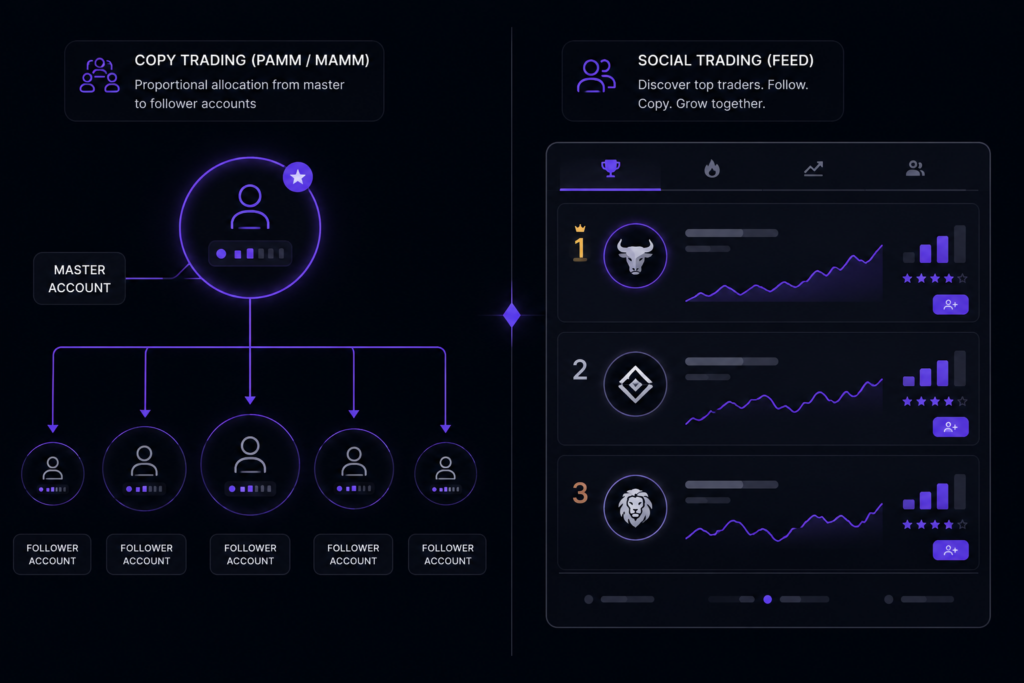
Most operators use “social trading” and “copy trading” interchangeably in internal roadmap discussions, and that habit is costing them revenue. The two products serve different client segments, carry different regulatory exposure, and monetize differently. A brokerage that builds copy trading when its client base actually wants social trading — or vice versa — ends up with a feature nobody uses and a development budget that doesn’t come back.
Financial Impact
Consider a mid-size FX/CFD brokerage with 3,500 funded accounts. Industry-reported adoption rates for social and copy features among retail brokerage clients run 15–25% of the active base once the product is positioned correctly. Positioned incorrectly, adoption stalls closer to 3–5% — clients try the feature once, don’t understand what it’s for, and abandon it.
That gap is not cosmetic. At the midpoint of the correct-positioning range (20% adoption, 700 accounts), and assuming a conservative $18–$26 average monthly spread contribution per engaged account from the additional trading volume the feature drives, the incremental spread revenue lands between roughly $12,600 and $18,200 per month. At 4% adoption on the same base (140 accounts), that same calculation returns $2,500–$3,600 per month — a difference of roughly $120,000–$175,000 annually, before any performance-fee revenue share is counted. The product itself doesn’t change that outcome. Whether it matches client intent does.
Insight: They Solve Different Problems
Copy trading is an execution decision. A follower allocates capital to a signal provider and trades are mirrored into their account automatically — via PAMM proportional allocation or MAMM fixed-multiplier allocation — with no discretionary input from the follower after setup. The follower is opting out of decision-making entirely.
Social trading is an information decision. The client retains full control over every order but gains visibility into what other traders — often ranked, verified, or featured — are doing, thinking, or discussing. Some social trading environments include an optional one-click “copy this trade” action, which is where the two categories blur in vendor marketing and internal team language. But the default behavior is different: social trading clients place their own trades; copy trading clients don’t place trades at all.
The confusion is expensive because the two products require different infrastructure and appeal to different client segments. Copy trading needs an allocation engine, sub-account risk segregation, and performance-fee accounting rails. Social trading needs a feed, trader profiles, leaderboards, and lighter-weight execution hooks — no allocation logic is required because the client is still pulling the trigger.
Opportunity: Segment, Don’t Choose
Most brokers frame this as an either/or decision because they’re budgeting for one build. That framing understates the addressable client base. Client segmentation research across retail brokerages consistently identifies two distinct groups within the same funded-account pool: a smaller cohort (often 15–20% of active accounts) that wants full delegation and will pay a performance fee for it, and a larger cohort (40%+ in many books) that wants information and validation but is unwilling to hand over execution control.
A brokerage offering only copy trading captures the first group and leaves the second group unaddressed — which is often the larger revenue opportunity, since social trading clients continue placing trades (and generating spread) at their own pace rather than concentrating volume through a handful of signal providers. A brokerage offering only social trading captures engagement and retention but misses the performance-fee revenue layer entirely. Offering both, on a shared underlying platform, captures the full addressable segment without duplicating infrastructure.
Social + Copy Trading, One Stack
Not sure which segment your client base actually wants? We’ll map it in a 30-minute walkthrough.
PAMM/MAMM allocation · Leaderboards & feeds · Shared risk layer
Practical Breakdown
Step 1 — Segment your existing book before building anything. Pull trading activity for the last 90 days and split accounts into three buckets: fully passive (near-zero manual trades, high dormancy risk), semi-active (irregular trading, engagement with market commentary or education content if you track it), and fully active (consistent independent trading). The first bucket is your copy trading candidate pool. The second is your social trading candidate pool. The third rarely adopts either product and shouldn’t be a build justification.
Step 2 — Decide allocation architecture for copy trading separately from feed architecture for social trading. These are genuinely separate technical decisions. PAMM/MAMM allocation engines need to sit inside your execution loop for fill-parity between master and follower accounts — sub-100ms divergence is the standard tolerance before slippage complaints start. Social feeds do not touch execution at all and can be built or licensed as a lighter, faster-to-ship layer.
Step 3 — Build the signal-provider or featured-trader pipeline before launch, not after. Both products are dead on arrival with zero visible participants. For copy trading, convert your top-performing existing clients into signal providers using performance data you already hold. For social trading, seed the feed with in-house market commentary or a small group of active traders willing to make positions visible, until organic participation reaches critical mass.
Step 4 — Price the performance-fee split (copy trading) and decide whether social trading carries any fee at all (usually it doesn’t, and shouldn’t). A common split is 15–20% of signal-provider profit share retained by the broker. Social trading typically monetizes purely through the additional spread volume it drives, not through direct fees, because charging for visibility (rather than delegation) suppresses adoption.
Step 5 — Instrument both for churn signals from day one. Copy trading churn shows up as follower withdrawal after a signal provider drawdown. Social trading churn shows up as feed disengagement — declining session time on the social tab — well before account closure. Both are leading indicators worth tracking separately.
Regulatory Weight Differs Between the Two Models
The distinction matters beyond product design because it changes regulatory exposure. PAMM allocation, where follower capital is pooled and traded under a single manager’s discretion, resembles portfolio management in the eyes of several regulators — CySEC and FCA guidance both treat discretionary allocation structures with heightened scrutiny compared to standard execution-only brokerage. MAMM structures, where funds stay segregated in individual sub-accounts but mirror a master strategy, generally carry somewhat lighter treatment, though jurisdiction-specific counsel is still warranted before launch.
Social trading, by contrast, rarely triggers the same review. Because the client places every order themselves, most regulators treat the feed and leaderboard components as marketing or engagement tooling rather than a managed-account product. This is one of the underappreciated reasons social trading is often the faster product to bring to market: the compliance review cycle is materially shorter when discretion never leaves the client’s hands. Brokers evaluating which product to build first should weigh this alongside the revenue modeling above — a faster compliance path can mean social trading reaches production months before an equivalent copy trading rollout clears legal review in a discretion-sensitive jurisdiction.
Where Brokers Get the Segmentation Wrong
The most common mistake isn’t choosing the wrong product outright — it’s assuming the entire funded-account base is a single audience for whichever product gets built. A brokerage that builds copy trading and markets it broadly to all 3,500 accounts in the earlier example will see the bulk of that audience ignore the launch entirely, because most of those accounts were never passive-capital candidates to begin with. The resulting adoption numbers look like product failure when they’re actually a targeting failure.
The fix is targeted rollout rather than blanket rollout. Passive and dormant accounts identified in Step 1 should receive copy trading onboarding communication specifically — not a general feature announcement sent to the full client list. Semi-active accounts should be introduced to the social feed through in-app prompts tied to their existing trading activity, not a separate marketing campaign competing for attention against everything else in the inbox. Brokers that skip this targeting step consistently report adoption numbers 3–5x lower than brokers that segment first, even when the underlying product build is identical.
There’s also a sequencing question worth deciding upfront: some operators try to launch both products simultaneously to “get it all live at once.” In practice, this usually slows both launches down, because the teams responsible for signal-provider recruitment (copy trading) and feed content seeding (social trading) end up competing for the same limited operations bandwidth in the weeks before go-live. Sequencing the launches two to four weeks apart, with the lighter social trading product typically going first, tends to produce cleaner adoption data for both and gives the operations team room to build a signal-provider bench before copy trading needs one.
Soft Positioning
SpencerLogic’s Invest Social platform is built to run both models on shared infrastructure rather than forcing a build-one-or-the-other decision. The allocation engine, signal-provider marketplace, performance-fee accounting, and follower risk controls needed for copy trading sit on the same bridge-level integration as the feed, leaderboard, and trader-profile components needed for social trading — so operators aren’t maintaining two disconnected systems or paying for two separate development projects. It integrates with your existing MT4/MT5 environment and shares the same risk management layer used across the rest of your stack, whether you’re running it standalone or as part of an all-in-one white label brokerage solution alongside liquidity aggregation, bridging, and client portals.
Ready to figure out which model — or both — actually fits your book? Book a demo and we’ll walk through your account segmentation together.
Conclusion
You don’t need to commit to a full rebuild to test this. Most brokers start by adding the lighter of the two products — typically social feed functionality — to validate engagement before investing in allocation infrastructure for copy trading. Both can run on the same platform when you’re ready to add the second. Talk to SpencerLogic about your rollout sequence.
FAQ
Is social trading the same as copy trading?
No. Copy trading automatically replicates a signal provider’s trades into a follower’s account with no manual input required. Social trading gives clients visibility into other traders’ activity and commentary, but the client places every trade themselves.
Which one should a broker build first?
It depends on client segmentation, not vendor preference. Brokers with a large passive or dormant account base typically see faster ROI from copy trading. Brokers with an active but under-engaged client base typically see faster ROI from social trading. Reviewing 90 days of trading activity data is the fastest way to answer this before committing budget.
Can a broker offer both on the same platform?
Yes, and this is increasingly the default approach. Modern white-label modules run PAMM/MAMM allocation engines and social feed components on shared infrastructure, avoiding duplicate integration work and giving operators a single risk and reporting layer across both products.
How is copy trading regulated differently from social trading?
Copy trading, particularly PAMM structures, often triggers portfolio-management-adjacent regulatory treatment in several jurisdictions because the broker or signal provider is exercising discretion over follower funds. Social trading, where the client retains full execution control, generally falls under standard brokerage disclosure requirements. Regulatory review by jurisdiction is recommended before launch of either.
Does social trading generate direct revenue, or only indirect revenue?
Social trading is typically monetized indirectly, through the additional spread and commission volume generated by more engaged, more active clients — not through a direct fee on the feature itself. Copy trading generates both spread revenue and a direct performance-fee share from signal-provider profits.
What’s the typical build timeline for each?
A white-label copy trading module with PAMM/MAMM allocation typically deploys in two to six weeks. Social trading feed functionality, which doesn’t touch the execution layer, can often ship faster when licensed rather than built in-house — timelines vary by integration complexity with your existing CRM and client portal.
Will offering both products cannibalize the same client base?
Rarely, if segmentation is done correctly beforehand. The two products tend to appeal to distinct groups — passive capital versus active-but-uninformed traders — and cross-adoption (a client using both) is generally additive to engagement rather than substitutive.