Most product roadmaps list “social trading” and “copy trading” as the same line item. They are not the same infrastructure, they do not carry the same licensing exposure, and they do not produce the same revenue curve. Brokers who treat them interchangeably tend to build the wrong thing first, then retrofit — usually at a cost that could have been avoided by getting the taxonomy right before the first sprint.
The distinction matters because it changes three decisions before a single line of code gets written: which allocation engine to license, which regulatory disclosures apply, and which client segment the product actually serves.
What Each Term Actually Means
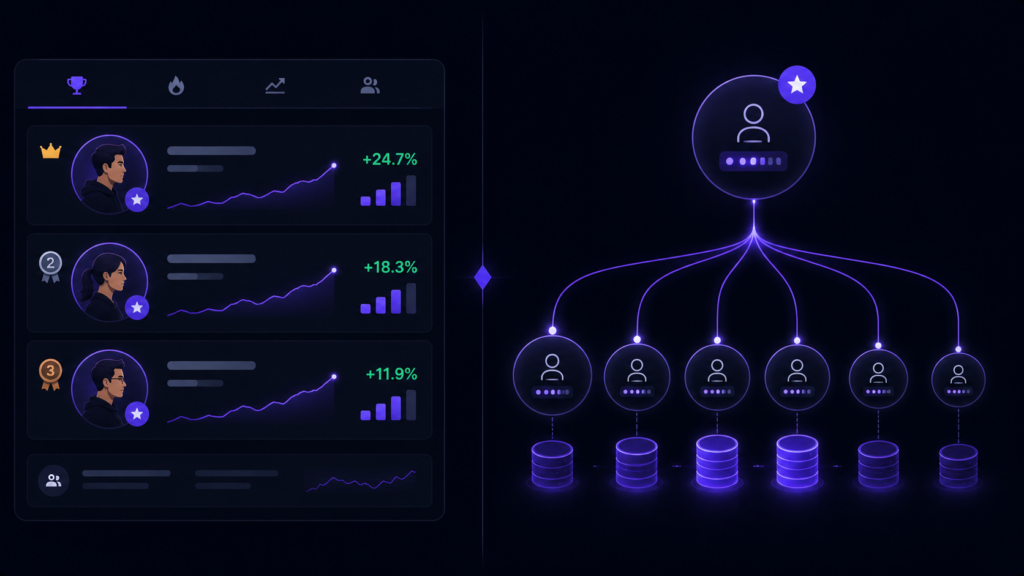
Social trading is a discovery and community layer. Clients see other traders’ public performance, open positions, sentiment, and commentary. Some social trading platforms stop there — the value is transparency and community, not automated replication. A trader browses leaderboards, follows a feed, and decides manually whether to place a similar trade in their own account. No funds move automatically, and in many implementations no trade executes automatically either.
Copy trading is an execution layer. A follower allocates capital to a signal provider, and every trade the provider places is replicated proportionally into the follower’s account — automatically, in real time, without the follower touching the order ticket. This is where PAMM (Percentage Allocation Management Module) and MAMM (Multi-Account Management Module) architectures live: PAMM pools follower capital and distributes P&L proportionally by contribution; MAMM keeps capital in individually owned sub-accounts while mirroring a master strategy at a follower-selected multiplier.
The practical distinction for a broker building infrastructure: social trading is a UI and data problem — leaderboards, feeds, performance transparency. Copy trading is an execution and settlement problem — real-time trade replication, fee accrual, and risk segregation across potentially thousands of linked sub-accounts.
A platform can offer both, and the strongest brokerage products usually do — social discovery feeds a copy trading funnel. But building copy trading infrastructure assuming it is “social trading with an extra button” undersizes the engineering problem by an order of magnitude.
The Financial Impact of Getting This Wrong
Consider a mid-size FX/CFD brokerage with 3,500 active retail accounts and average monthly account lifetime of 14 months before churn.
If this broker builds a social trading feed only — leaderboards, commentary, performance transparency — and stops there, they capture engagement value: time-on-platform increases, and clients research signal providers before manually replicating trades. Industry-reported engagement lifts for leaderboard-driven platforms run 10–20% on session frequency. But manual replication introduces latency between when a leader trades and when a follower manually places the same order, typically 30 seconds to several minutes depending on how actively the follower is watching. That latency gap produces price divergence on volatile instruments, and followers who lose money on delayed replication tend to blame the broker’s platform, not their own execution timing.
Now model the same broker building true copy trading infrastructure — automated PAMM/MAMM allocation with sub-100ms replication between master and follower fills. Applying a conservative 20% adoption rate across the 3,500-account base (700 followers), with an average of 1.8–3x lifetime extension reported by operators running mature copy programs, and a 15–25% lift in average revenue per copier from higher notional exposure:
| Metric | Social-trading-only build | True copy trading infrastructure |
|---|---|---|
| Followers activated | ~350 (browsing only, no auto-replication) | ~700 (20% adoption) |
| Avg. lifetime extension | Minimal — no execution lock-in | 1.8–3.0x |
| Incremental annual revenue (illustrative) | $80K–$150K (engagement-driven) | $650K–$950K (retention + performance fee share) |
| Signal provider revenue layer | None (no fee mechanism) | 20–30% performance fee share, broker-retained portion |
The gap is not marginal. It is the difference between a feature that improves session metrics and an infrastructure layer that changes unit economics on the client base.
Why Brokers Conflate the Two
Three reasons this distinction gets lost in planning:
Vendor naming is inconsistent. Some platform vendors market copy trading modules under a “social trading” brand name, and some genuinely social-only feed products use “copy” in their marketing copy because it tests better with prospects. The commercial language does not reliably signal the underlying architecture — brokers have to look at the execution mechanism, not the product name.
Licensing teams flag copy trading, not social trading, as the regulatory concern — and that flag often gets misread as “social trading is the safe, simple version.” In many regulatory regimes, a signal provider receiving performance-based compensation for managing follower capital can be classified as engaging in portfolio management or investment advisory activity, which triggers licensing obligations that a pure discovery feed does not. That is a real distinction, but it leads some product teams to default toward social trading as the “lower-risk MVP” without accounting for the fact that it also delivers a fraction of the retention value.
Roadmap sequencing treats copy trading as a phase-3 or phase-4 initiative — something to bolt on after CRM, IB programs, and back-office automation are mature. In practice, the infrastructure decision (PAMM vs. MAMM vs. pure discovery feed) needs to happen early, because retrofitting execution-layer replication onto a platform architected only for a social feed means rebuilding the allocation and settlement layer from scratch.
The Practical Breakdown: Choosing the Right Layer for Your Brokerage
Step 1 — Audit your existing client base for signal-provider candidates. Copy trading only works if there is a credible pool of traders willing to run public strategies. A brokerage with 5–15 consistently profitable, willing signal providers has enough critical mass to launch a copy program. Fewer than that, and a social discovery layer alone may be the more honest starting point.
Step 2 — Decide the allocation model before selecting a vendor. PAMM suits brokers whose signal providers prefer pooled fund management with proportional distribution — simpler accounting, heavier regulatory framing in most jurisdictions. MAMM suits brokers whose followers want individually owned sub-accounts with configurable exposure multipliers — more operationally complex, generally lighter regulatory framing since capital never pools.
Step 3 — Confirm execution architecture sits at the bridge level, not as a post-trade plugin. Plugin-based copy modules replicate trades after the master’s fill confirms, introducing latency that shows up as slippage divergence between master and follower P&L — the single most common source of follower complaints and provider churn in early deployments.
Step 4 — Build the fee settlement and disclosure layer alongside the execution layer, not after. Performance fee accrual, drawdown disclosure, and per-jurisdiction risk warnings need to be part of the initial build. Retrofitting compliance language after a copy trading module is already live with active followers is a materially harder project than including it at launch.
Step 5 — Layer social discovery on top once execution infrastructure is stable. Leaderboards, performance transparency, and community feed features are lower-risk to add incrementally and materially improve the top of the copy trading funnel once the underlying replication engine is proven.
For a deeper technical walkthrough of the allocation engine build itself — provider onboarding, drawdown triggers, and settlement automation — see SpencerLogic’s guide to launching a copy trading platform.
Where This Sits in a Modern Broker Stack
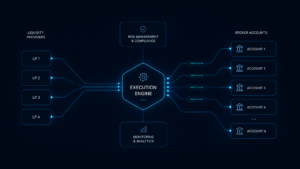
Copy trading execution cannot run in isolation from the broker’s core risk architecture. When a master account draws down, every linked follower sub-account needs real-time exposure visibility — the same monitoring layer that governs the broker’s own book. SpencerLogic’s risk management suite extends the same real-time exposure monitoring used across standard retail flow to copy trading sub-accounts, so a master account drawdown triggers the same automated alerting and margin logic rather than a separate, disconnected monitoring path.
For brokers evaluating whether to build this in-house or license it, SpencerLogic’s Invest Social platform runs PAMM, MAMM, and social discovery feeds on a single allocation engine at the bridge level — connected to the same MT4/MT5 environment and risk layer as the rest of the stack. It is modular: a brokerage with existing infrastructure can deploy it as a standalone layer, and a brokerage building from scratch can combine it with SpencerLogic’s all-in-one white label brokerage solution — trading platform, liquidity aggregation, bridging, risk management, and client portals — to have a complete, copy-trading-ready operation running in weeks rather than quarters.
Not sure whether PAMM, MAMM, or a discovery-only feed fits your client base? Book a 30-minute walkthrough and we’ll map the right architecture against your existing stack.
Social Trading vs Copy Trading
Not sure which architecture fits your client base? Let’s map it in a 30-minute walkthrough.
PAMM · MAMM · Signal provider infrastructure
Start Small, Scale With the Data
You do not need to launch a full PAMM/MAMM engine and a social discovery feed in the same release. Brokers who get this right typically validate signal provider supply first — confirm there are enough credible, willing traders in the existing client base — then build the execution layer against that confirmed demand. A discovery feed can run in parallel to surface candidate providers while the allocation engine is being integrated.
Whichever sequence fits your operation, the architecture decision belongs at the start of the roadmap, not the end of it. Book a demo and we’ll walk through where your existing stack stands relative to both models.
FAQ
Is social trading the same as copy trading?
No. Social trading is a discovery and transparency layer — leaderboards, feeds, and performance visibility — where replication, if it happens at all, is manual. Copy trading is an automated execution layer where a follower’s capital is proportionally and automatically replicated against a signal provider’s trades.
Do PAMM and MAMM require different licensing treatment?
Treatment varies by jurisdiction, but in many regulatory regimes PAMM’s pooled-fund structure draws closer scrutiny as investment management activity than MAMM’s individually owned sub-account model. Brokers should confirm classification with counsel before selecting an allocation model, not after.
Can a brokerage offer both social trading and copy trading?
Yes, and many of the strongest implementations do — a social discovery feed drives client interest toward vetted signal providers, who then convert into the copy trading program. The two layers should be architected to work together rather than as separate, disconnected products.
What’s the minimum signal provider base needed to launch copy trading?
Operator data generally suggests 5–15 consistently active, credible signal providers is the minimum critical mass to generate meaningful follower adoption. Below that, a discovery-only social feed may be the more realistic starting point.
Does copy trading work across crypto and multi-asset books, not just FX?
Yes. Modern allocation engines apply the same PAMM/MAMM logic across FX, CFDs, and crypto instruments, letting multi-asset brokers monetize copy trading across their full product range rather than a single asset class.
How long does it take to integrate a white-label copy trading module versus building in-house?
A white-label PAMM/MAMM module typically integrates in two to six weeks via API into an existing trading environment. An in-house build for equivalent functionality typically runs twelve to eighteen months and $300,000–$600,000 in development cost.
What is the most common technical failure point in copy trading deployments?
Plugin-based architectures that replicate trades after the master’s fill confirms, rather than at the bridge/execution level. That latency gap produces slippage divergence between master and follower P&L — the most frequently cited driver of follower and provider churn.