Most brokerage operators use “social trading” and “copy trading” interchangeably in internal planning documents, and it costs them. The two are different products, with different execution architecture, different regulatory exposure, and different revenue mechanics. Brokers who scope a build or a white-label deployment against the wrong definition end up either overbuilding a feature nobody asked for, or underbuilding the compliance controls the actual product requires.
This distinction is not academic. It determines what you’re licensing, what your risk desk needs to monitor, and how you structure fees for the traders you’re recruiting to your platform.
Financial Impact: The Cost of Conflating the Two
Consider a mid-sized FX broker with 4,000 active clients evaluating a copy trading rollout. If the operator scopes the build as “social trading” — a feed-and-discussion layer with manual trade replication — the technical requirement is comparatively light: a content feed, trader profiles, and optional one-click order duplication that still routes through the client’s own manual confirmation.
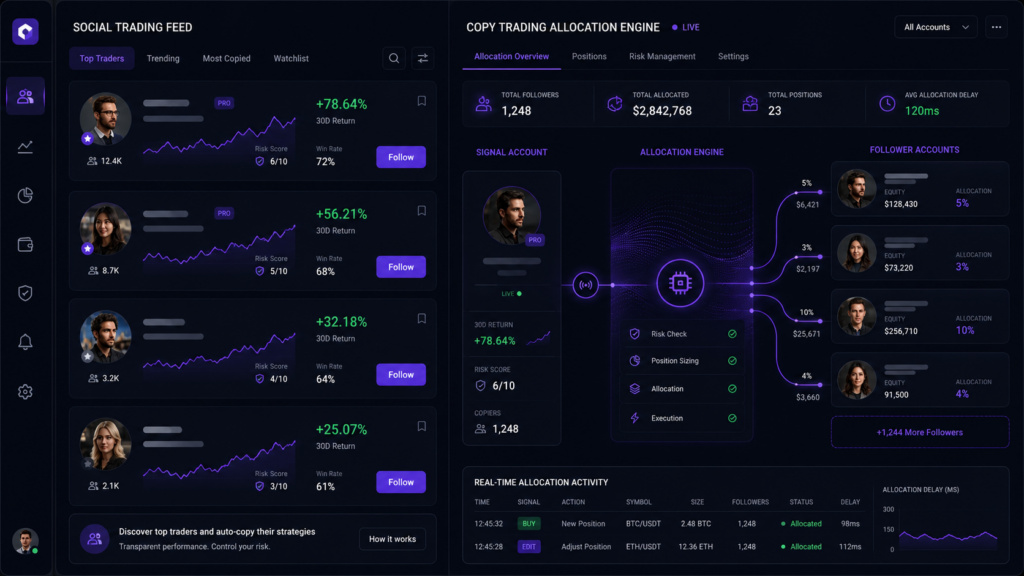
If the actual product is copy trading — automated, real-time position mirroring at the account level — the requirement set changes entirely. You now need an allocation engine that proportionally sizes follower trades against account equity, real-time execution at the bridge or gateway layer (not the UI layer), slippage and rejection handling across potentially hundreds of simultaneous follower accounts, and a fee mechanic — typically a performance fee with high-water mark tracking — that most social-trading-only platforms don’t natively support.
The gap between these two builds, sourced from typical white-label vendor quotes and in-house development estimates, runs 4 to 7 months of engineering time and a mid-six-figure budget difference when copy trading is discovered mid-project rather than scoped up front. Brokers who get the definition wrong at the RFP stage routinely re-scope twice before they reach production.
Insight: Why the Confusion Persists
The confusion is structural, not careless. Social trading and copy trading sit on a continuum, and most consumer-facing platforms — eToro is the most cited example — blend both into a single product experience. From the trader’s side, the line blurs further: a follower can browse a social feed, evaluate a trader’s public statistics, and then enable auto-copy, all inside the same session.
But from the broker’s infrastructure and compliance side, the line is sharp:
Social trading is an information and discovery layer. Traders view feeds, performance statistics, and community discussion. Execution stays manual — the follower places their own order, informed by what they’ve seen. The broker’s obligation is largely a content and data-display one: accurate performance reporting, no misleading claims, standard KYC.
Copy trading is an execution layer. Once a follower opts in, trades replicate automatically and proportionally into their account without a manual confirmation step per trade. The broker is now facilitating discretionary-adjacent portfolio management at scale, which pulls in additional regulatory scrutiny in most jurisdictions — FCA, CySEC, and ASIC all treat automated replication differently from a content feed, with disclosure, suitability, and in some cases licensing implications that a pure social feed does not trigger.
That regulatory divergence is the part most operators miss until compliance flags it during due diligence.
Opportunity: Two Products, Two Revenue Levers
Treated as separate products, social trading and copy trading open two distinct monetization paths rather than one.
Social trading monetizes through engagement and retention. A trader who follows feeds, engages with signal providers, and stays active in a community checks in more often and churns less — the value shows up in average client lifetime and trading volume, not in a direct fee line.
Copy trading monetizes directly. Performance fees on signal providers (typically 10–30% of profits, broker-configurable), spread markup on copied volume, and — for brokers running a managed-account desk alongside it — PAMM/MAMM-style allocation fees. This is a revenue-generating infrastructure layer, not a retention feature.
The brokers extracting the most value run both, deliberately separated: social trading as the top-of-funnel discovery and engagement layer, copy trading as the monetized execution layer that social trading feeds into. Conflating them in planning means under-monetizing the copy trading side or over-engineering the social side.
Practical Breakdown: Scoping the Build Correctly
For operators evaluating a build or a white-label deployment, four questions separate a social trading scope from a copy trading scope:
- Does the trade execute automatically, or does the follower confirm manually? Automatic execution is copy trading. This single answer resolves most of the ambiguity.
- Does the product touch account equity in real time? Copy trading requires proportional position sizing against live account balance. Social trading does not.
- What’s the fee mechanic? If you need performance fees, high-water marks, or signal provider payout logic, you’re building copy trading infrastructure, not a content layer.
- What’s the compliance surface? Automated replication typically requires additional disclosure language, suitability assessment, and in some jurisdictions a specific regulatory permission. A social feed generally does not.
Once the product is correctly scoped, the technical decision follows: native, bridge-level integration versus a plugin bolted onto the front end. Native integration processes follower positions inside the same execution loop as direct client trades — no secondary latency layer between signal and fill. Plugin architectures introduce a translation step that widens slippage under volatility, which matters most exactly when signal providers’ trades are most valuable — during fast markets.
Social Trading vs Copy Trading
Not sure which product you’re actually scoping? Let’s map it against your existing stack in 30 minutes.
Allocation engine · Signal provider fees · Native bridge integration
Soft Positioning
SpencerLogic’s Invest Social platform is built to run both models on the same infrastructure rather than forcing operators to choose one at the outset. The social feed and discovery layer sits on top of the same allocation engine that powers automated copy trading — so a broker can launch with a lighter social trading footprint and turn on automated replication, performance fee mechanics, and PAMM/MAMM allocation later, without a second integration project.
Because the engine operates at the MT4/MT5 bridge and gateway level, follower positions are processed inside the same execution loop as direct client trades, whether they originate from a manual copy or an automated one. That native integration is part of why brokers running SpencerLogic’s bridging and liquidity aggregation stack can add copy trading in weeks rather than the twelve-to-eighteen-month timeline typical of a from-scratch build. For operators building a stack from the ground up, Invest Social is one module inside an all-in-one white label brokerage solution that also covers trading platform, price engine, risk management, and client portals — so the copy trading decision doesn’t become an isolated integration problem.
Ready to see whether your current stack can support automated copy trading without a rebuild, or whether a phased social-trading-first rollout makes more sense? Book a demo and we’ll walk through both paths against your infrastructure.
Conclusion
You don’t have to commit to the full copy trading build on day one. Most operators launch the social and discovery layer first, validate demand and signal provider interest, then layer in automated replication and performance fees once the engagement data supports it. What matters is scoping the two correctly from the start, so the compliance and infrastructure decisions match the product you’re actually building — not the one you assumed you were building.
Schedule a demo with SpencerLogic to map your current stack against both models.
FAQ
Is copy trading legal for FX/CFD brokers?
Yes, in most major jurisdictions, though the specific disclosure and suitability requirements vary. FCA, CySEC, and ASIC each treat automated trade replication differently from a content-only social feed, and offshore jurisdictions are typically more permissive. Confirm requirements with your compliance counsel before launch.
Can I run social trading without offering copy trading?
Yes. Many brokers launch a social feed and trader-discovery layer first, without automated replication, to test engagement before committing to the additional compliance and infrastructure work copy trading requires.
What’s the difference between copy trading and PAMM/MAMM?
Copy trading typically operates at the individual trade level, replicating each position into follower accounts. PAMM and MAMM are managed-account structures where a fund manager trades pooled or individually-managed capital directly. Some platforms, including Invest Social, support both from the same allocation engine.
How do signal providers get paid in a copy trading model?
Most commonly through a performance fee — typically 10–30% of profits generated for followers, broker-configurable — often with a high-water mark to prevent fees on recovered losses. Some brokers also pay a flat volume-based rebate.
Does copy trading increase my risk desk’s workload?
It changes it more than it increases it. Position sizing and exposure now flow through an allocation engine rather than individual client decisions, which concentrates risk monitoring on signal provider behavior and follower cohort exposure rather than thousands of independent decisions.
How long does it take to add copy trading to an existing MT4/MT5 setup?
With native bridge-level integration, typically two to six weeks depending on your existing configuration. Plugin-based or from-scratch builds run significantly longer — often twelve to eighteen months for a fully custom build.
Do I need a separate license to offer copy trading?
Not always, but the disclosure and suitability obligations attached to automated trade replication are generally more stringent than for a standard trading account. This varies by jurisdiction and should be confirmed with regulatory counsel before launch.