Most brokers launching a white-label crypto exchange copy whatever fee structure the last exchange they used was running. Binance uses maker-taker, so the new exchange uses maker-taker. No one on the team has modeled what that structure actually does to revenue at 800 active traders instead of 8 million.
Fee model selection gets treated as a settings toggle during onboarding. It is not. It is a revenue architecture decision that determines who trades on the platform, how much liquidity gets posted organically, and whether the exchange’s take rate survives contact with a competitor undercutting on price. Get it wrong and the exchange either bleeds margin to a race-to-the-bottom fee war or drives away the exact traders who post the liquidity that makes the order book usable.
Financial Impact: The Same Volume, Three Different Revenue Outcomes
Consider an exchange running 1,800 active traders, processing $4.2M in daily notional volume across a mixed book of majors and mid-cap tokens. This is illustrative, not a specific client figure, but the mechanics generalize.
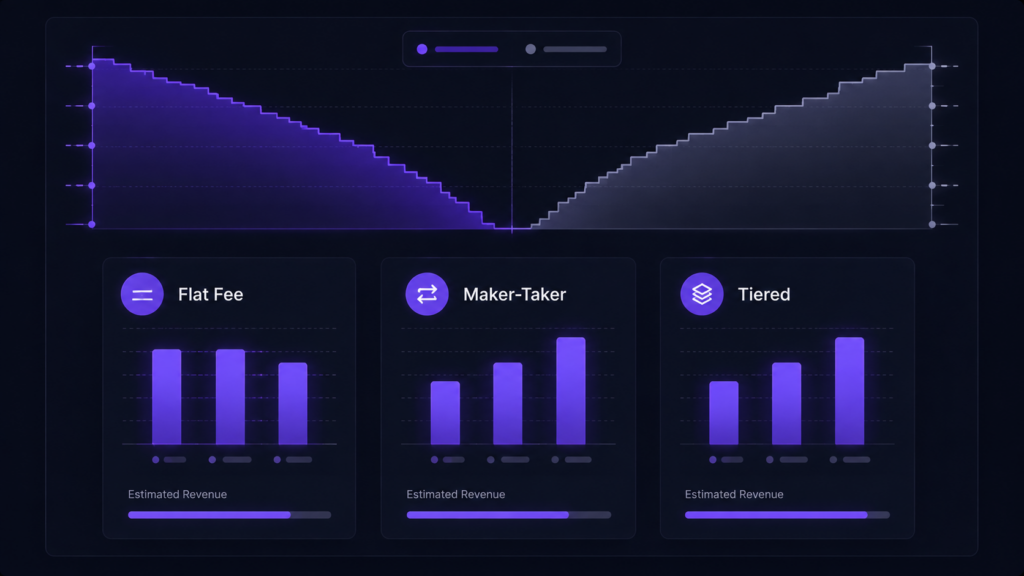
Flat rate model (0.15% on every trade, maker and taker alike). Revenue is straightforward: $4.2M × 0.15% = $6,300/day, or roughly $2.3M annualized. Simple to communicate, easy for traders to understand, and it requires no order-book classification logic. The cost is that flat rate structures give makers no incentive to post resting liquidity. Traders who would otherwise leave limit orders sitting in the book to earn a rebate instead trade at market, which thins the order book and widens the effective spread traders experience — a cost that shows up in complaints, not in the fee statement.
Maker-taker model (0.02% maker rebate, 0.10% taker fee). Assume 40% of volume executes as maker (a realistic split once rebates start attracting resting orders) and 60% as taker. Maker revenue: $4.2M × 40% × (-0.02%) = -$336/day in rebate cost. Taker revenue: $4.2M × 60% × 0.10% = $2,520/day. Net: $2,184/day, or roughly $797,000 annualized — lower gross revenue than flat rate, but the rebate typically deepens the order book by 15–30% within the first two quarters as market makers and active traders start posting limit orders to capture the rebate. Deeper books reduce slippage, which reduces churn, which is a second-order revenue effect the daily fee number does not capture.
Tiered volume model (0.20% for under $50K/month trailing volume, stepping down to 0.05% above $2M/month). This structure concentrates revenue capture on the long tail of smaller retail accounts while using low fees to retain the handful of high-volume accounts that provide the bulk of order-book depth. On the same $4.2M daily volume, assuming a realistic distribution where 70% of notional comes from accounts in the top two tiers, blended effective rate lands around 0.08–0.09%, producing roughly $3,400–$3,800/day. This model requires the most operational overhead — trailing-volume calculation, tier assignment, tier-change notifications — but it is the structure most retail-facing exchanges converge on once they have enough account history to segment traders meaningfully.
The gap between the lowest and highest annualized revenue estimate above is close to $3M on identical trading volume. That is not a rounding error in a fee schedule. It is the difference between an exchange that funds its own growth and one that runs at breakeven while competitors iterate faster.
The Insight Most Operators Miss
Fee model decisions get made once, at launch, by whoever configured the exchange platform — and then rarely revisited, because changing a live fee structure risks trader backlash. That means the structure chosen in the first 90 days, often copied from a competitor’s public fee page without knowing that competitor’s actual volume mix, becomes the exchange’s revenue architecture for years.
The deeper problem is that fee model and liquidity architecture are not independent decisions. An exchange running internal market making (see SpencerLogic’s guide to launching a white-label crypto exchange) has different fee-model math than one running external LP aggregation, because the exchange itself may be the primary maker on its own book. Choosing maker-taker fees while running 100% external LP aggregation means the exchange is paying rebates to third-party liquidity it does not control, on top of whatever spread markup the LP relationship already captures. That is a double cost most fee-model spreadsheets never model correctly.
The Opportunity: Fee Structure as a Retention Lever, Not Just a Revenue Line
Brokers evaluating a crypto exchange add-on tend to model fee revenue in isolation from client retention. That understates the real value. A tiered structure that rewards a broker’s existing high-volume FX clients with preferential crypto fees — using the same client ID and account tier the broker already maintains for FX — turns the fee schedule into a cross-sell mechanism rather than a standalone crypto product with its own separate economics.
This works because the client segmentation and tiering logic a broker already runs for FX margin and spread pricing can extend directly into the crypto exchange fee schedule, provided the risk and account infrastructure is unified rather than siloed per product. This is the practical case for running crypto fee tiers off the same account infrastructure as FX and CFD tiers rather than a bolted-on separate system.
Practical Breakdown: Choosing and Implementing a Fee Model
Step 1: Model your actual maker/taker split before choosing a structure. Pull trading data from a comparable exchange or, if launching fresh, use the split from the liquidity architecture already selected. An exchange running heavy internal market making will naturally see a higher maker percentage than one leaning on external LP feeds.
Step 2: Price against the competitive set your traders actually compare you to — not the largest global exchanges. A regional or niche exchange competing against Binance on headline fee rate will lose that comparison every time; the more relevant comparison set is other white-label and mid-tier regional exchanges serving the same trader segment.
Step 3: Build in a tier-migration notification workflow before launch, not after the first trader complaint about a fee change they didn’t see coming. Tiered models fail on communication more often than on math.
Step 4: Separate the fee schedule from the spread markup. Traders evaluate total execution cost, not just the posted fee rate. An exchange with a low headline fee but wide effective spreads is not actually cheaper, and sophisticated traders will find this out. Real-time exposure and spread monitoring through a risk management suite makes it possible to track effective cost per trade, not just the fee line, across the client base.
Step 5: Revisit the model quarterly against actual volume distribution, not annually. Trader behavior shifts faster on a newer exchange than the annual-review cadence most brokerages default to from their FX operations.
Step 6: Stress-test the model against a fee war scenario before launch. Regional and mid-tier exchanges regularly cut headline fees to zero for a promotional window to acquire volume from a competitor. Model what happens to the exchange’s own retention and revenue if a direct competitor runs a zero-fee promotion for 60–90 days. Exchanges that have already modeled this scenario can respond with a matched promotion funded by reserves set aside for exactly this purpose, or hold firm on fees while competing on execution quality and spread — but only if that decision was made in advance rather than reactively during the promotion window, when panic pricing tends to erode margin further than the competitive threat justified.
Step 7: Decide in advance how VIP or market-maker agreements interact with the published fee schedule. Most exchanges eventually negotiate custom rebate or fee arrangements with a handful of high-volume market makers whose liquidity underwrites the rest of the book. These agreements should be modeled and capped before the first one is signed — an ad hoc VIP rate negotiated under pressure from a departing market maker sets a precedent that becomes difficult to walk back for the next negotiation.
Soft Positioning
None of this requires building fee-tier logic, rebate accounting, and tier-migration workflows from scratch. The Spencer Exchange platform supports configurable maker-taker, flat, and tiered fee schedules natively, with tier assignment that can pull directly from existing client segmentation data already running for FX and CFD accounts. Combined with liquidity aggregation and the price engine for execution quality that the fee schedule alone can’t fix, this is what an all-in-one white label brokerage solution looks like in practice: fee architecture, liquidity, and risk running on one infrastructure layer instead of three disconnected vendor relationships that each need separate reconciliation.
Not sure which fee model fits your volume profile? Book a demo and we’ll model the revenue impact for your specific trading mix before you commit to a structure.
Exchange Monetization, Modeled
Not sure which fee structure fits your volume profile? Let’s map it in a 30-minute walkthrough.
Maker-taker · Tiered pricing · Revenue modeling
Conclusion
Fee model choice is reversible, but it is expensive to reverse — trader trust in fee stability is hard to rebuild once a structure changes without warning. Start with a model that matches the liquidity architecture already in place, price it against the competitors your traders will actually compare it to, and revisit the math every quarter rather than assuming the launch-day structure still fits a year of volume growth. Book a demo and we’ll walk through fee modeling against your actual trader mix before you lock in a structure.
FAQ
What’s the difference between maker-taker and flat rate fee models?
Maker-taker charges different rates depending on whether a trade adds liquidity (maker, resting limit order) or removes it (taker, market order), often with a rebate for makers. Flat rate charges the same fee regardless of order type. Maker-taker incentivizes deeper order books; flat rate is simpler to communicate and administer.
Do tiered fee structures work for smaller exchanges?
Yes, but the tier thresholds need to be calibrated to actual account volume distribution rather than copied from a large exchange’s public schedule. A tier structure built around $1M+/month volume tiers is meaningless if the exchange’s largest accounts trade $200K/month.
How much does a fee rebate program cost in maker rebates?
It depends on maker volume share and the rebate rate chosen, but a common range for smaller exchanges building initial book depth is 0.01–0.03% rebate on maker volume, funded by a correspondingly higher taker fee.
Can fee tiers be linked to FX/CFD account tiers on a multi-asset broker?
Yes, provided the exchange and FX/CFD platforms share underlying client and account infrastructure. This is one of the practical advantages of running crypto exchange operations on the same stack as existing FX operations rather than as a separate bolted-on product.
How often should a fee schedule be reviewed after launch?
Quarterly for the first year, based on actual maker/taker volume split and competitive positioning, then at minimum semi-annually once volume patterns stabilize.
Does the fee model affect regulatory or compliance exposure?
Fee models themselves are not typically a compliance trigger, but fee disclosure requirements vary by jurisdiction, and rebate programs in some markets require specific disclosure to avoid characterization as an undisclosed inducement. Confirm disclosure requirements with counsel for each jurisdiction the exchange serves.
What happens to order book depth if fees are set too high?
Traders — particularly market makers and high-frequency participants who are fee-sensitive by design — route volume elsewhere, thinning the book and widening effective spreads for remaining traders, which can trigger further attrition in a compounding cycle.