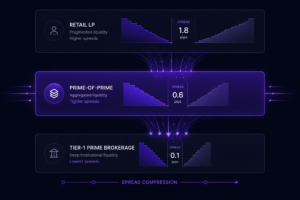
Most brokers focus on which liquidity providers they connect to. Fewer ask how that liquidity becomes a price their clients actually see. The gap between those two questions is where margin gets made or lost.
A price engine sits between your LP feed and your trading platform. It ingests raw bid/ask data from multiple sources, constructs a tradable price stream, applies your spread and markup rules, and publishes quotes to MT4, MT5, or any downstream platform — all in under a millisecond. When it works well, clients notice nothing. When it works poorly, they notice slippage, rejections, and erratic spreads. Then they leave.
Understanding what a price engine actually does — and where the architectural decisions that determine your fill quality and margin are made — is not optional for a modern brokerage.
The Core Function: From Raw Feed to Tradable Quote
A raw LP feed is not a price your clients can trade. It is an unprocessed stream of bids and offers from one or more institutional counterparties, arriving in milliseconds, with gaps, stale ticks, and varying depth of market across instruments.
A price engine transforms that feed through four sequential operations:
1. Ingest and normalize. Data arrives from multiple LPs in different formats and at different latencies. The engine normalizes timestamp, decimal precision, and symbol naming across all feeds before any aggregation happens.
2. Aggregate and rank. The engine compares bids and asks across all LP feeds, constructs a best bid/offer (BBO) from the top of each book, and builds a composite price. For a broker with six LP connections, the engine is selecting the tightest spread from a real-time competition among six counterparties, every tick.
3. Apply markup and spread rules. This is where the brokerage’s revenue logic sits. The engine applies configurable mark-ups per LP, per symbol, or per client group. A retail flow account sees a wider spread than an institutional account. A high-frequency client profile triggers a different markup than a low-volume retail trader. These rules execute in microseconds without code changes or manual intervention.
4. Publish to downstream platforms. The final price stream is distributed to MT4, MT5, proprietary platforms, and client portals. Latency from raw LP tick to platform display is where sub-millisecond architecture separates institutional-grade systems from legacy bridge setups.
The Latency Problem: Why Microseconds Are a Revenue Issue
Latency in pricing is not a technical nuisance. It is a direct cost.
Consider a mid-tier broker running 35,000 monthly active clients across FX majors and metals. The broker uses a legacy single-LP connection with a price engine publishing quotes at 8–12ms latency. Institutional market participants — even retail algorithmic traders using off-the-shelf tools — can detect stale quotes and exploit them. Every time a latency-aware client trades a stale price, the broker absorbs the difference.
At volume, the math is concrete. Illustratively: a 2ms average quote staleness across 400,000 monthly trades, with an average 0.3 pip adverse fill on 15% of those trades, adds up to meaningful unbooked losses on a $5 mark-up per lot model. A broker running 20,000 lots per month at those parameters loses the equivalent of several hundred lots of net revenue to preventable slippage.
The fix is not a faster LP. It is a faster price engine — one that normalizes, aggregates, and publishes quotes faster than market participants can arbitrage the gap.
Sub-1ms price engines eliminate that window. They do not reduce arbitrage risk; they eliminate it by ensuring the price the client sees is never older than the market.
Aggregation: The Spread Margin Engine
Single-LP pricing is the most common infrastructure mistake among emerging brokers. The logic seems sound: one LP, one connection, one relationship to manage. The problem is that a single LP gives you that LP’s book, at that LP’s terms, with no competitive pressure on depth or pricing.
Multi-source aggregation changes the economics entirely.
With aggregation, the price engine pulls quotes from multiple LPs simultaneously and constructs a best bid/offer that no single LP would offer independently. If LP A shows EUR/USD at 1.08500/1.08502 and LP B shows 1.08499/1.08501, the aggregated BBO is 1.08499/1.08502 — tighter than either source. The broker then applies their mark-up on top of that tighter raw spread.
The business impact is twofold. First, tighter raw spreads improve client fill quality, which reduces churn. Second, because the broker’s mark-up is applied on top of a tighter base, the broker captures more of the mark-up as margin rather than offsetting spread cost. A broker paying 0.4 pip raw on a single LP and marking up 0.6 pip earns 0.6 pip gross per lot. A broker aggregating to 0.2 pip raw and applying the same 0.6 pip mark-up still earns 0.6 pip — but their clients see a 0.8 pip spread versus 1.0 pip, which is a competitive advantage on visible pricing.
This is why aggregation is not just a technology decision. It is a margin optimization strategy.
Spread and Markup Control: The Configuration Layer
A price engine’s configuration layer determines how the brokerage’s revenue model operates in practice. The key controls:
Per-symbol markup. Apply different mark-ups to different instruments. Major FX pairs carry tighter mark-ups to remain competitive. Exotics and CFDs carry wider mark-ups where client price sensitivity is lower.
Per-LP markup. If one LP’s feed has higher average reject rates or worse depth on specific instruments, the engine can apply a degradation mark-up to that LP’s contribution — or remove it from aggregation for those symbols automatically.
Per-client-group pricing. Segment clients by trading profile. High-frequency or high-volume accounts often receive tighter spreads in exchange for volume; the engine applies the right rule set per account group without manual override.
Skew logic. When the book is net long or short beyond a threshold, the engine can skew prices — pushing the bid or ask — to encourage client flow that reduces internal exposure before it reaches the LP hedge threshold.
Real-time adjustment. All of the above should be adjustable without downtime. A price engine that requires a restart to change a mark-up rule is a liability during volatile markets.
These configurations are where experienced risk desks and inexperienced brokers diverge most visibly. The controls exist in most modern price engines. The discipline to configure and maintain them correctly is what separates operators who control margin from those who guess at it.
A-Book, B-Book, and the Price Engine’s Role in Risk Routing
A price engine does not make A-book versus B-book decisions — that is the risk management layer’s function. But the price engine is the mechanism through which those decisions execute.
In an A-book flow, the engine routes the client price through to the LP and sends the offsetting hedge order simultaneously. The speed of that hedge execution is determined entirely by the price engine’s latency. A slow engine means the hedge arrives after the LP price has moved — internalization cost on every A-book trade.
In a B-book flow, the engine holds the position internally. The price it publishes to the client is not hedged externally, which means the accuracy of the markup and the fairness of the spread directly determine whether the broker’s book is healthy or toxic. B-book operations with misconfigured price engines attract latency arbitrage and algorithmic flow that systematically extracts value from the broker’s book.
In a hybrid model, the engine must route different client segments to different execution paths in real time, based on client classification rules. This requires a price engine capable of simultaneously maintaining multiple pricing streams — different mark-ups, different depth sources — by account group, without adding latency to any of them.
For a technical discussion of how SpencerLogic’s bridging infrastructure connects the price engine to LP execution routing, see Liquidity Bridge vs. Aggregator: Key Differences and Use Cases and What Is Liquidity Bridging? A Broker’s Guide.
What to Evaluate in a Price Engine: An Operator Checklist
When assessing price engine infrastructure — whether evaluating your current system or selecting a new one — these are the specifications that matter:
Latency floor. What is the median and 99th-percentile tick-to-platform latency across major instruments? Benchmarks below 1ms for tick-to-quote and below 3ms for order-to-acknowledge are current institutional standards.
LP connection count. How many simultaneous LP feeds can the engine aggregate without latency degradation? An engine that performs well at two LP connections but degrades at six is not a scaling solution.
Markup configurability. Can spread and mark-up rules be changed in real time without a restart? Can they be applied at the symbol, LP, and client-group level simultaneously?
Rejection rate handling. Does the engine automatically re-route rejected orders to the next-best LP? What is the timeout logic and how does it affect fill rates during LP outages or last-look rejection windows?
Stale tick filtering. How does the engine handle ticks that arrive out-of-sequence or with abnormal timestamps? Stale tick penetration into published prices is one of the most common sources of client arbitrage.
Audit trail. Does the engine maintain a complete log of price construction decisions — which LP feed was used, what markup was applied, what the raw and published prices were — at the order level? Post-trade explainability is a regulatory and operational requirement.
For a detailed look at how modern bridge architecture and price engine design reduce slippage in practice, see Reducing Slippage and Latency With a Modern Bridge Architecture.
How SpencerLogic’s Price Engine Is Built
SpencerLogic’s multi-asset price engine aggregates real-time pricing from 25+ Tier-1 LPs with sub-1ms latency. It functions as the central pricing infrastructure for brokers running FX, CFDs, and crypto — publishing to MT4, MT5, Spencer Trader, and any custom front-end through a single integration layer.
The configuration layer allows full spread, markup, and skew control at the symbol, LP, and client-tier level, adjustable in real time without downtime. Depth-of-book management enables dynamic pricing models that respond to client trading profile — applying tighter conditions to institutional flow and protecting book health automatically.
The engine integrates directly with SpencerLogic’s liquidity aggregation and bridging infrastructure, removing the integration overhead that typically comes from stitching together vendor components. For brokers operating an all-in-one white label brokerage solution across multiple asset classes, having the price engine, aggregator, and bridge on a single stack eliminates latency introduced at handoff points between separate vendors.
The result is a pricing infrastructure that is controllable, auditable, and fast enough to compete at the institutional level — without requiring a quant team to configure it.
To see how the price engine fits into a full broker technology review, speak with a SpencerLogic infrastructure specialist at spencerlogic.com/demo.
Conclusion
A price engine is not a commodity component. It is the layer where your LP relationships translate into client experience and where your markup configuration translates into net margin per lot. Brokers who treat it as a commodity — choosing the cheapest option or leaving configuration at defaults — leave money on both sides: higher slippage costs and uncaptured spread margin.
The architecture decisions that matter most are latency at the tick-to-platform level, depth of aggregation across LP sources, and granularity of markup configuration. Get those right and the price engine becomes a margin engine. Get them wrong and it becomes a liability that shows up in client complaints, fill rate reports, and monthly P&L reviews.
Start with an audit of your current tick-to-platform latency. The number alone will tell you where the gaps are.
Book a technical walkthrough at spencerlogic.com/demo
FAQ
What does a price engine do in forex brokerage?
A price engine ingests raw bid/ask data from one or more liquidity providers, normalizes and aggregates that data into a best bid/offer, applies the broker’s spread and markup rules, and publishes a final tradable price stream to the trading platform. It operates continuously, in real time, at sub-millisecond speeds.
How does latency in a price engine affect broker profitability?
Price engine latency creates stale quotes — prices that no longer reflect the current market by the time they reach the client. Sophisticated traders and algorithms detect and exploit stale prices, creating adverse fills that cost the broker margin. Sub-1ms price engines eliminate the window in which that exploitation can occur.
What is the difference between a price engine and a liquidity aggregator?
A liquidity aggregator combines multiple LP feeds into a composite best bid/offer. A price engine takes that aggregated feed and applies the broker’s markup logic, skew rules, and client segmentation before publishing the final price. The two functions often run as integrated modules within a single infrastructure layer.
Can a price engine handle multiple asset classes simultaneously?
Modern multi-asset price engines handle FX, CFDs, metals, and crypto within a single architecture. Each asset class has distinct tick frequency and depth characteristics; the engine normalizes these into a unified pricing model that can apply separate markup logic per instrument type.
How does a price engine support A-book and B-book execution?
In A-book flows, the price engine routes orders to the LP and triggers a simultaneous hedge. In B-book flows, the engine holds positions internally and applies markup to control book health. In hybrid models, the engine maintains separate pricing streams by client segment, routing each to the appropriate execution path in real time.
What markup controls should a price engine offer?
At minimum: per-symbol markup, per-LP markup, per-client-group spread differentials, real-time skew adjustment, and adjustability without system downtime. Advanced engines also support automated skew rules triggered by net book exposure thresholds.
How do I benchmark my current price engine’s performance?
The key metrics are: median tick-to-platform latency (target below 1ms), 99th-percentile order-to-acknowledge time (target below 3ms), fill rate by LP during peak hours, reject rate by LP, and stale tick penetration rate. Most institutional-grade price engines expose these via a real-time analytics dashboard.