Most exchange operators add stablecoin pairs the same way they add any other token: flip a switch in the matching engine, list USDT or USDC against the majors, and move on. That approach works for about a quarter. Then a payment processor freezes a settlement batch pending documentation the exchange never collected, or a regulator asks for proof of reserve attestation the operator assumed the stablecoin issuer handled. Stablecoin trading is not a listing decision. It is a compliance and settlement architecture decision wearing a listing decision’s clothes.
The Financial Impact of Getting This Wrong
Consider a mid-tier exchange processing $40M in monthly stablecoin volume across USDT, USDC, and a regional stablecoin pair. If that exchange has not implemented issuer-specific monitoring, a single Travel Rule compliance gap on transfers above the reporting threshold can trigger a full account freeze from its banking partner while the issue is resolved — typically 5 to 15 business days. At $40M in monthly volume, even a conservative 10-day freeze on 20% of flow represents roughly $2.6M in stalled client funds and, more damagingly, a support queue that turns into a public trust problem within 48 hours.
The reverse cost is smaller but constant: exchanges that over-engineer stablecoin compliance — treating every pair like a high-risk corridor — add friction that pushes volume to competitors with cleaner deposit-to-trade times. The right posture is neither reflexive caution nor casual listing. It is calibrated to the specific stablecoin’s issuance model, redemption mechanics, and jurisdictional exposure.
Run the numbers on a smaller exchange and the exposure looks different but no less material. A $6M-monthly-volume operator running two stablecoin pairs with no issuer-specific monitoring is typically underestimating its Travel Rule exposure by a wide margin, because operators without pair-level analytics tend to assume Travel Rule-eligible transfers are rare edge cases. In practice, once a client base includes even a handful of OTC desks or high-net-worth traders moving size, 15-20% of stablecoin volume by dollar value routinely clears the reporting threshold. Discovering that exposure retroactively, during a banking partner’s periodic review rather than proactively through your own monitoring, is what turns a routine compliance question into a frozen settlement account.
Why Most Operators Miss This
The root issue is that stablecoins are not one asset class. USDC is issued by a regulated entity with monthly attestations and direct redemption rights. USDT operates under a different disclosure regime with less redemption transparency for retail holders. Algorithmic and yield-bearing stablecoins carry depeg risk that fiat-backed tokens do not. Treating all three under a single “stablecoin” listing policy is the single most common failure point exchange operators bring to a compliance review.
A second miss is architectural: many exchanges bolt stablecoin support onto existing crypto-to-crypto listing infrastructure without separating stablecoin flows into their own monitoring lane. Fiat-equivalent instruments need fiat-adjacent controls — enhanced transaction monitoring thresholds, issuer reserve verification, and settlement reconciliation against issuer redemption windows — none of which a generic token-listing pipeline was built to handle.
A third, quieter miss is organizational rather than technical. Compliance teams at most mid-tier exchanges own KYC/AML policy but not issuer relationship monitoring, while the trading desk owns pair economics but has no mandate to track issuer attestation cadence. Stablecoin risk falls into the gap between those two functions. The exchanges that handle this well assign explicit ownership of issuer-level monitoring — reserve attestations, redemption terms, any regulatory action against the issuer — to a single team, rather than assuming it is implicitly covered by general listing due diligence.
The Opportunity
Exchanges that get stablecoin infrastructure right unlock two things competitors without it cannot offer: same-day fiat-equivalent settlement without banking rails, and a credible answer when institutional counterparties ask about reserve verification and Travel Rule handling before routing volume. Under the U.S. GENIUS Act framework and the EU’s MiCA regime, both of which formalize stablecoin issuance and reserve standards, exchanges that built compliant infrastructure early are positioned to onboard institutional stablecoin flow that operators still running ad hoc controls cannot touch. This is a margin lever, not a cost center — properly structured stablecoin rails reduce dependence on traditional banking partners for settlement while opening a client segment that values regulatory clarity over marginal fee savings.
The Practical Breakdown
1. Classify before you list. For each stablecoin under consideration, document the issuance model (fiat-backed, crypto-collateralized, algorithmic), the issuer’s attestation cadence, and direct redemption availability. This classification determines the monitoring tier the pair gets assigned.
2. Build issuer-specific reserve checks into onboarding. Before listing, confirm the issuer publishes reserve attestations on a defined cadence (monthly is standard for major issuers) and establish an internal process to review each new attestation as it publishes — not just at initial listing.
3. Separate Travel Rule infrastructure for stablecoin corridors. Transfers above the applicable jurisdictional threshold require originator and beneficiary information exchange between VASPs. Stablecoin volume concentrates disproportionately in this bracket because it is the preferred instrument for larger transfers — size the Travel Rule infrastructure accordingly, not as an afterthought bolted onto general AML tooling.
4. Reconcile settlement against issuer redemption windows, not just on-chain confirmation. On-chain settlement finality and issuer-side redemption availability are not the same thing. An exchange that treats a stablecoin deposit as immediately withdrawable in fiat before confirming issuer redemption capacity is carrying unhedged settlement risk during any issuer-side disruption.
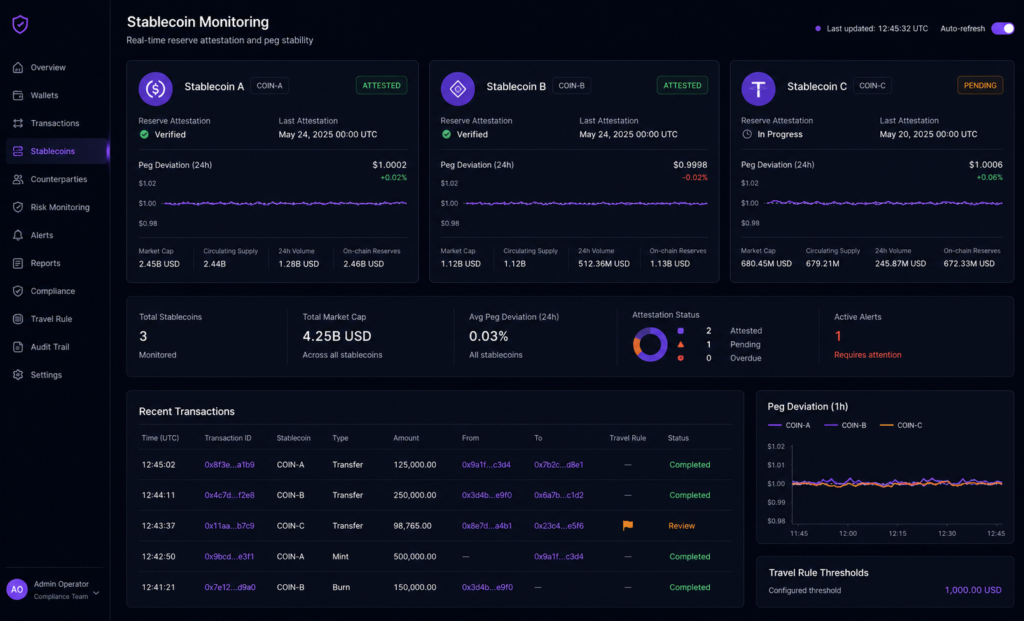
5. Monitor for depeg exposure on a pair-by-pair basis. Even fiat-backed stablecoins have experienced temporary depegs during banking-sector stress events. Build automated alerting on price deviation from $1.00 par beyond a defined tolerance band, with a pre-agreed trading halt protocol for the affected pair.
6. Document the compliance checklist per stablecoin, not per exchange. Regulators and banking partners increasingly ask for pair-specific compliance documentation, not a blanket exchange-level policy. An operator who can produce a per-instrument compliance file during an audit resolves the review substantially faster than one reconstructing documentation on request.
7. Set explicit internal ownership for issuer monitoring. Assign a single team — typically compliance, with trading desk input on pair economics — to own the ongoing relationship with each stablecoin issuer’s disclosures. Ambiguity about who is watching for issuer-side changes is how attestation gaps go unnoticed for months.
Every one of these steps is a build-and-maintain cost if approached from scratch — reserve monitoring feeds, jurisdiction-aware Travel Rule logic, and depeg alerting are ongoing engineering commitments, not one-time configuration. Exchanges that build this in-house typically underestimate the maintenance burden: issuer attestation formats change, jurisdictional thresholds get revised, and new stablecoin issuance models (yield-bearing stablecoins have grown fastest among crypto instruments over the past year) require the classification framework itself to be extensible rather than fixed at launch.
Stablecoin Compliance, Pre-Built
Still building Travel Rule and reserve monitoring from scratch?
Issuer classification · Reserve attestation tracking · Depeg alerting
Where SpencerLogic Fits
Spencer Exchange, SpencerLogic’s crypto exchange engine, ships with issuer-aware stablecoin monitoring built into the compliance layer rather than added as a plugin — reserve attestation tracking, jurisdiction-configurable Travel Rule logic, and automated depeg alerting are part of the same infrastructure that handles KYC/AML for every other listed instrument. Combined with SpencerLogic’s Liquidity Aggregation product, stablecoin pairs draw from the same Tier-1 and prime-of-prime feeds as the rest of the order book rather than requiring a separate liquidity relationship. For operators running FX/CFD alongside a crypto desk, the MT4/MT5 Bridge and Gateway keeps settlement and reporting on one infrastructure layer instead of stitching together a stablecoin-specific vendor on top of an existing stack. This is the same principle behind SpencerLogic’s broader position as an all-in-one white label brokerage solution: compliance-critical infrastructure should be native to the platform, not a patchwork added under deadline pressure after the first audit finding.
Conclusion
Stablecoin trading is not inherently riskier than any other listed instrument — it is differently risky, in ways that generic crypto-listing infrastructure was not built to catch. Operators do not need to treat every stablecoin pair as a maximum-scrutiny corridor, and they do not need to build reserve monitoring and Travel Rule logic from a blank sheet. Start with issuer classification on your current stablecoin pairs, confirm attestation cadence, and build depeg monitoring on the highest-volume pair first. From there, scheduling a demo is the fastest way to see what a fully integrated compliance layer looks like next to what you are running today.
Frequently Asked Questions
What’s the difference between compliance requirements for fiat-backed and algorithmic stablecoins?
Fiat-backed stablecoins from regulated issuers typically require reserve attestation verification and redemption-window reconciliation. Algorithmic and crypto-collateralized stablecoins carry additional depeg risk that needs its own monitoring layer, since there is no direct fiat redemption backstop.
Does the Travel Rule apply differently to stablecoin transfers than other crypto assets?
The Travel Rule applies at the same jurisdictional thresholds regardless of asset type, but stablecoin volume concentrates more heavily in the affected size bracket because stablecoins are the preferred instrument for larger transfers, making dedicated Travel Rule infrastructure more operationally important for stablecoin corridors specifically.
How often should we review a stablecoin issuer’s reserve attestations?
At minimum, on the same cadence the issuer publishes them — monthly for most major issuers. Treat each new attestation as a live compliance event requiring review, not a formality to file away.
Can we list a stablecoin without direct redemption rights for our users?
Yes, this is common, but it changes your settlement risk profile. If your users cannot redeem directly with the issuer, your exchange is the sole point of fiat-equivalent liquidity for that pair, which increases the operational importance of your own reserve and liquidity monitoring.
What triggers a depeg trading halt, and who decides?
Set an automated price-deviation threshold from $1.00 par (commonly 1-2% sustained deviation) that triggers an alert, with a pre-agreed internal protocol for who authorizes a trading halt and under what conditions trading resumes. Deciding this in advance, rather than during a live depeg event, is what separates an orderly response from a chaotic one.
Do MiCA and the GENIUS Act require the same compliance controls?
No — they are separate frameworks with different reserve, disclosure, and licensing requirements. Exchanges operating across both EU and U.S. client bases need jurisdiction-aware compliance logic rather than a single unified policy, since a control that satisfies one regime may not satisfy the other.
How does stablecoin compliance interact with our existing KYC/AML stack?
It should extend it, not duplicate it. Stablecoin-specific monitoring — reserve checks, depeg alerts, Travel Rule thresholds — sits alongside your existing KYC/AML infrastructure and should share the same case management and reporting pipeline rather than running as an isolated system.