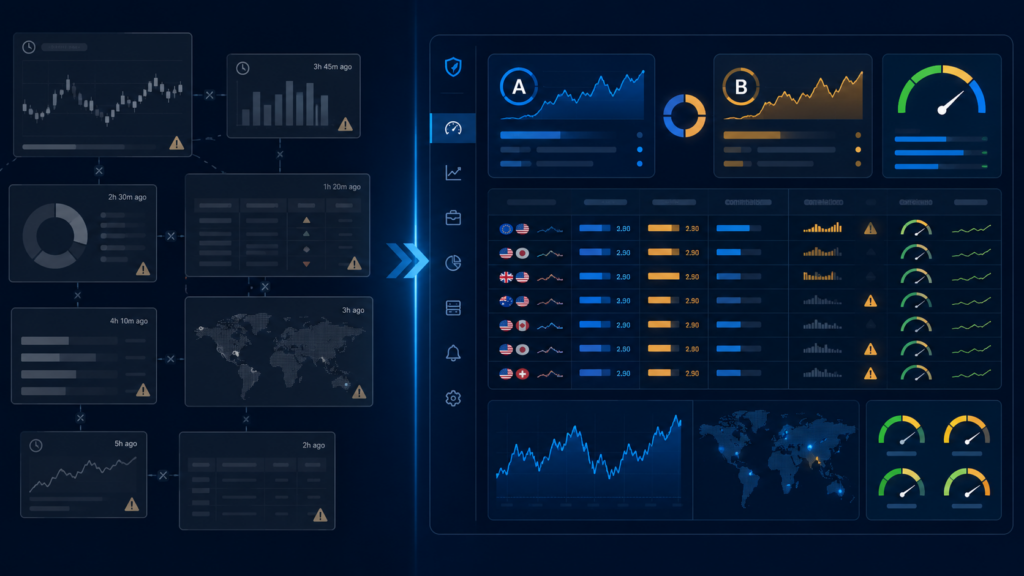
Most brokerages can describe their A-book and B-book split in one sentence. Few can describe, in real time, what their combined exposure actually is across both books, every symbol, and every client tier. That gap between knowing your model and knowing your live exposure is where risk desks lose money quietly, month after month, without ever showing up as a single dramatic event.
Risk management at most brokerages is still built around end-of-day reports and a dealer’s gut feel about which clients to watch. That worked when retail volume was lower and correlated flow was rare. It does not work when a handful of accounts can move thousands of lots within minutes on a single news print.
The problem rarely announces itself as a single event. A risk desk does not usually wake up to one catastrophic loss. It accumulates dozens of smaller missed signals — a client cluster building correlated exposure here, a markup left static through a volatility spike there — until the cumulative drag on margin only becomes visible in the quarterly numbers, with no single moment anyone can point to as the cause.
The Cost of Flying Blind on Exposure
Consider a mid-sized broker running 4,000 funded accounts with a 70/30 A-book/B-book split and average daily volume of 18,000 lots across FX majors. On a typical session, the B-book absorbs roughly 5,400 lots of client flow internally.
Now assume a single high-volume client cluster — three correlated accounts trading the same directional bias on EUR/USD around a rate decision — builds a combined 600-lot net short position inside the B-book over four hours. Without real-time exposure aggregation, that position is invisible until the end-of-day report runs. If the pair rallies 80 pips against the position before anyone notices, the broker is carrying an unrealized loss in the range of $480,000 on that single cluster alone.
That is not a hypothetical extreme. It is the ordinary failure mode of manual or delayed exposure tracking: correlated flow accumulates inside the blind spot between reports, and the first the desk hears about it is when the number is already large. Brokers running real-time position aggregation catch that same cluster within minutes, while it is still a 100-lot position instead of a 600-lot one — the difference between a manageable hedge and a headline-worthy loss.
The same blind spot shows up in margin call management. A desk relying on manual margin monitoring typically reviews account equity against margin requirements on a fixed schedule — often hourly during active sessions. During a sharp move, equity on a leveraged account can cross from comfortably margined to a stop-out level in under ten minutes. A broker without automated, continuous margin monitoring either liquidates late, absorbing negative balance exposure the client cannot cover, or liquidates inconsistently across similar accounts, creating a fairness and compliance problem on top of the financial one.
Why Most Brokers Miss This
The root cause is rarely a lack of risk awareness. It is architecture. Risk management gets bolted onto the back office as a reporting function rather than built into the execution path as a control function. The dealing desk sees fills. The risk team sees yesterday’s aggregates. Neither sees the same picture in the same moment.
This split happens because most brokers build their A-book/B-book logic and their monitoring tooling at different times, often with different vendors, and never fully integrate them. The bridge routes orders. A separate dashboard, refreshed on a schedule, reports on what already happened. By the time a pattern is visible in the dashboard, the position behind it has already grown past the point where a clean hedge is cheap.
This fragmentation compounds as brokers add asset classes. A desk that built its risk process around FX alone, then added CFDs, then added crypto, often ends up monitoring three separate exposure pictures instead of one combined view. A client running correlated positions across an FX pair and a correlated crypto asset can carry meaningful combined risk that never appears as a single number anywhere in the broker’s reporting, because no single system was built to see across all three books at once. The connection between A-book/B-book routing decisions and the underlying execution infrastructure is explored in more depth in our risk management and A/B-book execution guide.
Reframing Risk as a Margin Lever
Treated correctly, risk management stops being a cost center and becomes one of the more direct levers on broker margin. Every B-book position correctly identified and either hedged or allowed to run based on real client edge — rather than guessed at — is margin protected or margin captured. Every toxic flow pattern caught before it scales is a loss avoided rather than absorbed.
Brokers running centralized, real-time risk infrastructure report markup optimization gains in the 3–5% range and additional volatility-based markup gains of 5–7%, according to platform-reported figures from brokers using automated price validation and skewing tools. Those numbers compound. A broker doing $2 million in monthly net trading revenue capturing even the lower end of that range is looking at six figures of annual margin that was previously left on the table through static, unmonitored pricing and exposure rules.
The Practical Breakdown
Building this correctly does not require a multi-quarter infrastructure project. It requires sequencing the right controls in the right order.
Step 1 — Centralize exposure visibility. Every position, across A-book and B-book, across every platform you run, needs to land in a single real-time view. If your dealing desk and your risk team are looking at different screens, you already have a blind spot. This is the highest-leverage step and the one that makes every subsequent step possible — segmentation rules and automated triggers are only as good as the exposure data feeding them.
Step 2 — Segment clients by risk profile, not just by account size. Trading frequency, win rate, average holding time, and correlation with other accounts matter more than deposit size when deciding A-book versus B-book routing. A $500 account trading a consistently profitable scalping pattern is a bigger risk concern than a $50,000 account trading swing positions. Segmentation should be reviewed periodically, not set once at onboarding and left static as a client’s trading behavior evolves.
Step 3 — Set automated exposure triggers, not manual review thresholds. Manual review means someone has to remember to look. Automated triggers mean the system flags the position the moment it crosses a defined threshold, regardless of whether anyone happened to be watching that symbol. Triggers should account for both single-account exposure and aggregated exposure across correlated accounts, since the latter is the pattern most likely to slip past a manual process.
Step 4 — Build a hedging decision tree before you need one. Internalization versus external hedge should be a pre-defined rule set based on exposure size and correlation, not a judgment call made under pressure during a fast market. A documented decision tree — at what exposure level a position moves from internal offset to external hedge, and which liquidity provider handles which instrument — removes the delay that comes from deciding under pressure.
Step 5 — Automate margin call workflows alongside exposure monitoring. Margin and exposure are related but distinct risk surfaces, and both need continuous monitoring rather than scheduled review. Automated margin call triggers, tiered warning notifications, and consistent stop-out logic protect both the client and the broker from the fairness and compliance problems that come from inconsistent manual liquidation.
Step 6 — Run quarterly stress tests against historical volatility events. Replaying a past flash crash or rate-decision spike against your current book composition reveals weaknesses that calm-market monitoring never will. Stress testing should include scenarios specific to your client base’s typical instruments and trading patterns, not just generic market-wide shocks.
Where Infrastructure Closes the Gap
None of these five steps require a custom-built risk engine from scratch. SpencerLogic’s Risk Management Suite centralizes dealing books across every platform a broker runs, with real-time P&L, automated markup and skew controls, and client risk scoring built into the same interface the dealing desk already uses — closing the gap between execution and monitoring rather than adding a second dashboard on top of it.
That risk layer connects directly into bridging infrastructure for order routing and into Spencer Trader for multi-asset execution, so exposure data reflects what is actually happening across FX, CFDs, and crypto books rather than one product line in isolation. For brokers running custom dashboards or proprietary reporting layers on top, the Developers Toolkit exposes the same exposure and risk data through REST and FIX endpoints, so existing tooling does not need to be rebuilt from scratch.
This is deliberately modular. A broker with an existing bridge and an existing risk process can drop the Risk Management Suite in as a standalone upgrade. A broker building from scratch can combine it with SpencerLogic’s all-in-one white label brokerage solution — trading platform, liquidity aggregation, bridging, risk management, and client portals running as one connected stack rather than separately maintained systems that each see a different slice of the book.
Start Small, Then Scale the Controls
None of this requires ripping out an existing setup in one move. The brokers who get the most value from upgrading risk infrastructure typically start with exposure visibility alone — getting A-book and B-book positions into a single real-time view — before layering in automated triggers and segmentation rules. Each step reduces blind spots without requiring the next step to already be in place.
The cost of waiting is not theoretical. It is the next correlated flow cluster building unnoticed in the gap between today’s end-of-day report and tomorrow’s. Book a personalized walkthrough to see how centralized risk monitoring would look against your current book.
FAQ
What is the difference between A-book and B-book risk management?
A-book routing passes client orders directly to liquidity providers, transferring market risk away from the broker in exchange for a smaller, more predictable spread margin. B-book risk management means the broker retains client positions internally, profiting when clients lose but carrying direct market exposure that must be actively monitored and, when needed, hedged.
How often should a brokerage review its risk exposure?
Exposure should be visible continuously, not reviewed on a fixed schedule. End-of-day or even hourly review windows leave gaps where correlated positions can accumulate unnoticed. Automated, real-time monitoring closes that gap without requiring constant manual checks.
Can small or newly launched brokers afford institutional-grade risk management?
Yes. Modern risk management platforms are modular and priced for brokers well below institutional scale, removing the historical assumption that real-time exposure monitoring requires a dedicated risk desk and six-figure infrastructure spend.
What triggers should an automated risk system flag?
Common triggers include net exposure crossing a defined threshold per symbol or client group, correlated positions across multiple accounts trading the same directional bias, rapid position growth within a short window, and margin utilization approaching defined limits.
How does AI-assisted risk monitoring differ from traditional rule-based systems?
Rule-based systems flag positions that cross pre-set static thresholds. AI-assisted monitoring adjusts those thresholds dynamically based on market volatility, correlation patterns, and historical client behavior, catching toxic flow patterns that a fixed rule set would miss until the position is already large.
Does hedging always mean transferring risk externally?
No. Internal hedging — offsetting one client’s position against another’s within the same book — is often cheaper and faster than routing externally, provided the broker has the exposure visibility to identify offsetting positions in real time.
What is the first step a broker should take to improve risk management?
Centralizing exposure visibility across every platform and book into a single real-time view. Every other control — segmentation, automated triggers, hedging rules, stress testing — depends on that visibility existing first.