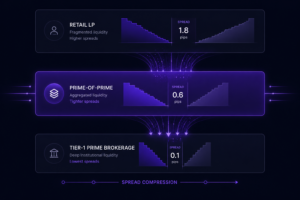
Most brokers pick an execution model once, at launch, and never revisit the decision. That is the mistake. Execution model is not a branding choice or a compliance checkbox — it is the single variable that determines how your revenue is generated, how much market risk sits on your book, and how your IB program pays out. Get it wrong and you either bleed margin to a liquidity provider that doesn’t match your client mix, or you carry risk exposure your capital base was never built to absorb.
This is a decision guide for brokers who are past the theory and need to know which model — STP, ECN, or market maker — actually fits their operation today.
The Financial Impact: What Execution Model Actually Costs You
Consider a mid-size brokerage running 400 active traders, average trade size of 1.2 lots, and 18,000 trades per month across major FX pairs.
Under a pure STP model with a 1.2-pip average markup, that broker generates roughly $216,000 in monthly spread revenue, with essentially zero market risk retained — the broker earns the markup regardless of whether the client wins or loses. Technology and LP costs typically run 8–12% of that revenue.
Switch the same book to ECN with a $7-per-lot round-turn commission, and monthly revenue drops to roughly $151,200 — lower per-trade yield, but the broker attracts a different client segment: higher-volume, lower-latency-sensitive traders who would never tolerate a spread markup. IB commission structures also shift, since ECN volume is naturally suited to lot-based rebates rather than spread-share arrangements.
Run the same volume under a market maker (B-book) model and the arithmetic changes entirely. Assume a realistic retail loss ratio of 70–75% — the industry-reported range for undiversified retail FX flow. On $18,000,000 in notional monthly volume, a broker internalizing that flow can realize significantly higher revenue than either A-book model, because it captures client losses directly rather than a spread or commission. But that revenue is not guaranteed: it is variance-exposed, capital-intensive, and it concentrates tail risk on individual large-account blowouts that can wipe out a month of gains in a single session.
The point is not that one model is “better.” It is that each model produces a completely different revenue curve, risk profile, and capital requirement — and most brokers never run these numbers before committing.
There is also a second-order cost that rarely shows up in these calculations until it’s too late: client churn from execution mismatch. A professional, EA-driven trader placed on a market maker account will detect requotes and widened spreads during volatility within weeks, and will move to a competitor offering ECN access. Conversely, a retail client placed on raw ECN pricing with a per-lot commission structure often finds the fee model confusing relative to an all-in spread, and abandons the account before it becomes profitable for the broker to service. Execution-model mismatch is an acquisition-cost problem as much as it is a revenue problem — every client lost to the wrong model is a client the marketing budget already paid to acquire.
The Insight: Why Brokers Get This Wrong
Brokers default to whichever execution model their first liquidity provider or platform vendor offered them, then never revisit the decision as the client base matures. A broker that launched three years ago targeting small retail accounts under a market maker model, and has since attracted a professional, EA-driven, high-volume client segment, is now running the wrong model for half its book — and leaking either revenue or client trust as a result.
The second failure mode is regulatory mismatch. Market maker models face heavier disclosure obligations in most jurisdictions, and some regulators (ESMA-aligned bodies in particular) scrutinize B-book conflict-of-interest structures closely. Brokers that haven’t reassessed their model against current regulatory guidance are carrying compliance risk they may not have priced in.
The third failure mode is treating execution model as an all-or-nothing decision. Most execution-model content aimed at brokers frames the choice as STP versus ECN versus market maker, full stop — as if a brokerage must pick one lane and stay in it. In practice, the brokers with the healthiest margins are the ones who stopped treating this as a binary choice years ago and started treating it as a routing problem to be solved per client segment, continuously, rather than a platform decision made once at launch and left untouched.
The Opportunity: Execution Model as a Margin Lever
Reframed correctly, execution model choice is not a fixed cost of doing business — it is one of the highest-leverage margin decisions a brokerage makes. A broker segmenting its book by client profile, rather than running a single model for every account, can route professional and high-volume flow to ECN (protecting margin on the segment most sensitive to spread markup) while running retail flow through STP or a risk-managed B-book (capturing higher yield on a segment with a statistically predictable loss pattern).
This is the logic behind the hybrid model that most brokers in 2026 have converged on: A-book for professional clients, internalized B-book for the retail tail, with automated risk thresholds that flip individual accounts between books based on real-time profitability and volume signals.
Practical Breakdown: How to Choose (and Implement) Your Model
- Segment your existing book first. Pull trade-level data for the last 90 days and bucket clients by average trade size, holding period, win rate, and EA usage. This tells you what percentage of your flow is professional-grade versus retail-pattern before you touch your execution architecture.
- Map each segment to a model. High-volume, low-holding-period, EA-driven accounts belong on ECN or raw-spread STP. Discretionary retail accounts with short holding periods and consistent losing patterns are candidates for internalization, subject to your capital base and regulatory posture.
- Confirm your LP relationships can support the split. A hybrid model requires liquidity connectivity that can route different account types to different destinations in real time — not a single feed pointed at one LP.
- Size your risk desk to your B-book exposure. If you internalize any portion of your flow, you need real-time exposure monitoring and defined intervention thresholds, not end-of-day reconciliation.
- Review your IB commission structure against the new model mix. Spread-share commissions don’t translate cleanly to ECN volume; lot-based rebates don’t translate cleanly to B-book. Running both models means running both commission types.
- Re-audit your regulatory disclosure. If you’re adding or expanding a market maker component, your best-execution policy and client disclosures need to reflect it before, not after, the change goes live.
- Pilot before you migrate the full book. Move one client segment at a time and measure revenue-per-trade, rejection rate, and slippage against your pre-migration baseline for at least 30 trading days.
Execution Model, Mapped
Not sure whether your book needs STP, ECN, or a hybrid split? Let’s map it in 30 minutes.
Segmentation · Risk thresholds · LP routing
The hardest part of this shift is rarely the decision — it’s the infrastructure. Running a true hybrid model means your liquidity aggregation layer, your bridging technology, and your risk monitoring all need to communicate in real time, routing each order to the right destination based on live client classification rather than a static rule set configured once at launch.
Soft Positioning
This is precisely the layer SpencerLogic’s infrastructure is built for. Our bridging and liquidity aggregation stack lets brokers route professional flow to ECN-grade liquidity and retail flow to an internally managed book from a single configuration layer, with a risk management suite monitoring exposure across both in real time. It’s part of what makes SpencerLogic function as an all-in-one white label brokerage solution — brokers don’t need to stitch together separate vendors for aggregation, bridging, and risk; the components are built to operate as one modular platform, deployable in days rather than the months a from-scratch integration would require.
Ready to see whether your book should be running a hybrid model? Book a demo and we’ll map your exact segmentation and routing setup in 30 minutes.
Conclusion
Changing your execution model doesn’t have to mean re-platforming your entire brokerage overnight. Start with the segmentation exercise, pilot a single client cohort on the model that better fits its trading pattern, and scale from there once the data confirms the shift is working. The infrastructure to support a hybrid setup — aggregation, bridging, and risk monitoring under one roof — is available as a modular add-on to your existing stack. Book a demo to walk through what a phased migration would look like for your specific book.
FAQ
What is the difference between STP and ECN execution?
STP routes client orders to one or more liquidity providers with the broker adding a spread markup as revenue. ECN gives clients direct access to an aggregated order book from multiple liquidity sources, with the broker charging a fixed per-lot commission instead of a markup.
Is market maker (B-book) execution illegal?
No. Market maker execution is legal in most jurisdictions and widely used, but it carries specific disclosure obligations because the broker takes the opposite side of client trades. Regulatory scrutiny of B-book conflict-of-interest structures has increased in ESMA-aligned markets.
Can a broker run more than one execution model at the same time?
Yes — this is the hybrid model most brokers in 2026 use. Professional and high-volume clients are typically routed to A-book (STP or ECN), while a portion of retail flow is internalized, subject to real-time risk monitoring and defined exposure thresholds.
How do IB commissions differ between STP, ECN, and market maker models?
STP volume is typically suited to spread-share commissions. ECN volume is more commonly paired with lot-based rebates or per-trade commissions. Market maker flow requires its own reconciliation logic since IB payouts aren’t tied to a visible spread markup.
What technology does a broker need to run a hybrid execution model?
A liquidity bridge and aggregation layer capable of real-time order routing by client classification, a risk management system with live exposure monitoring, and a commission engine that can handle multiple payout structures simultaneously.
How often should a broker reassess its execution model?
At minimum annually, and immediately after any material shift in client base composition — for example, a surge in EA-driven or high-volume trading, or a regulatory change affecting disclosure requirements in your licensing jurisdiction.
Does switching execution models require a new broker license?
Generally no, but it may require updating your best-execution policy and client-facing disclosures with your regulator, particularly if you are adding or expanding a market maker component to a book previously run as pure STP or ECN.