The Liquidity Tier You’re Paying Retail Prices to Avoid
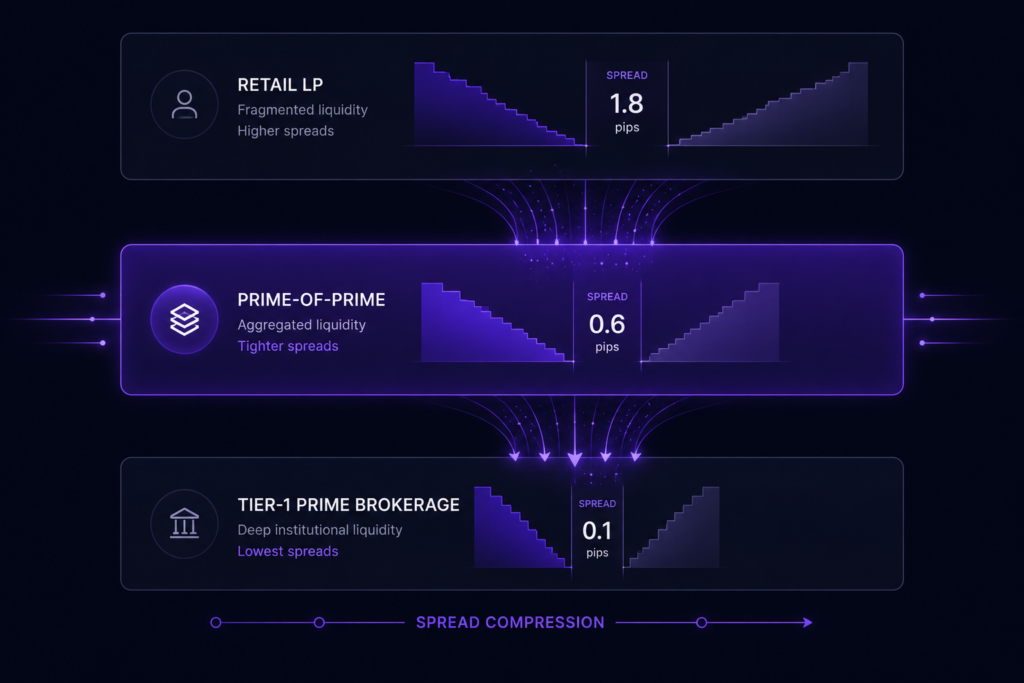
Most brokers assume there are two liquidity options: a retail-facing LP aggregator, or a Tier-1 bank relationship that requires nine-figure balance sheets and a prime brokerage license. Neither is true. There is a middle tier, and most tier-2 brokers never formally evaluate it because nobody explained it clearly enough to put on a shortlist.
That tier is prime-of-prime (PoP). It is the mechanism by which brokers with $500K to $5M in operating capital — not $50M — get institutional-grade pricing, depth, and execution quality that would otherwise require a direct Tier-1 bank relationship. If your brokerage is still routing through a single retail LP or a thin two-provider aggregation setup, you are very likely paying a liquidity tax you don’t need to pay.
The Financial Impact of Staying at Retail Tier
Consider a mid-size FX/CFD broker processing $8 million in daily notional volume across majors, minors, and a handful of metals. Operating on a retail-tier LP feed, average effective spread on EURUSD sits around 0.9 pips during normal sessions and widens to 2.1 pips during London/New York overlap volatility.
A PoP-sourced feed at the same volume typically compresses that spread to 0.3–0.5 pips normal session, 0.8–1.1 pips during overlap — a reduction of roughly 45–55% in spread cost passed through to the broker’s markup ceiling. On $8M in daily volume, that spread compression translates to approximately $2,800–$4,200 in additional daily margin capacity, or $700,000 to $1.05 million annually, assuming the broker retains even half of the improved pricing as margin rather than passing all of it to clients.
Separately, retail-tier feeds carry materially higher rejection and requote rates during news events — often 15–25% of orders during high-impact releases, compared to 3–6% on a properly configured PoP feed. Each rejected order is a fill the client experienced as failure, whether or not the broker’s markup logic was technically correct. That failure rate compounds into client attrition that doesn’t show up on a spread comparison spreadsheet but shows up in retention numbers within two quarters.
Why Most Tier-2 Brokers Never Move Off Retail Tier
The gap isn’t awareness that institutional liquidity exists. It’s a misunderstanding of the access requirements. Brokers assume PoP access requires the same balance sheet, credit line, and onboarding process as a direct prime brokerage relationship with a Tier-1 bank — six-figure minimum deposits held as collateral, ISDA documentation, dedicated relationship management, and month-long onboarding.
That’s the requirement for prime brokerage, not prime-of-prime. A PoP provider is itself a client of one or more Tier-1 banks — it holds the prime brokerage relationship, the balance sheet requirements, and the credit lines, and then re-distributes that access to smaller brokers through its own onboarding process, which is dramatically lighter. Most PoP providers onboard brokers with $50K–$250K in initial collateral, standard KYC/AML documentation, and a two-to-four-week technical integration — not months, and not the balance sheet of a mid-size hedge fund.
The confusion between the two tiers keeps brokers paying retail spreads for years past the point where PoP access would have paid for itself in the first quarter.
There’s a second, quieter barrier: technical integration anxiety. Brokers running a stable MT4/MT5 setup are often reluctant to touch bridge configuration for fear of introducing downtime or symbol-mapping errors into a working system. That risk is real when integration is handled manually, symbol by symbol, against a single new feed. It’s substantially lower when the PoP source is added as an additional route within an existing multi-source aggregation layer rather than a wholesale replacement of the current bridge — the broker’s platform keeps trading normally throughout the evaluation window, with the new feed proving itself in parallel before anything is switched over.
Reframing PoP as a Margin Lever, Not a Cost Center
The instinct is to evaluate PoP access as an expense line — provider fees, technical integration cost, minimum collateral tied up. That framing misses where the actual return sits.
PoP access doesn’t just tighten spreads for clients. It expands the broker’s own markup ceiling. A broker sourcing 0.3-pip base spreads can competitively offer clients 0.8-pip all-in pricing and retain 0.5 pips as margin — pricing that’s still meaningfully tighter than a retail-tier competitor offering 1.2 pips all-in on a 0.9-pip base. The broker wins on client-facing price and improves internal margin simultaneously, which is not possible on a retail feed where the spread floor is already close to the competitive ceiling.
It also changes the broker’s positioning with introducing brokers and VIP client segments. IBs evaluating where to route high-volume clients look directly at execution quality — fill rate, slippage, spread consistency during volatility. A broker who can point to PoP-sourced depth and a monitored, documented execution track record has a materially stronger pitch than one running a single retail LP relationship.
The Practical Path to PoP Access
Step 1: Audit current fill quality before shopping providers. Pull 30–60 days of execution data — fill rate, average slippage, rejection rate by symbol and session. This baseline is what you’ll use to evaluate whether a PoP provider is actually delivering improvement, and it’s the same data IBs and VIP clients will eventually ask to see.
Step 2: Confirm the provider’s underlying Tier-1 relationships. Not all PoP providers are equal. Ask which Tier-1 banks and non-bank market makers sit behind the feed, how many independent liquidity sources are aggregated, and what the provider’s own credit standing looks like. A PoP provider with two thin bank relationships isn’t meaningfully better than a strong retail LP.
Step 3: Right-size the collateral commitment. Most PoP providers structure collateral tiers based on expected volume. Don’t over-commit capital to secure a tier you won’t fill for a year — negotiate a starting tier matched to current volume with a documented path to better pricing at higher tiers.
Step 4: Integrate through a bridge that supports multi-source aggregation, not a single-feed connection. PoP access delivers the most value when it’s aggregated alongside existing sources rather than replacing them outright on day one. A multi-asset liquidity aggregation layer lets the broker run the PoP feed and existing relationships in parallel, routing by symbol and session, and phase out weaker sources as the PoP relationship proves out.
Step 5: Monitor fill quality against the pre-migration baseline for 60–90 days. Don’t assume improvement — verify it against the Step 1 numbers. If fill rate and spread compression aren’t tracking toward projections within 60 days, that’s the signal to renegotiate collateral tier or evaluate a second provider. Keep the reporting simple: fill rate, average slippage, and rejection rate by session, reviewed weekly against the baseline, is enough to make a confident go/no-go call without building a full analytics program around a single provider evaluation.
Where SpencerLogic Fits
Sourcing and integrating a prime-of-prime relationship independently is a multi-month project involving provider evaluation, bridge configuration, symbol mapping, and ongoing performance monitoring — work most brokerage tech teams weren’t built to carry on top of daily operations. SpencerLogic’s Liquidity Aggregation product provides pre-integrated access to Tier-1 and prime-of-prime liquidity sources directly, without requiring the broker to independently source, vet, and onboard a PoP provider from scratch.
The Price Engine synthesizes the aggregated PoP and Tier-1 feeds into a single tradable ladder with session-aware spread curves, while the MT4/MT5 Bridge handles symbol mapping and execution routing so the broker’s existing platform doesn’t need to be rebuilt to consume institutional-grade depth. For brokers running exposure across FX, CFDs, and crypto under one book, the Risk Management Suite consolidates position monitoring across all sources feeding the aggregated ladder.
Configured this way, the stack functions as an all-in-one white label brokerage solution — brokers get institutional liquidity access, execution infrastructure, and risk monitoring as one integrated system rather than assembling and maintaining separate vendor relationships for each piece. Deployment for brokers with existing MT4/MT5 infrastructure typically completes in one to two weeks, not the months a from-scratch PoP integration project would otherwise require.
Not sure whether your current spread and fill data justifies the move to PoP-tier liquidity? Book a demo and we’ll benchmark your last 60 days of execution data against a PoP-sourced projection, free.
Retail Spreads vs. PoP Access
What would institutional liquidity actually save your book?
Spread compression · Fill rate · Margin ceiling
Start With the Data, Not the Provider List
Prime-of-prime access is not the exclusive province of nine-figure brokerages. It’s a middle tier built specifically for firms operating between retail LP access and full prime brokerage — and for most tier-2 brokers running $5M+ in daily notional, it pays for itself within a quarter through spread compression alone, before accounting for the retention value of better fill quality.
The brokers who move on this early aren’t taking a leap of faith. They’re pulling their own execution data, confirming the gap between current and achievable pricing, and treating the migration as a scoped infrastructure project rather than a strategic bet. Start small, verify against your baseline, and scale the relationship as volume and confidence build.
Ready to see what prime-of-prime access would mean for your book? Book a demo and we’ll walk through your current execution data together.
FAQ
What is the difference between a prime broker and a prime-of-prime provider?
A prime broker is a Tier-1 institution (typically a major bank) that provides direct credit, clearing, and market access, usually requiring balance sheets and collateral in the tens of millions. A prime-of-prime (PoP) provider is itself a client of one or more prime brokers and re-distributes that access to smaller brokers and funds with dramatically lower collateral and onboarding requirements.
How much capital do I need to access prime-of-prime liquidity?
Most PoP providers set initial collateral requirements between $50,000 and $250,000, depending on the provider and expected trading volume — a fraction of the multi-million-dollar minimums typically associated with direct prime brokerage relationships.
Will switching to a prime-of-prime feed disrupt my existing operations?
Not if it’s aggregated alongside your current liquidity sources rather than replacing them outright. Running the PoP feed in parallel with existing relationships during a 60–90 day evaluation window lets you verify performance before phasing out weaker sources.
How long does prime-of-prime integration typically take?
Independent sourcing and integration usually takes two to four weeks for the provider relationship alone, plus additional time for bridge configuration and symbol mapping. Brokers using a pre-integrated aggregation platform typically go live in one to two weeks.
Does prime-of-prime liquidity only apply to FX, or does it cover CFDs and crypto too?
PoP providers increasingly offer multi-asset feeds spanning FX, metals, indices, and — through specialized providers — crypto. Brokers running multi-asset books should confirm asset coverage during provider evaluation rather than assuming FX-only.
How do I know if my broker is ready to move off a retail-tier LP?
The clearest signal is volume: brokers processing $3–5M or more in daily notional typically see PoP access pay for itself in spread compression alone within one to two quarters. Below that threshold, the math is closer and depends more on client segment mix and rejection-rate pain.
What happens to my existing LP relationship if I add a PoP feed?
Most brokers keep the existing relationship active during the evaluation period and route by symbol or session based on which source performs better, rather than terminating the original relationship outright. This preserves optionality and avoids concentration risk on a single new provider.