



TL;DR
- A modern bridging system is a revenue amplifier, not just a technical cost.
- Reduced slippage, faster execution, and fewer rejections directly improve broker profitability.
- Operational automation lowers staffing needs, errors, and support overhead.
- Better execution quality boosts trader retention and lifetime trading volume.
- Spencer Logic’s bridge delivers measurable ROI with improved fill rates, latency cuts, and seamless integrations.
Behind every thriving brokerage lies a careful balance between technology investment and operational efficiency. The pursuit of faster execution, tighter spreads, and stable infrastructure often comes with tangible costs — but when implemented strategically, these costs transform into measurable returns. Liquidity bridging is a textbook example: it requires initial setup, maintenance, and integration, yet its impact on execution quality, trader retention, and overall profitability is exponential.
Understanding the economics of bridging means understanding how technology drives revenue at every stage of the broker lifecycle. This article breaks down the financial logic behind modern bridge infrastructure — why it pays for itself, how it scales, and how brokers can quantify its ROI in clear, actionable terms.
Bridging as a Profit Center
Most new brokers view a bridge as an expense — an unavoidable piece of middleware necessary to connect to liquidity providers. But that perspective is incomplete. The bridge is not a cost center; it is a profit amplifier. Each improvement it introduces — tighter pricing, faster fills, reduced rejections — ripples through the broker’s P&L.
Consider slippage reduction alone. If your brokerage executes 100,000 trades per day and the average slippage decreases by just 0.3 pips due to better bridging, the impact is substantial. Over a month, that marginal improvement can translate into tens of thousands of dollars in retained spread or reduced hedging losses. Multiply that by growing trade volume, and the ROI compounds naturally.
In short, bridging is an investment that scales with success. The more volume you handle, the greater the return.
Cost Structure and Hidden Efficiencies
The direct costs of a bridging system include licensing, setup, hosting, and ongoing support. But the hidden costs of not having an advanced bridge are much larger. Without efficient routing, brokers face higher rejection ratios, manual trade corrections, client disputes, and increased staff time spent on reconciliation.
In financial terms, the bridge automates what would otherwise require a larger dealing desk. It minimizes operational errors and support overhead, freeing staff to focus on strategy and growth rather than troubleshooting.
Furthermore, a modern bridge like Spencer Logic’s integrates seamlessly with CRM, risk management, and reporting tools — eliminating the need for multiple vendors and redundant systems. When evaluating ROI, brokers should calculate the total cost of ownership (TCO), not just the license fee.
Revenue Impact Through Execution Quality
Execution quality directly correlates with trader retention. Numerous studies show that traders who experience consistent fills and predictable spreads are more likely to increase their trading volume. Each millisecond of reduced latency, each fraction of a pip saved, enhances the perceived reliability of the broker.
This reliability turns into recurring revenue. Traders who trust their broker’s infrastructure don’t just stay longer; they trade more. That compounding activity increases commission income for ECN brokers and spread-derived revenue for market makers.
Therefore, the ROI of bridging extends beyond technical metrics. It influences brand perception, client satisfaction, and ultimately lifetime customer value (LTV).
Reducing Risk Costs
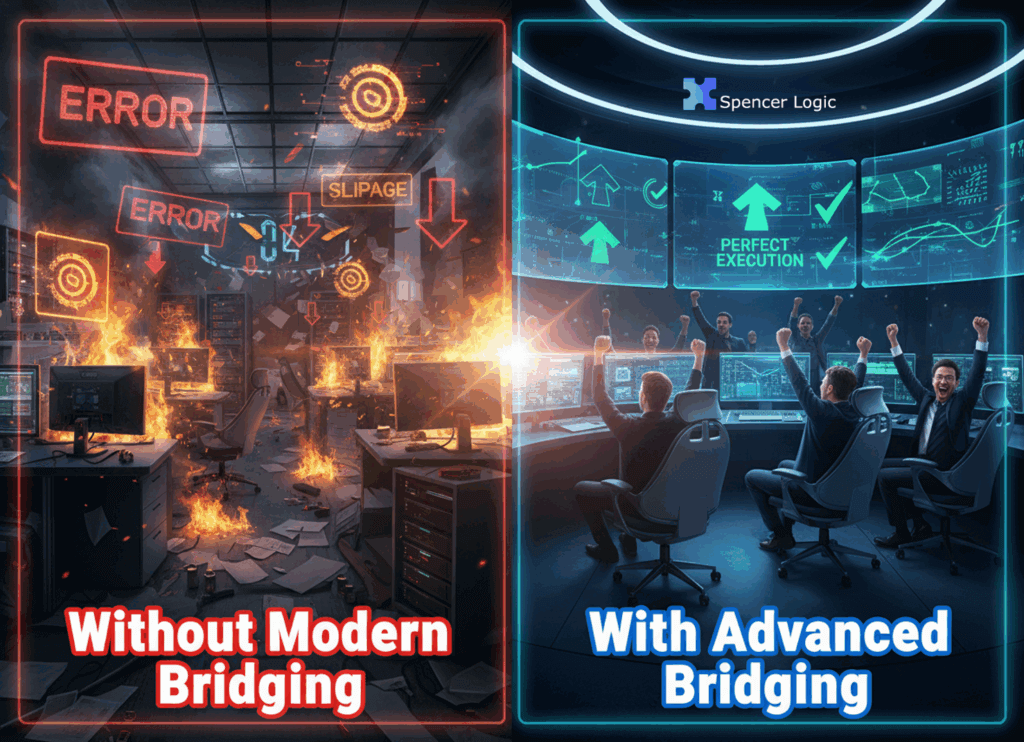
Bridging also protects profitability by improving risk management efficiency. With clear visibility into order routing and exposure, brokers can manage their A-book and B-book balance dynamically. This reduces unhedged positions and prevents slippage-based losses during volatile periods.
When execution becomes faster and more predictable, the broker’s hedging process aligns more closely with client execution, minimizing exposure mismatch. This synchronization not only safeguards capital but also allows more flexible hedging strategies — translating into better capital utilization and higher margins.
Quantifying ROI: A Simple Framework
To measure the return on bridging technology, brokers can analyze three core indicators:
- Execution Speed: Average latency reduction (in milliseconds) and its impact on slippage.
- Operational Efficiency: Reduction in manual interventions, support tickets, and reconciliation tasks.
- Client Retention & Volume Growth: Increase in active trader lifetime and average monthly trading volume post-bridge implementation.
When these data points are tracked consistently, the ROI calculation becomes clear: bridging not only reduces costs but amplifies revenue streams.
The Spencer Logic Advantage
Spencer Logic’s bridging architecture was built from the ground up to deliver measurable economic value. Our partners report improvements in fill rates exceeding 10–15%, latency reductions of over 30%, and a consistent decrease in client support overhead within months of deployment.
By combining speed, transparency, and automation, Spencer Logic transforms bridging from a technical utility into a strategic asset that directly drives profitability.
Conclusion
The economics of bridging are straightforward: every improvement in execution precision, latency, and transparency compounds into long-term financial gain. In a market where spreads are shrinking and competition intensifies, brokers can no longer afford inefficiencies hidden within their technology stack.A modern bridge is not a luxury; it’s the engine of profit optimization. Spencer Logic delivers that engine — a low-latency, data-driven bridge that turns connectivity into a measurable ROI advantage.
Learn more about how our Bridging Solution can improve your bottom line through superior execution and operational efficiency.