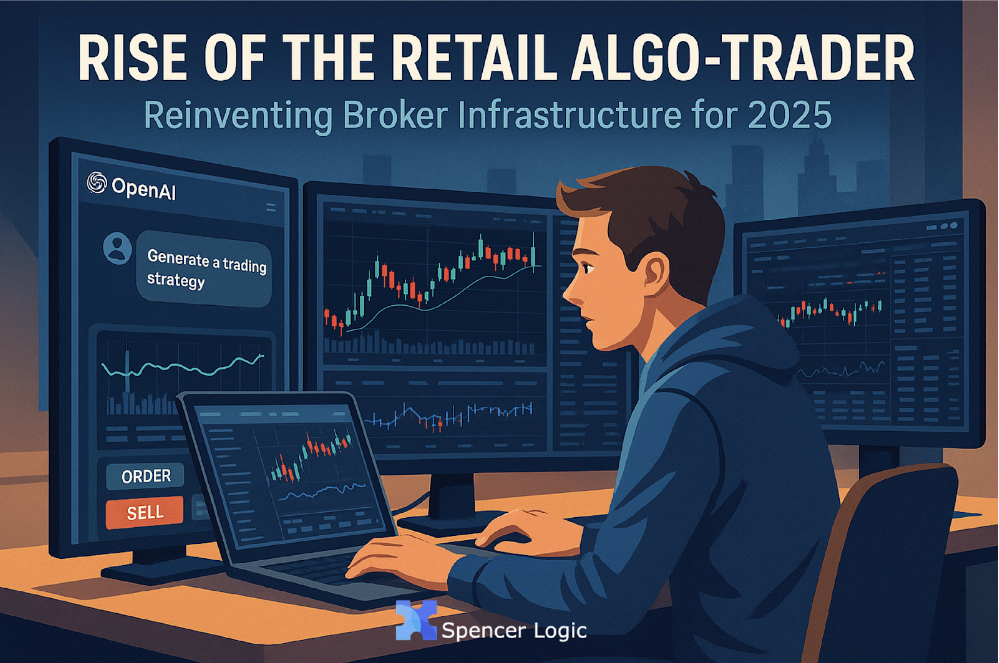
By Logic Pulse | Spencer Logic Insights Series
Retail trading isn’t just growing — it’s automating. More of the orders hitting brokers today come from expert advisors, API-connected scripts, and copy-trading systems than from someone clicking “buy.” That shift changes the shape of the flow a broker has to handle, and it’s exposing infrastructure that was built for a slower, more manual era. Here’s how big the retail boom actually is, why automation strains broker plumbing differently, and what it takes to stay competitive.
- How big is the retail boom, really?
- What's driving retail algo adoption
- Why automated flow strains broker infrastructure
- The emerging-market angle: why brokers in Dubai and beyond are watching
- What brokers need to thrive
- Where social and copy trading fit
- Built for the flow that's coming
- FAQ
- Related articles
How big is the retail boom, really?
The numbers are striking. According to Finance Magnates’ FM Intelligence, retail CFD and FX trading generated roughly $1.6 trillion per day in Q1 2026, up from about $905 billion a day a year earlier. On FM Intelligence’s measure, retail now accounts for about 16.6% of global FX turnover — up from 9.4% a year before, the largest twelve-month jump in their series, and a rise from under 3% back in late 2020. Active retail accounts in their dataset reached 7.42 million, up 42% year over year.
Whatever the exact figure, the direction is unambiguous: retail is a structurally larger share of the market than it was even two years ago, growing far faster than institutional FX turnover. And a rising portion of that volume isn’t manual — it’s automated.
What’s driving retail algo adoption
Several forces are pushing retail traders from clicking to coding:
- Expert advisors and scripting are mainstream. MT4 and MT5’s MQL languages put automated strategies in reach of ordinary traders, and marketplaces for ready-made EAs lower the barrier further.
- API access has opened up. More brokers and platforms expose REST and FIX APIs, letting traders connect their own systems directly.
- Copy and social trading automate participation. A trader doesn’t need to write a line of code to run an automated strategy — following a signal provider does it for them, at scale.
- Compute and AI tools got cheap. Backtesting, data, and increasingly AI-assisted strategy generation are available to individuals, not just funds.
The common thread: the retail order now increasingly arrives from a machine, on a machine’s schedule, with a machine’s precision.
Is your infrastructure ready?
See how Spencer Logic handles algo-trader order flow — live.
Smart routing · Liquidity aggregation · Real-time risk engine
Why automated flow strains broker infrastructure
Automated retail flow behaves differently from manual flow, and that difference lands squarely on a broker’s infrastructure:
- It’s spikier and more correlated. EAs and copy systems fire together — on a news print, a signal, a session open — so instead of orders arriving in a smooth trickle, they arrive in bursts, correlated across many accounts at once. Infrastructure sized for average load buckles at the peak.
- It’s more latency-sensitive. Automated strategies exploit small, fast edges, which puts pressure on execution speed and makes slippage and rejects more visible and more contested.
- It’s more likely to be toxic. Latency arbitrage, hedging across accounts, and news-spike strategies concentrate in automated flow — exactly the flow that hurts a B-book if it isn’t detected and routed accordingly.
- It needs real-time risk, not end-of-day risk. When exposure can build across thousands of correlated automated accounts in seconds, a risk process that reviews the book hourly is a process that finds out too late.
In other words, the retail algo boom doesn’t just mean more volume — it means harder volume, of a kind that older, fragmented broker setups weren’t designed to carry.
The emerging-market angle: why brokers in Dubai and beyond are watching
This isn’t only a developed-market story. Fast-growing brokerage hubs — Dubai prominent among them — are onboarding retail traders who are automation-native from day one, and they’re building (or buying) infrastructure accordingly. For a broker competing in these markets, being able to handle automated flow well isn’t a nice-to-have; it’s table stakes for the clients worth winning.
What brokers need to thrive
Handling automated retail flow competitively comes down to four capabilities working together:
- Liquidity aggregation. Multiple LP feeds combined into a deep, competitive composite book, so spreads hold up when automated flow hits in bursts and demands tight pricing.
- Low-latency bridging. Fast, colocated order routing that keeps slippage and rejects down — because automated strategies will notice, and complain about, every millisecond.
- A real-time risk engine with AI-driven execution. Live exposure aggregation across correlated accounts, toxic-flow detection, and routing that reacts instantly — deciding per order what to internalize and what to pass through, as conditions change.
- Scalable, modern platforms. Infrastructure that holds its performance from a few hundred accounts to tens of thousands without a rebuild.
Underneath all four is the same principle: the systems have to be built to operate together, because automated flow stresses the seams between components first.
Where social and copy trading fit
Copy and social trading are a big part of why retail participation is automating, so they’re part of the infrastructure question too. Invest Social is Spencer Logic’s standalone social and copy-trading platform — a way for brokers to offer automated, follow-a-strategy participation to clients who will never open a code editor. It’s a distinct product rather than a bolt-on to MetaTrader, which keeps the social layer clean and scalable while your core trading infrastructure does its job underneath.
Built for the flow that’s coming
The retail algo-trader isn’t a trend to watch — they’re already a large and growing share of the orders brokers handle every day, and the share that’s hardest to serve well. The brokers who thrive are the ones whose routing, liquidity, risk, and platforms were built to carry automated, bursty, latency-sensitive flow, not retrofitted to survive it. That’s the infrastructure Spencer Logic builds.
Want to see how your stack handles automated flow? Book a technical walkthrough.
FAQ
What is retail algorithmic trading? It’s retail traders using automated systems — expert advisors (EAs), API-connected scripts, or copy/social-trading strategies — to place and manage orders, rather than trading manually. The strategy runs on a machine, so orders arrive with a machine’s speed and timing.
How big is retail trading now? Per Finance Magnates’ FM Intelligence, retail CFD/FX generated around $1.6 trillion per day in Q1 2026 — roughly 16.6% of global FX turnover, up from about 9.4% a year earlier — with active accounts up more than 40% year over year. The retail share has grown faster than institutional FX turnover.
Why does automated retail flow strain brokers? Because it’s spikier, more correlated, more latency-sensitive, and more likely to be toxic than manual flow. EAs and copy systems fire together, so load arrives in bursts, and automated strategies are quick to exploit — and complain about — any execution weakness. It also demands real-time rather than end-of-day risk management.
What infrastructure does a broker need to handle algo traders? Liquidity aggregation for deep, competitive pricing under burst load; low-latency, colocated bridging to minimize slippage and rejects; a real-time risk engine with toxic-flow detection and dynamic routing; and platforms that scale without a rebuild — all built to work together.
How does copy/social trading relate to the algo boom? Copy and social trading let a trader run an automated, follow-a-strategy approach without writing any code, which is a major driver of retail automation. For brokers, offering it (for example via a dedicated social-trading platform) captures that demand while keeping the social layer separate from core trading infrastructure.