Crypto Exchange Liquidity: Market Making vs. External LP Aggregation

Posted on

The Order Book Problem Most New Exchanges Misdiagnose

Most crypto exchanges that fail in their first 18 months don’t fail because of marketing. They fail because their order books are too thin to sustain competitive trading activity. Traders who experience wide spreads, rejected orders, or visible price gaps leave within weeks and do not return. The operators who built those exchanges typically attribute the problem to low user count. In most cases, the actual cause is a liquidity architecture decision made before the exchange went live.

The choice between running an internal market-making operation and sourcing liquidity through external LP aggregation is not a technology preference. It is a capital allocation decision with direct consequences for spread quality, execution reliability, and long-term retention. Getting it wrong is expensive, and the cost does not always surface immediately.


The Financial Reality of Thin Books

Consider an exchange launching with 1,000 active traders, processing approximately $3 million in daily notional volume. The exchange charges a 0.1% maker-taker fee on matched trades.

Under a thin-book scenario — where internal market making covers only the top five token pairs and leaves long-tail pairs unquoted — roughly 25% of orders find no fill at the requested price. Some re-route to a worse price. Some cancel. A fraction abandon the trade entirely.

At $3M in daily volume, a 25% fill-rate degradation removes approximately $750,000 from the pool of matchable trades each day. At 0.1% fee revenue, that translates to $750 per day in foregone exchange income — $273,750 annually — from liquidity gaps alone.

This calculation does not include trader attrition, which compounds over time. Users who experience a failed order once are less likely to return. Users who experience it twice rarely do. The exchange loses not just the fee revenue on the failed trade but the lifetime value of the client relationship.

An exchange with adequate depth across its listed pairs closes that gap. The central question is what it costs to achieve that depth — and through which mechanism.


Why Internal Market Making Costs More Than Operators Project

Internal market making is structurally more expensive than most new exchange operators budget for.

An exchange running its own market-making desk must hold inventory positions across every listed asset, absorb the directional risk that comes with those positions, hedge net exposure on external venues, and maintain quoting logic that keeps spreads competitive during volatile sessions.

For a new exchange listing 20 to 30 token pairs, the working capital requirement for inventory — before hedging costs, before personnel — is typically in the range of $500,000 to $2 million, depending on pair volatility and the minimum depth the operator considers acceptable. Hedging on external venues costs between 5 and 15 basis points per side for liquid pairs, more for long-tail assets. During high-volatility periods, inventory risk compounds: a sudden 8% directional move on an unhedged position can eliminate the equivalent of three to four weeks of fee revenue in a single session.

Many operators discover this only after going live. The temptation to begin with internal market making — because it appears cheaper in the initial budget model — frequently results in either undercapitalization or inconsistent quoting that damages trader confidence before the exchange reaches the volume needed to sustain organic book depth.


Reframing the Problem as a Structural Choice

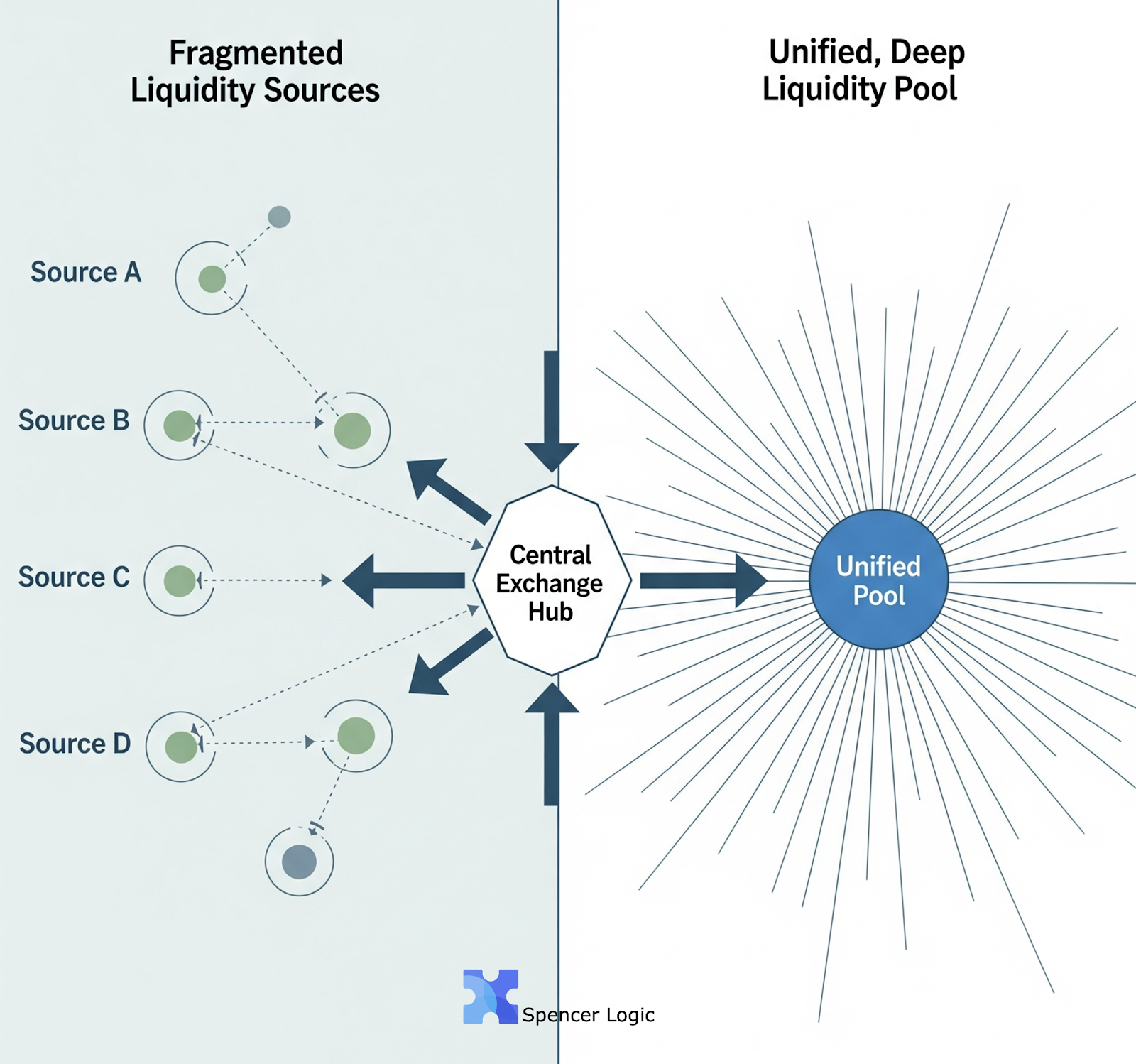
External LP aggregation changes the economics. Instead of holding inventory, the exchange routes orders to a pool of pre-integrated liquidity providers and earns revenue on the spread markup between the LP feed and the price shown to traders.

This structure offers two compounding advantages at scale. First, the exchange operator does not carry directional risk — the LP absorbs it. Second, aggregation across multiple LPs creates a synthetic order book with depth that a single internal desk could not replicate without significantly higher capital. For token pairs where the exchange does not generate sufficient organic maker volume, LP aggregation ensures a continuous, tradeable quote.

The operator’s task shifts from managing an inventory book to managing LP relationships, monitoring fill quality, and tuning spread markup logic. This is operationally simpler, more predictable, and does not require the exchange to maintain capital buffers against adverse price moves.

The crossover point — where organic maker volume is sufficient to reduce LP dependency — typically arrives around $10M to $30M in daily notional volume for a mid-tier exchange. Before that threshold, LP aggregation is almost always the lower-cost, lower-risk configuration.


The Operator’s Practical Framework

Step 1: Segment the instrument list by depth requirement

Not every listed pair needs external LP coverage. High-volume pairs — BTC/USDT, ETH/USDT, and a handful of top-20 tokens — may generate sufficient internal depth within weeks of launch. Long-tail pairs rarely do. Segment the listing plan at launch: define which pairs carry LP feed priority and which run on organic depth with LP as backstop. This segmentation determines where capital and configuration effort should concentrate.

Step 2: Set the fee structure to incentivize organic market making

Maker-taker fee structures directly influence order book depth. A zero-fee or negative-fee maker tier encourages traders and algorithms to post limit orders, which adds depth without LP cost. The exchange earns on taker fees. This is standard practice at competitive venues and reduces the proportion of activity that requires LP routing.

Step 3: Define routing logic by instrument and market condition

LP aggregation operates most efficiently when routing logic is instrument-specific and condition-aware. During normal market conditions, orders should route to the LP offering the best bid-ask on the aggregated feed. During high-volatility periods or when LP spreads widen, routing logic should adjust to avoid fills at prices that degrade trader experience. Define these parameters before go-live, not in response to a live problem.

Step 4: Monitor fill quality and LP performance continuously

Fill rates, slippage distributions, and rejection rates by LP should be monitored in real time at the instrument level. An LP that consistently rejects orders on a specific pair during high-volume sessions needs to be reconfigured or replaced. This is an ongoing operational task, not a one-time setup decision. For brokers also running FX or CFD products alongside crypto, monitoring execution quality across both books requires unified exposure visibility — a function the Risk Management Suite handles at the position level.

Step 5: Build toward organic depth without abandoning LP infrastructure

As exchange volume grows, the proportion of LP-routed trades naturally declines as organic maker activity increases. The LP feed remains the backstop. Treat it as permanent infrastructure rather than a launch-phase workaround.


How SpencerLogic Approaches Exchange Liquidity Infrastructure

For exchange operators who want to go live without building liquidity infrastructure from scratch, the Spencer Exchange platform is a white-label crypto exchange engine that integrates directly with SpencerLogic’s Liquidity Aggregation product, providing access to pre-integrated Tier-1 and prime-of-prime LP feeds without the capital overhead of internal market making.

The stack connects to the Price Engine for ultra-low-latency feed distribution across all listed instruments. For exchanges that also operate MT4/MT5 FX products alongside crypto, the MT4/MT5 Bridge consolidates execution routing into a single infrastructure layer, removing the need to manage separate vendor relationships for each product line.

This configuration functions as an all-in-one white label brokerage solution for operators who want to offer crypto exchange functionality alongside traditional CFD or FX instruments without building separate technology stacks for each. It deploys in days rather than months, with LP relationships and feed configuration handled at the infrastructure level.

For context on how the bridge and aggregation layers interact, the article Liquidity Bridge vs. Aggregator: Key Differences and Use Cases covers the technical relationship between the two systems in detail.


Start with the Right Architecture

Crypto exchange liquidity is not a problem that resolves at higher user counts. Thin order books cause fill failures, fill failures cause attrition, and the cycle compounds before volume ever reaches the level needed to generate natural market-making depth.

The operators who launch with a clear-eyed view of their liquidity architecture — segmenting instruments, setting appropriate fee structures, and relying on LP aggregation where organic depth is insufficient — build exchanges with a structural advantage from day one.

Ready to structure your exchange liquidity stack before go-live? Walk through your instrument list and LP configuration with the SpencerLogic team — book a technical demo.


FAQ

What is the minimum capital required to run internal market making on a crypto exchange?

There is no universal floor, but an exchange listing 20 to 30 pairs typically requires $500,000 to $2 million in working capital to maintain adequate inventory depth, before hedging costs. Operators who underestimate this figure usually experience consistent fill failures on long-tail pairs within the first few months of operation.

How does LP aggregation affect the spreads traders see on a crypto exchange?

LP aggregation constructs a synthetic order book by combining the best available bids and asks from multiple liquidity providers. The result is typically a tighter composite spread than any single LP could offer alone. The exchange operator applies a markup on top of the aggregated feed, which is the primary revenue mechanism.

Can an exchange run both internal market making and LP aggregation at the same time?

Yes, and most mature exchanges operate this way. The standard configuration uses internal market-making capacity for high-volume pairs where the exchange generates sufficient organic depth, and LP feeds as the primary source of quotes on long-tail or newly listed instruments. The transition from LP-dominant to organic-dominant liquidity happens naturally as volume grows.

What is smart order routing (SOR) in a crypto exchange context?

SOR is routing logic that automatically directs each order to the liquidity source offering the best available fill at the time the order is submitted. In a multi-LP environment, SOR evaluates the aggregated feed in real time and selects the optimal LP or combination of LPs for each order, reducing slippage and improving fill consistency across instruments.

How do maker-taker fee structures affect order book depth?

Maker-taker models charge a lower fee — sometimes negative, effectively a rebate — for orders that add liquidity to the book, and a higher fee for orders that consume liquidity. This incentivizes traders and algorithmic market makers to post limit orders, which deepens the book and reduces the proportion of trades that require LP routing.

What metrics should exchange operators monitor to evaluate LP performance?

The key operational metrics are fill rate (percentage of orders filled at the requested price), average slippage per instrument, rejection rate by LP, and spread stability during high-volatility sessions. An LP that performs well during normal conditions but widens spreads or increases rejections during volatility is a direct risk to exchange revenue and trader retention.

At what volume does organic market making typically replace LP aggregation as the primary liquidity source?

The crossover point varies by instrument mix and exchange configuration, but most mid-tier exchanges reach LP-independence on their top five to ten pairs somewhere between $10M and $30M in average daily notional volume. Long-tail pairs may require LP support indefinitely, regardless of overall exchange volume.


SpencerLogic provides institutional-grade trading infrastructure for established brokerages and exchange operators. Schedule a demo to discuss your liquidity and technology stack.
Integrating a Liquidity Bridge With MT4 and MT5: A Broker’s Technical Roadmap

Posted on

TL;DR:

  • Seamless MT4 & MT5 bridge integration = faster execution & higher trust.
  • Spencer Logic’s bridge reduces latency & improves accuracy.
  • Unified system for liquidity, risk, and compliance.
  • Multi-asset scalability with 24/7 operational support.
  • Future-ready: connects to traditional & digital markets.

For brokers, the quality of execution defines the brand. Clients may initially choose a broker for spreads or promotions, but they stay for speed, stability, and trust. The backbone of that performance lies in the seamless connection between the trading platform and external liquidity. And at the center of that connection stands one critical piece of infrastructure: the liquidity bridge.

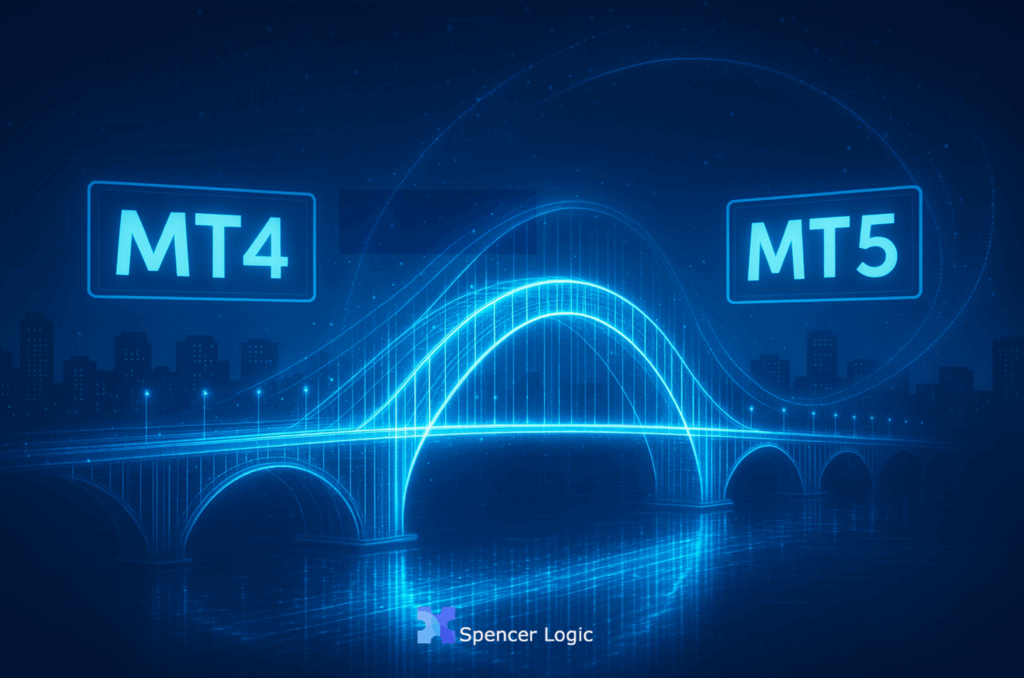
Among the most widely used platforms in the industry — MetaTrader 4 and MetaTrader 5 — each offers unique strengths, architectures, and integration challenges. Successfully connecting them to institutional liquidity through a bridge requires not only technical knowledge but also a clear operational strategy. This article provides a deep dive into how bridge integration works for each platform, the challenges brokers encounter, and how a modern bridging system like Spencer Logic’s resolves them.


Why Integration Quality Matters

Every trading platform provides an interface for order execution, charting, and client management. But these interfaces were never meant to handle direct institutional routing on their own. They rely on an external connector — the bridge — to communicate with liquidity providers, prime-of-prime partners, or aggregators.

Poor integration creates hidden costs. Latency increases when the bridge and platform exchange data inefficiently. Order mismatches appear when symbol mapping or pricing precision is inconsistent. Reporting gaps emerge when trade confirmations fail to synchronize correctly between the two systems. The result is an experience where traders sense something “off” — delayed confirmations, inconsistent slippage, or inaccurate account metrics.

In contrast, a properly integrated bridge functions invisibly. Orders move in milliseconds, trade histories align perfectly, and pricing remains stable across instruments. The technical challenge for brokers is to make that invisibility consistent across all platforms they support.


Integrating a Bridge With MT4

MetaTrader 4 remains one of the most popular retail trading platforms, largely due to its simplicity and vast EA ecosystem. However, it was designed in an era when most brokers operated as market makers rather than true liquidity intermediaries. Connecting MT4 to external liquidity requires bridging technology to fill that structural gap.

The bridge communicates between the MT4 Server and liquidity providers through FIX API or proprietary protocols. Integration typically involves the following key components:

  1. Server Plug-in: Installed on the MT4 server, the plug-in captures incoming orders and passes them to the bridge.
  2. Bridge Core Engine: Processes these orders, translates them into FIX messages, and sends them to the designated liquidity venue.
  3. Execution Response: Once filled, trade details return through the same path and update the MT4 client terminal in real time.

This process seems straightforward but requires precise calibration. Each liquidity provider has unique symbol naming conventions, pricing decimal structures, and minimum trade sizes. The bridge must harmonize all of this data to prevent rejections or misquoted prices.

A professional-grade bridge also handles partial fills, requotes, and order aggregation, ensuring that MT4’s internal representation of open positions remains synchronized with external execution results.

Spencer Logic’s bridge architecture was specifically designed to simplify these integrations. Automated symbol mapping, dynamic price precision adjustment, and intelligent reconciliation algorithms eliminate the manual labor and risk that plagued earlier-generation connectors.


Integrating a Bridge With MT5

MetaTrader 5 (MT5) was developed as the evolution of MT4, adding multi-asset capability, hedging/netting modes, and an updated API. Yet, for all its modern features, MT5 integration presents a different set of challenges.

Unlike MT4, which relies heavily on plug-ins, MT5 offers a native gateway interface for liquidity connection. A bridge can communicate through the MetaTrader Gateway API, which allows external systems to act as liquidity endpoints.

Integration with MT5 typically follows this flow:

  • Orders from the MT5 Server are passed to the Gateway Plug-in, customized for the broker’s liquidity configuration.
  • The gateway interacts directly with the bridge engine, converting MT5 orders into FIX or API calls compatible with liquidity providers.
  • Fill confirmations are transmitted back, updating MT5 positions, balance, and exposure data.

Because MT5 is multi-asset by design, the bridge must manage instruments with varying tick sizes, contract specifications, and price feeds. Crypto pairs, metals, and indices can coexist within the same environment, each requiring its own liquidity source.

Spencer Logic’s bridge supports MT5 through a dedicated gateway module built for multi-asset routing. It automatically classifies order types, applies symbol-specific routing rules, and normalizes P&L reporting across instruments. The system also offers real-time risk dashboards, allowing brokers to visualize their A-book and B-book exposures directly from the bridge interface.

The combination of MT5’s flexibility and a robust bridging layer gives brokers institutional-grade control over both execution and risk management.


Technical Challenges Across Platforms

Integrating a bridge across MT4 and MT5 introduces technical complexity beyond simple connectivity. Each platform has unique data models, order types, and reporting structures. For brokers running multi-platform operations, maintaining consistency becomes a constant challenge.

  • Symbol Mapping: Each platform may represent the same instrument differently — for example, “EURUSD.” vs “EUR/USD.pro.” Without automated mapping, trades can be rejected or misrouted.
  • Latency Coordination: Different platforms handle network communication asynchronously, creating micro-delays that can affect execution fairness.
  • Risk Consolidation: Exposure across platforms must be aggregated accurately to maintain proper hedging ratios.
  • Reporting Harmonization: Account histories, balance updates, and swaps need to remain synchronized across systems to avoid client confusion.

Spencer Logic addresses these issues through an abstraction layer that standardizes data before it enters the bridge’s routing engine. All platforms communicate through a unified schema, ensuring that trades look and behave identically regardless of origin.


Security and Compliance in Bridge Integration

Bridging is not just about speed — it’s about trust. Every order passing through the bridge carries financial data that must be protected. Modern bridge integrations employ end-to-end encryption, TLS-secured FIX sessions, and IP whitelisting to prevent unauthorized access.

For regulated brokers, compliance auditing is equally vital. Bridges must generate immutable execution logs, record timestamps with microsecond precision, and archive trade data for years as required by MiFID II, ASIC, or FCA standards. Spencer Logic’s compliance engine automates this process, creating tamper-proof audit trails that satisfy both internal reviews and external regulators.

This level of transparency transforms the bridge from a technical connector into a compliance ally, ensuring that every trade meets not only performance standards but also legal obligations.


Operational Considerations During Deployment

Bridge integration is not a one-time installation; it is an operational process involving configuration, testing, and continuous optimization.

The most successful integrations follow a structured roadmap:

  1. Assessment: Define which liquidity sources and execution models (A-book, B-book, hybrid) the broker will use.
  2. Configuration: Map instruments, establish routing logic, and synchronize account parameters.
  3. Testing: Execute latency benchmarking, rejection analysis, and reconciliation tests under load.
  4. Deployment: Roll out the live bridge with monitoring dashboards active from day one.
  5. Iteration: Continuously refine routing and aggregation rules based on live performance metrics.

Spencer Logic supports brokers throughout this lifecycle. Our deployment team provides sandbox environments for pre-launch testing, ensuring that by the time the bridge goes live, performance metrics already meet institutional benchmarks.


Multi-Asset, Multi-Platform Scalability

The true challenge for modern brokers is not just connecting one platform but scaling across multiple. A broker may start with MT4, expand to MT5, and later add proprietary web terminals. Without a flexible bridging layer, each expansion becomes a new integration project — costly and time-consuming.

Spencer Logic’s architecture was designed to prevent this scenario. Once connected to our bridge, additional platforms or liquidity providers can be added modularly, with no downtime or data migration. The same routing engine and performance analytics apply universally.

This scalability allows brokers to evolve their business without technical disruption — a vital advantage in an industry where new asset classes and trading technologies emerge constantly.


The Human Element: Support and Monitoring

Even the most advanced bridge architecture requires skilled oversight. A broker’s dealing desk and technical team must understand the bridge’s dashboards, routing logic, and alerts. Real-time monitoring enables them to detect anomalies before they affect clients.

Spencer Logic provides 24/7 operational support with access to latency reports, liquidity performance scoring, and execution diagnostics. These insights empower brokers to maintain institutional standards of uptime and transparency, even with lean internal teams.


Why Unified Integration Matters for Clients

To traders, all that matters is whether the platform performs consistently. They don’t care which bridge is in use or where liquidity comes from — but they immediately notice inconsistencies. A properly unified bridge integration eliminates those inconsistencies entirely.

When latency, symbol mapping, and reporting align across MT4 and MT5, the client experience becomes seamless. Spreads remain predictable, slippage minimal, and trade histories accurate. This consistency not only retains traders but also reduces support costs, as fewer clients contact the help desk about execution discrepancies.

Integration quality, in other words, is invisible success — noticed only when it’s missing.


Looking Ahead: Toward Universal Platform Connectivity

The next generation of trading infrastructure is moving toward universal API-based platforms, where bridges won’t merely connect to MT4 or MT5 but to any venue supporting standardized protocols. Spencer Logic’s roadmap already anticipates this shift, with connectors for REST, WebSocket, and emerging decentralized exchange protocols.

In the near future, brokers will be able to extend their liquidity networks beyond traditional FX and CFD markets to include tokenized assets, on-chain derivatives, and synthetic instruments — all routed through the same bridge interface. Integration will remain the foundation, but its scope will broaden to encompass the entire spectrum of digital markets.


Conclusion

Integrating a liquidity bridge with MT4 and MT5 is far more than a technical exercise — it is the process of aligning your brokerage’s technology, risk management, and client experience into one cohesive ecosystem. Done correctly, it delivers not only faster execution but also consistency, transparency, and scalability across all platforms.

Spencer Logic’s bridging architecture was engineered for exactly this challenge. With native connectors for all major platforms, multi-asset support, and institutional-grade compliance and monitoring, it provides brokers with a unified foundation for growth.

Whether you operate on MT4, MT5, or multiple platforms, your success depends on the same principle: seamless, intelligent connectivity.

Liquidity Bridge vs. Aggregator: Key Differences and Use Cases

Posted on

By Logic Pulse | Spencer Logic Insights Series

TL;DR: Liquidity Bridge vs. Aggregator

  • Bridge = Connectivity: The Liquidity Bridge is the essential gateway connecting the trading platform (MT4/MT5) to LPs, handling order routing and risk management (A/B/Hybrid).
  • Aggregator = Optimization: The Liquidity Aggregator is the engine that combines multiple LP price feeds to create the tightest spreads and ensure best execution (essential for scale and competitiveness).
  • Relationship: The Bridge is the foundational infrastructure, and the Aggregator is the optimizer; you need the Bridge to function, and the Aggregator to win on pricing.
  • Spencer Logic Advantage: We offer an integrated Bridging & Aggregation Stack, providing both superior connectivity and optimal execution from a single, streamlined platform.

In the world of electronic trading, few terms are as frequently misunderstood as liquidity bridge and liquidity aggregator. Both are critical components in a broker’s technology stack, yet they serve different purposes. Many brokers use them interchangeably, which can lead to poor infrastructure decisions, higher costs, or suboptimal execution.

To scale successfully — whether you’re a startup broker or an established firm expanding into multi-asset markets — it’s essential to understand how these two systems differ, how they interact, and when each becomes necessary.

This article clarifies the relationship between liquidity bridges and aggregators, explores their key differences, and explains how brokers can leverage both strategically to improve execution, reduce costs, and enhance competitiveness.


The Role of Connectivity in Modern Brokerage

Electronic trading is built on connectivity. A broker’s success depends on how efficiently orders flow between traders, trading platforms, and liquidity providers (LPs). When traders click “Buy” or “Sell,” they expect an instant, fair, and transparent fill. Behind that simplicity lies a complex network of systems that route, match, and confirm each trade in milliseconds.

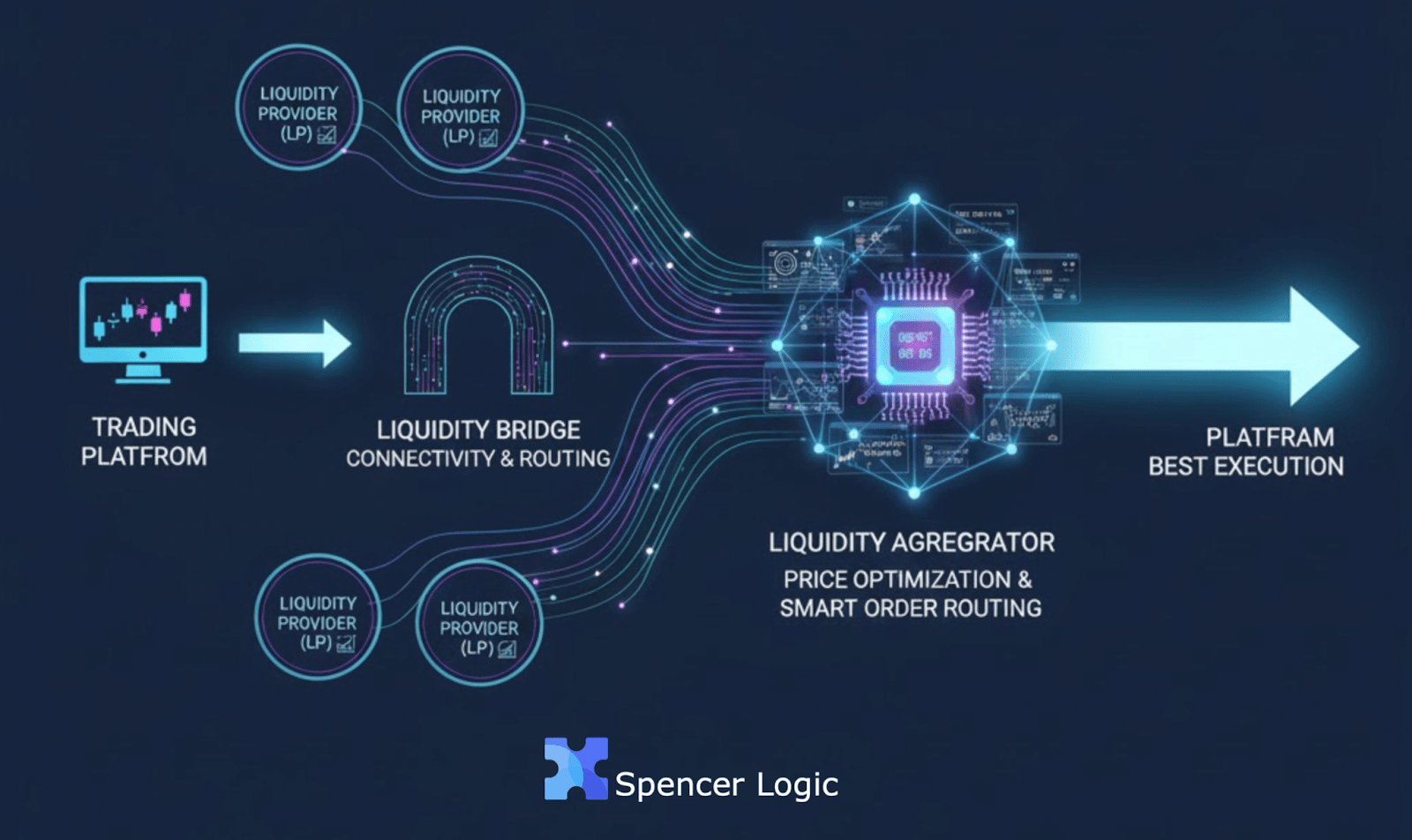
Two of the most critical systems in this process are the liquidity bridge and the liquidity aggregator. They are often developed as part of the same ecosystem, but their core functions differ. The bridge ensures communication between the trading platform and external liquidity venues, while the aggregator optimizes how prices are compiled and orders are executed across multiple liquidity sources.

Think of it this way: the bridge is the road that connects your brokerage to the market, and the aggregator is the traffic controller that manages which lane each order should take for the best result. Both are necessary, but they handle distinct parts of the execution journey.


What Is a Liquidity Bridge?

A liquidity bridge is middleware that connects your trading platform — such as MT4, MT5, or cTrader — to one or more external liquidity providers. It translates and routes trading instructions using standard financial communication protocols like FIX API.

The bridge’s job is to ensure that every trade initiated on your platform is transmitted, filled, and confirmed as efficiently as possible. It handles order routing, manages risk exposure, and supports A-book, B-book, or hybrid execution models.

A well-designed bridge acts as a broker’s control center, offering visibility into execution quality, latency, and slippage. It also provides tools to monitor order flow, set markups, and define routing logic based on volume, instrument, or client group.

In short, the bridge is the broker’s gateway to liquidity — the infrastructure that makes external execution possible.


What Is a Liquidity Aggregator?

While the bridge connects systems, the aggregator enhances execution efficiency by combining price feeds from multiple liquidity providers into a single, optimized stream. Instead of relying on one LP’s quotes, an aggregator compares all incoming bids and asks, identifies the best combination, and constructs a synthetic order book that delivers the tightest possible spreads.

This process, known as price aggregation, directly impacts how competitive your pricing appears to traders. For example, one LP might offer the best bid, while another offers the best ask. The aggregator merges these into a composite quote that your platform displays to clients.

Beyond price construction, aggregators can split large orders across several LPs to minimize market impact — a process known as order slicing or sweeping. They can also apply smart order routing (SOR) logic to ensure each order is executed at the best available price with minimal slippage.

In other words, the aggregator optimizes liquidity, ensuring that the connection provided by the bridge is not only functional but also efficient.


Bridge vs. Aggregator: The Core Differences

While both systems are part of the same execution flow, their functions are distinct. The easiest way to understand the difference is to compare their roles side by side:

FeatureLiquidity BridgeLiquidity Aggregator
Primary RoleConnects trading platforms to liquidity providersCombines and optimizes prices from multiple LPs
FocusConnectivity, routing, and risk managementPrice construction and execution optimization
ProtocolsFIX API, proprietary APIsFIX API, market data feeds
Execution ModelsSupports A-book, B-book, hybrid setupsFocuses on best-execution logic for A-book orders
UsersBrokers managing connectivityBrokers or institutional desks managing pricing and execution quality
Key BenefitEnables external execution and controlEnsures best pricing and deeper liquidity access

A bridge can exist without an aggregator — for example, if a broker connects to a single LP or prime-of-prime. However, an aggregator cannot function without a bridge or another form of connectivity to transmit its orders.

The bridge is the foundation. The aggregator is the optimizer. Together, they define a broker’s ability to compete on both speed and pricing.


How the Two Work Together in Practice

In a modern brokerage environment, bridging and aggregation typically operate as part of a single workflow:

  1. Trader places an order on MT4 or MT5.
  2. The bridge receives the order and routes it to the aggregator or directly to a designated LP.
  3. The aggregator compares prices from connected LPs, selects the best available combination, and executes the trade.
  4. The bridge confirms the fill, applies markups or commissions, and returns the confirmation to the trading platform.

This workflow happens in milliseconds, ensuring seamless execution from the trader’s perspective.

In Spencer Logic’s architecture, the bridge and aggregator components are tightly integrated. This allows brokers to enjoy both connectivity and optimization without juggling multiple vendors or complex integrations.


Why the Distinction Matters for Emerging Brokers

For new or scaling brokers, understanding the difference between a bridge and an aggregator is not just technical — it’s strategic. Early infrastructure decisions determine how scalable, profitable, and compliant your brokerage can become.

A broker that only installs a basic bridge may be able to execute trades but might offer uncompetitive spreads compared to rivals using aggregation. Conversely, investing in an aggregator without a stable bridge can lead to execution delays, data mismatches, or liquidity disconnects.

Getting the combination right from the start ensures that your brokerage can:

  • Offer institutional-grade execution to retail clients.
  • Compete on pricing without compressing your margins.
  • Expand seamlessly across multiple liquidity providers and asset classes.
  • Maintain transparency and control over every trade.

In a market where traders can switch brokers in seconds, infrastructure quality becomes a major differentiator.


The Evolution of Bridging and Aggregation Technology

Historically, liquidity bridges were simple connectors — software layers that relayed orders from MT4 to a liquidity provider. Aggregation, if it existed at all, was manual or limited to a few price feeds.

Today, both have evolved dramatically. Modern bridging systems integrate advanced risk engines, dynamic routing, and even real-time analytics. Aggregators now include algorithmic execution features, multi-asset support, and customizable order slicing strategies.

This evolution reflects the changing nature of trading. As clients demand access to FX, metals, indices, crypto, and derivatives under a single account, brokers must build systems capable of handling complex execution scenarios. Bridging and aggregation have become inseparable parts of that solution.

At Spencer Logic, this philosophy is embedded into our design: a multi-asset bridging stack that combines deep connectivity, smart order routing, and liquidity optimization in one unified platform.


When You Need a Bridge (But Not Yet an Aggregator)

If you are a small or newly launched broker connecting to a single LP or prime-of-prime, a liquidity bridge alone may be sufficient in the beginning. It will allow you to execute trades externally, manage markups, and monitor risk efficiently.

This setup is especially suitable when:

  • You have limited trading volume.
  • Your client base trades mainly major FX pairs.
  • Your goal is to establish operational stability before scaling liquidity sources.

However, once trading volume increases and client expectations rise, the absence of aggregation will begin to show — typically in the form of wider spreads, occasional slippage, and inconsistent fills during high volatility. At that point, adding aggregation capabilities becomes the natural next step.


When an Aggregator Becomes Essential

As your brokerage grows, offering competitive spreads and stable execution across multiple liquidity providers becomes essential. This is where a liquidity aggregator transitions from a “nice to have” to a “must have.”

You’ll know it’s time to integrate aggregation when:

  • You’re connected to three or more LPs.
  • You’re competing on tight spreads or ECN-style execution.
  • Your traders include algorithmic or high-frequency users.
  • You notice inconsistent fills across different market conditions.

An aggregator ensures you’re making the most of your liquidity relationships. It not only improves the prices you display but also increases execution speed and fill ratio — all of which translate directly into trader satisfaction and retention.


Cost and Complexity Considerations

While the technical concepts are straightforward, the implementation can vary widely depending on architecture and vendor. Some brokers prefer modular setups — separate bridge and aggregator vendors — while others choose integrated solutions like Spencer Logic’s all-in-one stack.

Modular setups offer flexibility but can introduce complexity, requiring multiple support teams, version synchronization, and separate monitoring tools. Integrated solutions, on the other hand, streamline operations, provide unified reporting, and simplify maintenance.

From a cost perspective, integrated systems typically reduce total cost of ownership (TCO) because they eliminate redundant licenses and infrastructure overhead. For emerging brokers with limited IT resources, this simplicity often outweighs the perceived flexibility of separate systems.


The Business Impact: Beyond Technology

Choosing between a bridge, an aggregator, or both isn’t only about technology — it directly affects your business metrics.

  • Spreads and Pricing: Aggregation tightens spreads, improving your market competitiveness.
  • Execution Quality: A stable bridge ensures orders are filled consistently.
  • Client Retention: Traders stay with brokers that execute efficiently.
  • Liquidity Relationships: Reliable connectivity attracts better LP terms.
  • Regulatory Readiness: Accurate routing and reporting simplify compliance.

Ultimately, the right configuration creates a virtuous cycle — better execution drives higher trading volume, which attracts more liquidity and allows even better pricing.


Case Example: From Single LP to Aggregated Infrastructure

Consider a mid-sized FX broker that initially connected to one prime-of-prime via a simple bridge. As the client base grew, so did complaints about inconsistent spreads and slippage during major news events.

The broker integrated an aggregation layer capable of sourcing quotes from five LPs and applying smart order routing. Within weeks:

  • Average spreads narrowed by 18%.
  • Fill ratio improved by 9%.
  • Client retention increased noticeably among active traders.

The infrastructure upgrade paid for itself within a few months, not through additional marketing, but through better execution — proof that technology decisions can have direct commercial impact.


The Future: AI-Assisted Bridging and Aggregation

The next evolution in liquidity infrastructure lies in automation and intelligence. AI-driven bridging systems can analyze execution data in real time, detect latency anomalies, and adjust routing dynamically. Aggregators are beginning to use predictive algorithms to forecast quote stability, helping brokers minimize slippage before it happens.

Spencer Logic’s R&D roadmap already integrates elements of this future — adaptive routing, performance scoring of liquidity providers, and machine-learning–based optimization to enhance execution efficiency across markets.

In the coming years, brokers who embrace intelligent bridging and aggregation will be able to deliver a trading experience indistinguishable from institutional-grade platforms — even for retail clients.


Conclusion

Liquidity bridges and aggregators are not rivals; they are partners in delivering world-class execution. The bridge connects your platform to the global liquidity network, while the aggregator refines that connection into competitive, optimized pricing.

For emerging brokers, the path forward is clear: start with a solid bridging foundation, and evolve into aggregation as your liquidity relationships and trading volume grow. Together, these systems form the infrastructure that determines whether your brokerage can scale sustainably in an increasingly demanding market.At Spencer Logic, we provide an integrated Bridging & Aggregation Stack designed specifically for multi-asset brokers. Our technology delivers low-latency connectivity, real-time optimization, and flexible execution control — all from a single, unified platform. If you’re ready to enhance your execution and pricing architecture, explore our Bridging Solution and see how Spencer Logic helps brokers build faster, smarter, and more scalable infrastructures.

Beyond the Blueprint: Mastering Liquidity Aggregation Through Continuous Performance & Explainability

Posted on

By Logic Pulse | Spencer Logic Insights Series

TL;DR for Busy COOs

Building a liquidity aggregation system is only half the battle. True mastery comes from its ongoing performance and, more importantly, its explainability. To turn your routing from a shrug into a strategy, you must:

  • Embrace the OPERA Framework: Observability, Performance Metrics, Explainability, Root Cause Analysis, and Adaptation are your keys to excellence.
  • Own your data. Rely on your own Business Intelligence (BI) to prove outcomes, not on a vendor’s opaque reports.
  • Demand explainability. Every order needs a paper trail. Implement reason codes to understand the “why” behind every execution, rejection, or timeout.
  • Adapt intelligently. Use a phased approach, starting small with “shadow mode” and gradually increasing traffic only when your KPIs clear established thresholds.

The Unfinished Symphony of Liquidity

You’ve orchestrated the construction of a powerful liquidity aggregation system. The blueprint is complete, the instruments are in place, but the performance—the true symphony—has just begun. Many businesses stop here, treating their system as a static piece of technology. But a truly excellent system isn’t just built; it’s conducted—a masterpiece that demands constant tuning, observation, and masterful adaptation.

The reality is, a liquidity aggregation system is a living, breathing entity. It must adapt to volatile markets, shifting venue behaviors, and the relentless demand for a smooth, predictable client experience. The question is no longer merely “is it working?” but rather, “how magnificently is it performing, and can I robustly defend its every note?”

This is where your system goes beyond the blueprint, transforming into an unwavering source of competitive advantage.


OPERA Framework: The Blueprint for Operational Excellence

To ascend to mastery in your liquidity operation, you must embrace a continuous cycle of observation, analysis, and refinement. At Spencer Logic, we distill this into the OPERA Framework: Observability, Performance Metrics, Explainability, Root Cause Analysis, and Adaptation. These five elements, when harmonized, elevate your liquidity aggregation system from a mere tool to a strategic, defensible asset.

1. Observability: Knowing Your System’s Pulse

This is the foundation of any high-performing system. It’s about making the entire machine legible. Through drop-copy and logs, you gain a complete, unvarnished view of every transaction. This raw data fuels your own Business Intelligence (BI) system—which, let me be clear, must be the ultimate authority for computing KPIs and proving outcomes. A vendor’s black box report isn’t enough; your own BI must illuminate the true story. Without this transparent visibility, you are, quite simply, operating blind.

2. Performance Metrics: The Business Barometer

With robust observability in place, you then leverage your BI system to track the KPIs that genuinely move the needle. These aren’t just report card grades; they are your system’s vital signs, your early warning system.

  • Fill Rate and Rejection Rate: Fundamental metrics, best bucketing by venue, symbol, size, and session, each enriched with corresponding reason codes.
  • Order-to-Ack (ms): A critical venue stability indicator. Spikes here often predict incidents before your clients even perceive a tremor.
  • Slippage and Markout: These track adverse selection, quantifying the true quality of your executions.
  • Stale-Quote Ratio: A direct, piercing light on data health regressions and venue responsiveness.

3. Explainability, Root Cause Analysis & Adaptation: The Power of ‘Why’ and the Path to Improvement

Measuring is good, but diagnosing is great. As we’ve discussed, if your routing isn’t explainable, it isn’t a strategy. This is where the true power of OPERA’s remaining elements – Explainability, Root Cause Analysis, and Adaptation – shines.

E. Explainability: The Heart of OPERA

Every single order should carry a full record, including reason codes (e.g., stale quote, timeout, last-look reject), the weights in effect, and latency checkpoints from ingest to route to acknowledgment. This isn’t optional; it’s the irrefutable post-trade narrative that your desk can defend.

Imagine this scenario: you notice a sudden dip in fill rates. Instead of guessing, you query your reason codes. You find an unusual spike in last-look reject codes from a specific venue during the London/New York overlap. The data, precise and undeniable, tells you exactly where the system is “coughing”. This is how you transform a vague problem into a sharp, strategic adjustment.

This level of transparency and data-driven insight has already transformed our clients’ operations:

Case Study: a Top-Tier Broker/Exchange

“We started with a small symbol pack in shadow mode, feeding it through the new stack. Within days, our reason codes cleaned up, last-look rejects fell during overlaps, and order-to-ack dropped. The monthly scorecard now tells the story—no hand-waving.”

— Client A, COO at a broker located in UAE


R. Root Cause Analysis: Unraveling the ‘Why’

Mastering Liquidity Aggregation Through Continuous Performance & Explainability

The beauty of Explainability is that it directly fuels Root Cause Analysis. The “why” uncovered by your reason codes isn’t just information; it’s the starting gun for diagnosis. When timeout codes surge, you can swiftly pinpoint a specific venue’s connectivity issues. When last-look reject codes rise, you can investigate specific liquidity provider behaviors. This eliminates guesswork, allowing your team to move from symptom to solution with surgical precision.

A. Adaptation: Evolving with Intelligence

Diagnosis, however, is merely a step. The final act in your operational symphony is Adaptation. This is the continuous cycle of using your measured performance and diagnosed insights to refine and improve your system.

  • Tune with Data, Not Bravado: Start with conservative spread floors and only tighten them with realized data, never a hunch.
  • Ramp by Gates: When introducing new logic or venues, promote traffic gradually (10% → 25% → 50% → 100%) only when your KPIs meet established thresholds, often leveraging shadow mode for safe testing.
  • Listen to the Alarms: Alert on stale-quote ratio and order-to-ack spikes; they are your earliest indicators of a venue incident requiring adaptation.

Conclusion: Build Trust, Not Just Technology

When you build for Explainability and tune with your own BI, your desk doesn’t just manage liquidity; it conducts it with mastery. Your team operates with a calm confidence, even when the market roars. You aren’t just aggregating liquidity; you are creating a predictable, defensible, and continuously improving operation that builds an unshakeable trust.

Spencer Logic stands ready to be your partner in this endeavor, helping you move beyond the blueprint to a continuously performing, fully explainable, and trusted liquidity operation.

How Liquidity Aggregation Really Works (And Why COOs Should Care)

Posted on

TL;DR for busy COOs

  • Liquidity aggregation is four disciplines working in lockstep: pricing, smart order routing (SOR), risk & controls, and observability. Get all four right to win VIP trust. 
  • Start with a small symbol pack, run shadow mode, and ramp by health gates (10%→25%→50%→100%).
  • Make routing explainable (reason codes, session-aware weights). Your BI should prove outcomes—not a vendor’s black box.
  • Track a tight KPI set (fill rate, order-to-ack, slippage/markout, stale-quote ratio). Act on trends, not anecdotes.

By Logic Pulse | Spencer Logic Insights Series


Late on a Sunday open, Client A’s desk saw spreads breathe and pings spike. The front end stayed calm. Quotes held their shape, orders found healthy venues, and VIP tickets got filled without a single “why did it go there?” email. That was not luck; it was a system designed for normalize → price → route → confirm → hedge → report, with guardrails and a paper trail from the very first packet. 

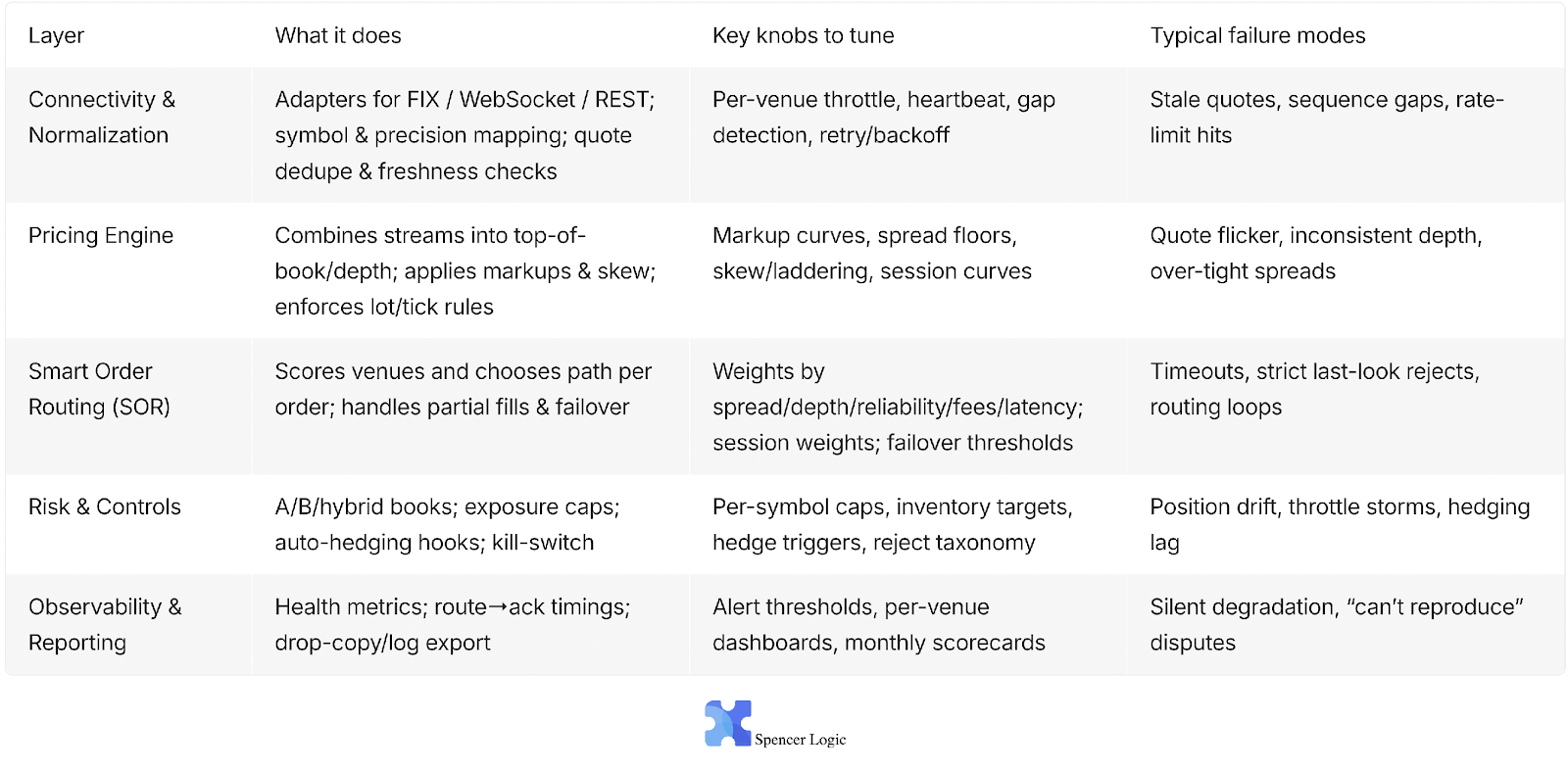
At the heart of this system are three “brains” and one conscience. The pricing engine shapes the quote you show; the SOR chooses the path for each order; risk & controls keep exposure and throttles sane; and observability makes the whole thing legible to business leaders and partners. Below is the stack—clear roles, clear knobs, clear failure modes.

Table 1 — Aggregation stack at a glance

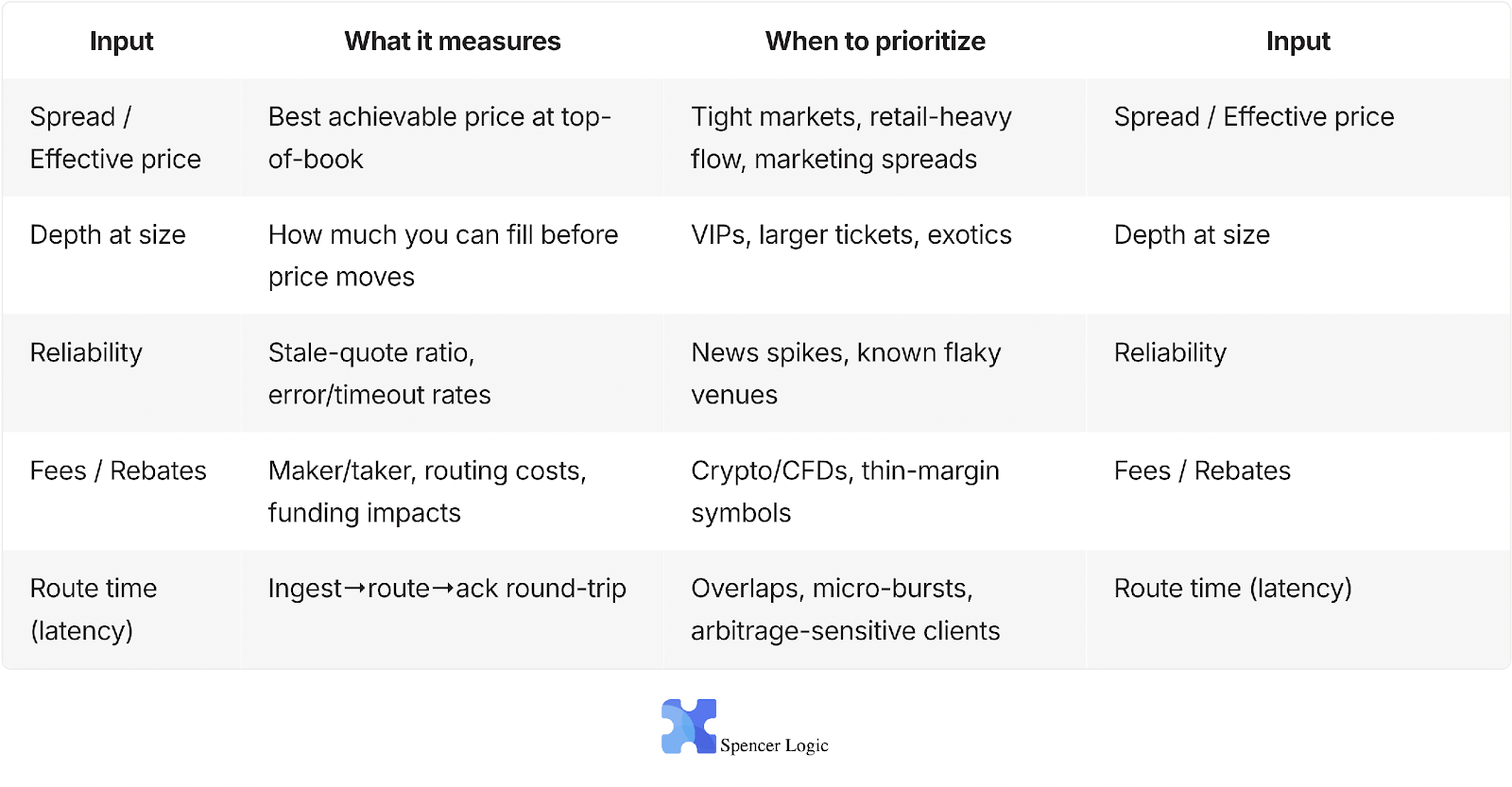
The SOR deserves special attention. It runs a lightweight cost/quality model every time: effective spread, depth at size, venue reliability, fees/rebates, and round-trip route time—tempered by session behavior (Asia/LDN/NY in FX; weekday/weekend in crypto). On prints and micro-bursts, it de-weights streams that start to time out or go stale and fails over pre-emptively. Most importantly, it stays explainable: “Venue X won because spread was tighter, depth met the ticket size, and ack time stayed within threshold.” 

Table 2 — SOR inputs and when to prioritize them

The pricing engine isn’t just arithmetic; it’s diplomacy between your book and the market. It consolidates streams into a tradable ladder, applies inventory-aware skew where it truly lowers hedging costs, and keeps spreads realistic with session curves. Watch quote flicker—it punishes conversion without guaranteeing better fills. Start conservative on floors; tighten with data, not bravado. 

Risk & controls are the quiet hero. Standardize reject taxonomies so ops can act fast. Keep per-symbol caps visible. Define a kill-switch policy you’ve actually rehearsed. None of this matters if you can’t see it, so wire drop-copy and logs into your BI. That’s how you prove outcomes to VIPs and partners—your numbers, your definitions. 

A step-by-step order walk-through

  • Normalize: ingest quotes; dedupe; validate freshness & precision.
  • Price: build top-of-book & depth; apply markups/skew.
  • Score: SOR evaluates venues with current weights & health gates.
  • Route: send; handle partial fills; fail over on ack breaches.
  • Hedge: apply inventory rules (A-book/hybrid); drop-copy.
  • Report: reason codes + timings feed BI KPIs. 

Client A — operating like a top-tier broker/exchange

“We started with ten symbols in shadow mode. Within days we had cleaner reason codes, fewer last-look rejects during overlaps, and a measurable drop in order-to-ack. Our monthly scorecard now tells the story for us—no hand-waving.”
Client A, COO (name withheld)

The KPIs that actually move the business

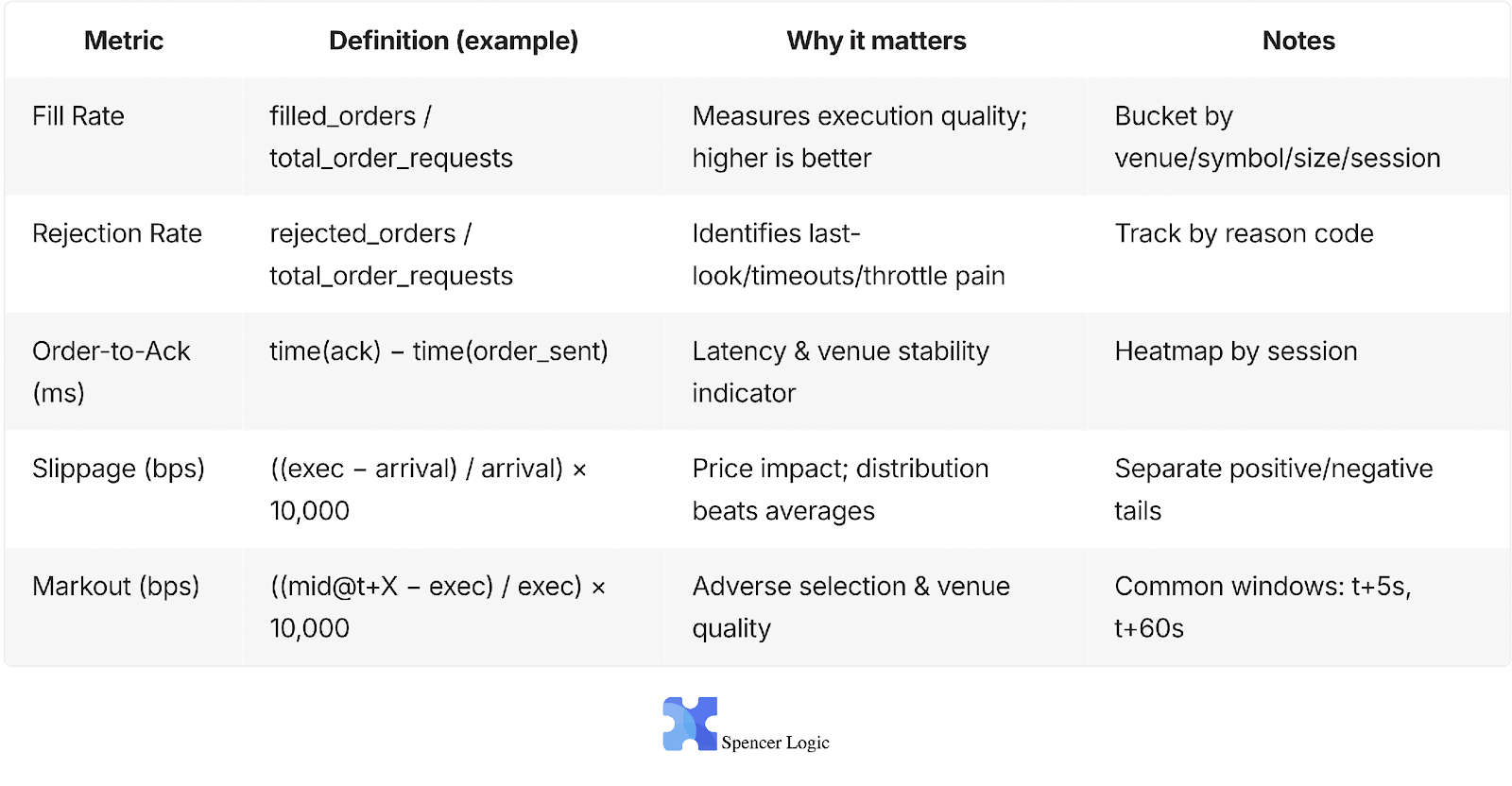
Measure in your existing BI from drop-copy and logs, keep definitions stable, and bucket by venue/symbol/size/session. Then manage the trend lines.

Table 3 — KPI cheat sheet (definitions & why they matter)

How to get live without boiling the ocean

  • Normalize reason codes in week one; ambiguity is the enemy of action.
  • Add session-aware SOR weights before you micro-tune spread floors.
  • Alarm on stale-quote ratio and order-to-ack spikes; these catch most venue incidents early.
  • Roll out behind health gates and let your KPI scorecard decide the next 10% of traffic. 

Bottom line: COOs don’t need a lecture in microstructure; they need predictability under stress and numbers they can defend. Build for explainability, tune with your BI, and keep the client story simple. Your routing becomes a strategy—not a shrug. 

The Chaos and the Cure: How Top Brokers are Unifying Their Multi-Asset Desks

Posted on

By Logic Pulse | The Science of Brokerage Operations

TL;DR for Busy COOs

  • The Problem: Managing separate tech stacks for FX, Crypto, and CFDs (the “Three-Engine Problem”) creates operational chaos, increases risk, and drains resources, especially during volatility.
  • The Solution: A unified Multi-Asset Liquidity Aggregation stack puts one “brain” behind all assets. This centralizes connectivity, smart order routing, risk management, and analytics into a single, robust system.
  • The Proof: Our clients see immediate benefits. As one Head of Ops stated, they replaced constant “fire drills” with a single source of truth, leading to higher fill rates, lower slippage, and a more efficient team.
  • The Path: Integration is fast and safe, taking days, not months. We use a phased go-live process (test, shadow, ramp) so you are always in control.
  • The ROI: Fewer operational emergencies, better execution for VIP clients, and a leaner, more effective ops team focused on growth instead of maintenance.

In the early days of advertising, my mentors taught me a simple, powerful truth: people don’t buy a product. They buy a solution to a problem. They buy relief from a pain point.

And for far too long, the central pain point for multi-asset brokers and crypto exchanges has been the same: a sprawling, chaotic collection of disparate systems. A separate liquidity stack for FX. Another for crypto. A third for CFDs. Each with its own vendor, its own integration quirks, and its own unique way of failing at 3 a.m. on a Saturday.

I call this the Three-Engine Problem. You’ve seen it. It’s the late-night call from a panicked ops team member. It’s the fragile API bridge that breaks every time a vendor pushes an update. It’s the constant scramble to reconcile three different risk reports and three different post-trade workflows. It’s the silent, steady drain on your team’s time and your firm’s profits.

But what if you could put a single, intelligent brain behind all three? A unified command center that handles FX, Crypto, and CFDs with one elegant, robust solution?

This is not a theoretical exercise. It is the practical, profitable reality for firms who have embraced Multi-Asset Liquidity Aggregation.

A Tale of Two Brokers

Let’s consider two firms. The first, Broker B, operates the traditional way. Their FX desk connects via FIX to half a dozen LPs. Their crypto team manages REST and WebSocket feeds from four exchanges. Their CFD desk gets a proprietary feed from a third-party vendor.

Now, imagine the moment volatility spikes.

On Broker B’s floor, three different teams are scrambling. The FX desk is dealing with rejected orders from a last-look LP. The crypto desk is wrestling with an exchange’s rate limits after a sudden market move. The CFD desk is getting hammered by slippage. Three different problems, three different incident playbooks, and three teams trying to communicate with one ops manager who just wants to go home.

Now, let’s look at Client Alpha, a successful brokerage we’ve worked with for over a year. Before they partnered with us, they faced this exact chaos. Their CEO put it simply: “We were spending more time managing vendors than we were managing our clients. Our people were exhausted.”

Today, Client Alpha operates with a single, unified stack. When volatility hits, their ops team follows one workflow. When they need to add a new liquidity provider, it’s a single integration path, not a multi-week project. They have a unified view of their exposure, allowing them to make faster, more confident decisions.

Client Alpha’s Head of Operations shared this with us recently:

“Before, our tech stack was a Rube Goldberg machine. One thing broke, and the whole day became a fire drill. Spencer Logic simplified everything. We now have a single source of truth for all our liquidity, risk, and post-trade data. Our fill rates are up, our slippage is down, and most importantly, my team finally gets to focus on growth. It’s the single best operational decision we’ve made.”

This is the power of a single brain behind three books.

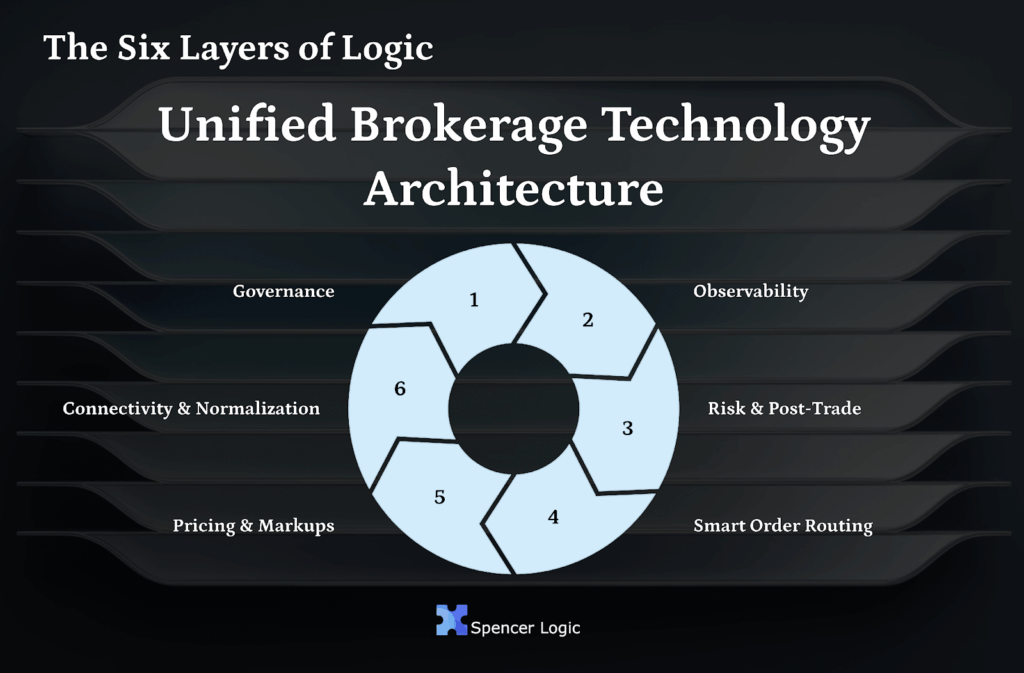
The Anatomy of the Solution: Six Layers of Logic

The solution isn’t magic; it’s methodical. It’s a carefully engineered system that keeps your desks independent yet coordinated.

  1. Connectivity & Normalization: This is the plumbing. It brings raw data from disparate sources into one standard format. FIX for FX/CFDs, REST/WebSocket for crypto, and even optional adapters for DeFi. No more mismatched symbols.
  2. Pricing & Markups: We aggregate depth from all venues. You then apply a single set of markup curves. Your quotes become consistent and fully within your control.
  3. Smart Order Routing (SOR): This is the genius layer. It doesn’t just pick the cheapest venue. It scores each one in real-time based on spread, depth, reliability, and fees, then automatically fails over when a stream degrades.
  4. Risk & Post-Trade: Your A/B/hybrid settings, exposure caps, and hedging rules all live in one place. Logs are fed directly into the BI stack you already use.
  5. Observability: We provide a clear view of the entire system, with alarms mapped to your existing incident playbook.
  6. Governance: You maintain a single, plain-English document explaining your routing logic for each asset class. Simple and transparent.

A Fast Path to Sanity: Integration in Days, Not Months

The most common misconception is that a project of this scale takes months. It doesn’t. We get you live quickly and safely.

  • Day 1-3: Wire Up & Smoke Test. We connect to your core venues and validate the flow of quotes and orders.
  • Day 3-5: Shadow & Tune. We run the system in a shadow mode, comparing performance against your existing setup while you tune the logic.
  • Same Week: Phased Go-Live. You ramp up traffic gradually—10%, 25%, 100%—all behind automated health gates. You are always in control.

The end result? You don’t have to “migrate the world” on day one. You prove the stability on core symbols and expand at your own pace.

This is the power of science over superstition. You don’t have to trust our word; you can measure the superior outcomes for yourself, using your own analytics. It’s about replacing complexity with clarity, chaos with control.

This is the solution to the pain you face every day. It’s not a promise; it’s a proven path to a better business.

X Aggregation: The Journey from Simple to Scalable

Posted on

By Logic Pulse | Spencer Logic Insights Series

Choosing the right liquidity model is one of the most critical decisions an FX broker can make. For many, a single liquidity provider (LP) seems like the straightforward choice: simple to launch, and often cost-effective. But what happens when simplicity becomes a constraint? The real journey for a scaling broker isn’t about finding a single solution, but about building a resilient, adaptable ecosystem that can grow with their business.

Let’s explore the true value of moving from a simple, single-LP setup to a multi-venue aggregation model—not through a technical spec sheet, but through the lens of a broker’s evolution.


TL;DR

  • Effective Pricing: Aggregation introduces price competition across multiple venues , leading to tighter effective spreads.
  • Boost Fill Rates: Unlike a single LP where you’re tied to one set of rules, an aggregator allows you to de-weight or exclude venues with poor fill behavior.
  • Enhance Resilience: A single-LP setup has a single point of failure , while a multi-path aggregator provides failover protection during venue timeouts or stale quotes.
  • Strengthen Your Story: Aggregation helps you build a stronger compliance narrative , and provides the granular data needed to justify your execution quality to IBs and regulators.

The Challenge: When “Simple” Isn’t Enough

A new broker often starts with a single LP, a lean and cost-effective approach. This works well initially. But as their client base grows and includes more sophisticated traders—the VIPs and Introducing Brokers (IBs)—new challenges emerge. The broker starts to receive feedback about widening spreads during volatile moments and a higher-than-desired number of rejections on larger trades.

The problem? A single stream, no matter how good, has its limits. The outcomes are tied to one set of rules, including last-look policies and throttles, which drive a big share of rejects. The broker finds their “simple” solution is now a single point of failure.

The Shift: Embracing Competitive Advantages

The broker decides to make a change. They choose to adopt an aggregation model, not just to add a new tool, but to fundamentally transform their offering. An aggregator consolidates streams from many venues, which are then scored by a Smart Order Router (SOR).

  • Pricing & Depth: Instead of relying on a single price feed, they now have multiple competitive quotes that compress the top-of-book. By combining streams from various venues, they also gain significant depth at size, which improves the quality of large-ticket outcomes and helps to reduce price impact.
  • Fills & Rejections: This is where the true power of aggregation shines. With a Smart Order Router (SOR), the broker can  de-weight or exclude venues with poor fill behavior. They can route away from quotes that are deteriorating, or venues with strict last-look policies. The result? Fewer rejections and higher fill rates, which directly translates to happier, stickier clients and IBs.

Beyond the Numbers: Reliability and Trust

The transition to aggregation isn’t just about optimizing metrics; it’s about building a more resilient and trustworthy business. With a single LP, the path is stable but vulnerable. An aggregator provides a multi-path system with failover logic that automatically handles timeouts or stale quotes from a venue. This means fewer outages and a more reliable trading environment for clients.

For IBs, this move provides a powerful story. They want a visible improvement in fills and slippage for their VIPs. An aggregated model gives you a stronger narrative to share with them, complete with audit trails and the ability to explain why a specific order routed to a certain venue. The broker can even provide a monthly scorecard to IBs, showing transparently their Fill%, Reject%, and Slippage. This is a stronger narrative for both clients and regulators, aligning with principles of the FX Global Code.

The initial costs of infrastructure and monitoring are higher with an aggregator , but for a scaling broker with VIPs and IBs, the better fills at size, resilience, and compliance story often justifies it. This move is about graduating from a simple setup to a model that can support long-term growth.

This is just the second chapter in a series of articles on liquidity aggregation. We invite you to stay tuned for more stories on how to build a stronger and more resilient business.

A Broker’s Guide to Liquidity Aggregation: Moving Beyond Technical Specsv

Posted on

By Logic Pulse | Spencer Logic Insights Series

Every FX broker faces a similar challenge: how to provide the best possible trading experience for clients in a fiercely competitive market. For years, the conversation has been dominated by technical jargon—fill rates, slippage, and complex architecture diagrams. But what if we told you the real story of liquidity aggregation isn’t about numbers and charts? It’s about people, their problems, and the solutions that truly transform their business.

At Spencer Logic, we’ve been helping retail brokers navigate this complex landscape for years. We believe the most powerful insights come from shared experiences, not a list of features. Let us tell you a story about a broker we’ll call “Broker A.”

TL;DR

  • Move beyond metrics: The real value of liquidity aggregation isn’t just about KPIs like fill rates; it’s about solving real-world problems like client complaints and lost business.
  • Embrace reliability: Aggregation acts as a safety net, protecting your business from the single point of failure that comes with a single liquidity provider.
  • Foster client trust: A more reliable system with fewer rejections leads to happier clients and stronger referral flows from Introducing Brokers.
  • Fast, focused integration: Our solutions can be integrated in days, not months, allowing you to quickly improve execution quality without extensive delays.
  • It’s about the story, not the specs: Ultimately, clients and partners want to know that your system is reliable and transparent, not get bogged down in technical details.

The Story of Broker A: A Search for Reliability

Broker A was a successful retail FX broker with a loyal client base. Their operation was solid, but they had a nagging issue: client complaints about order rejections and slow execution, especially during major news events. Their single-LP setup, while simple, left them vulnerable. When that one liquidity provider had an outage or started rejecting more orders, Broker A’s entire business was exposed.

They came to us frustrated. “My best clients are complaining, and I’m losing a few of our high-volume traders every month,” their COO told us. “I’m tired of saying, ‘It’s just market volatility.’ I need a solution.”

This wasn’t a technical problem for them; it was a trust problem. They needed to know their trading platform would be reliable, even when the market was chaotic. Their clients didn’t care about the difference between a Tier-1 bank and a non-bank LP; they cared about whether their trades were executed fairly and quickly.

We worked with them to integrate our liquidity aggregation solution, which pulls from multiple liquidity venues. Our goal wasn’t just to connect their system; it was to build a safety net. This is where the magic of a smart order router comes in. When one venue showed signs of slowing down or became unreliable, our system automatically routed their orders to another venue without missing a beat. This capability is about more than just technology—it’s about adding resilience to your business.

The result? Within a few days of a phased go-live, Broker A’s COO noticed a dramatic reduction in client complaints. Their clients felt the difference: trades that once might have been rejected were now being filled. This improved reliability led to happier clients and a stronger referral flow from their introducing brokers (IBs).

Beyond the Metrics: What Truly Matters

The initial article you read may have mentioned KPIs like Fill Rate and Slippage. While these are valuable for us to monitor behind the scenes, we don’t want our clients to get bogged down in them. Our job is to handle the complexity so you can focus on your clients.

Instead of providing you with a raw data dump, we focus on what really matters: clear, actionable insights. We believe that transparency should be in plain English, not a spreadsheet of technical terms. We give you the confidence to tell your clients: “We’re using a multi-venue system to ensure you get the best execution possible, and we have a built-in safety net.”

In the case of Broker A, the key takeaway wasn’t that their fill rate increased from 95% to 98%. It was that they could finally sleep at night knowing their business was protected from single points of failure.

A Fast-Track to Success

You might be thinking that a project like this takes months. The first article mentioned integration “in days”, and we’ve actually found that to be true, and often even faster for simple setups. We can typically get a broker started with a focused symbol pack in just 1-2 business days, running in a “shadow mode” to ensure everything works perfectly before a full rollout.

This isn’t just a promise; it’s our standard practice, designed to get you up and running quickly so you can start seeing a positive impact on your business.

We look forward to sharing more stories of how Spencer Logic has helped brokers build a more reliable and successful business.

The Most Powerful Weapon for Brokers in an Age of Volatility: The Unavoidable Value of Liquidity Aggregation

Posted on

By Logic Pulse | Spencer Logic Insights Series

Recent headlines have screamed of geopolitical tensions and unprecedented market uncertainty. A new wave of unpredictability is sweeping across global markets, leaving even the most seasoned analysts scrambling for answers. From commodity price shocks to sudden shifts in investor sentiment, the once-reliable patterns of market behavior have been thrown into disarray. This is not just a passing storm; it is a fundamental shift in the trading landscape.

For retail brokers and crypto exchanges, this environment presents a formidable challenge. The old way of doing business—relying on a single liquidity provider and hoping for the best—is no longer a viable strategy. When market volatility surges, single-source liquidity can dry up in an instant, leading to wider spreads, painful slippage, and an inability to execute trades at the best possible price. These are not merely operational hiccups; they are direct threats to your brand reputation, client loyalty, and, ultimately, your bottom line. Your clients, empowered by real-time information, are acutely aware of execution quality. They will not hesitate to move their capital to a brokerage that can deliver tighter spreads and faster, more reliable fills. In this new era, your clients’ trust is built on your ability to perform under pressure.

This is where the true value of robust liquidity aggregation reveals itself. Liquidity aggregation is no longer a luxury for the elite few; it is a critical necessity for any brokerage that intends to survive and thrive. By aggregating multiple liquidity streams from various top-tier providers, you create a deep, resilient pool of capital that can withstand even the most violent market swings. This multi-source approach ensures that even if one provider pulls back, others are ready to fill the void, guaranteeing a seamless trading experience for your clients.

Furthermore, true liquidity aggregation allows you to become a price maker, not just a price taker. With a powerful price engine, you can synthesize the best bids and offers from across your aggregated pool, offering your clients the most competitive prices in the market. This not only improves their trading experience but also gives you a significant edge over competitors who are still operating with outdated, single-source models. The benefit is twofold: your clients gain from superior pricing and execution, and you gain from increased trading volume and a reputation as a broker who prioritizes their success.

In this market, the ability to mitigate risk is just as important as the ability to secure liquidity. A sophisticated risk management system, integrated with your liquidity bridge, allows you to monitor and manage your exposure in real time. You can set granular parameters, manage hedged positions, and protect your firm from unexpected market events. Without these tools, you are essentially flying blind, leaving your firm vulnerable to the very volatility that your clients are seeking to capitalize on. The current market is unforgiving, and a lack of preparation can lead to catastrophic losses.

This is not a theoretical discussion. This is a call to action. The brokers who are prepared for this new reality are the ones who are already investing in technologies that deliver on these promises. They are the ones who will attract new clients and retain their most valuable ones. They understand that the old guard of Wall Street may be baffled by market behavior, but they, the modern, agile brokers, are armed with the tools to dominate it.


A Better Way to Operate: The Spencer Logic Solution

In this chaotic environment, your brokerage or crypto exchange needs more than just technology; it needs a partner. Spencer Logic understands the challenges you face because we have built our entire suite of solutions to solve them. Our technology is not just an add-on; it is the core infrastructure you need to turn today’s market challenges into your greatest opportunities.

Our Liquidity Aggregation solution is engineered to deliver the tightest spreads and deepest liquidity available in the market. We seamlessly connect you to a diverse network of top-tier liquidity providers, ensuring that your clients always get the best possible prices, regardless of market conditions. This is the foundation of a fair and transparent trading environment.

But we don’t stop there. Our advanced Bridging technology, combined with our intelligent Price Engine, ensures that every single order is executed with minimal latency and maximum efficiency. We eliminate the inefficiencies that lead to slippage and client frustration, giving you a competitive edge that builds client trust and boosts trading volume.

Furthermore, our robust Risk Management System provides you with the control you need to navigate this new era of volatility. You can monitor positions, set automated controls, and protect your firm’s capital from undue exposure. This isn’t just about security; it’s about giving you the confidence to grow your business aggressively, knowing you are protected.

The market has changed. The old rules no longer apply. The time to act is now. Do not wait for a catastrophic market event to expose the weaknesses in your current setup. Spencer Logic offers a proven, scalable, and customizable solution that will empower you to not only survive, but to thrive in the face of unprecedented volatility. Let us show you how our technology can make your brokerage stronger, more efficient, and more profitable.