Crypto Exchange Fee Models: Maker-Taker vs Flat Rate vs Tiered — What Actually Works

Posted on

Most brokers launching a white-label crypto exchange copy whatever fee structure the last exchange they used was running. Binance uses maker-taker, so the new exchange uses maker-taker. No one on the team has modeled what that structure actually does to revenue at 800 active traders instead of 8 million.

Fee model selection gets treated as a settings toggle during onboarding. It is not. It is a revenue architecture decision that determines who trades on the platform, how much liquidity gets posted organically, and whether the exchange’s take rate survives contact with a competitor undercutting on price. Get it wrong and the exchange either bleeds margin to a race-to-the-bottom fee war or drives away the exact traders who post the liquidity that makes the order book usable.

Financial Impact: The Same Volume, Three Different Revenue Outcomes

Consider an exchange running 1,800 active traders, processing $4.2M in daily notional volume across a mixed book of majors and mid-cap tokens. This is illustrative, not a specific client figure, but the mechanics generalize.

Flat rate model (0.15% on every trade, maker and taker alike). Revenue is straightforward: $4.2M × 0.15% = $6,300/day, or roughly $2.3M annualized. Simple to communicate, easy for traders to understand, and it requires no order-book classification logic. The cost is that flat rate structures give makers no incentive to post resting liquidity. Traders who would otherwise leave limit orders sitting in the book to earn a rebate instead trade at market, which thins the order book and widens the effective spread traders experience — a cost that shows up in complaints, not in the fee statement.

Maker-taker model (0.02% maker rebate, 0.10% taker fee). Assume 40% of volume executes as maker (a realistic split once rebates start attracting resting orders) and 60% as taker. Maker revenue: $4.2M × 40% × (-0.02%) = -$336/day in rebate cost. Taker revenue: $4.2M × 60% × 0.10% = $2,520/day. Net: $2,184/day, or roughly $797,000 annualized — lower gross revenue than flat rate, but the rebate typically deepens the order book by 15–30% within the first two quarters as market makers and active traders start posting limit orders to capture the rebate. Deeper books reduce slippage, which reduces churn, which is a second-order revenue effect the daily fee number does not capture.

Tiered volume model (0.20% for under $50K/month trailing volume, stepping down to 0.05% above $2M/month). This structure concentrates revenue capture on the long tail of smaller retail accounts while using low fees to retain the handful of high-volume accounts that provide the bulk of order-book depth. On the same $4.2M daily volume, assuming a realistic distribution where 70% of notional comes from accounts in the top two tiers, blended effective rate lands around 0.08–0.09%, producing roughly $3,400–$3,800/day. This model requires the most operational overhead — trailing-volume calculation, tier assignment, tier-change notifications — but it is the structure most retail-facing exchanges converge on once they have enough account history to segment traders meaningfully.

The gap between the lowest and highest annualized revenue estimate above is close to $3M on identical trading volume. That is not a rounding error in a fee schedule. It is the difference between an exchange that funds its own growth and one that runs at breakeven while competitors iterate faster.

The Insight Most Operators Miss

Fee model decisions get made once, at launch, by whoever configured the exchange platform — and then rarely revisited, because changing a live fee structure risks trader backlash. That means the structure chosen in the first 90 days, often copied from a competitor’s public fee page without knowing that competitor’s actual volume mix, becomes the exchange’s revenue architecture for years.

The deeper problem is that fee model and liquidity architecture are not independent decisions. An exchange running internal market making (see SpencerLogic’s guide to launching a white-label crypto exchange) has different fee-model math than one running external LP aggregation, because the exchange itself may be the primary maker on its own book. Choosing maker-taker fees while running 100% external LP aggregation means the exchange is paying rebates to third-party liquidity it does not control, on top of whatever spread markup the LP relationship already captures. That is a double cost most fee-model spreadsheets never model correctly.

The Opportunity: Fee Structure as a Retention Lever, Not Just a Revenue Line

Brokers evaluating a crypto exchange add-on tend to model fee revenue in isolation from client retention. That understates the real value. A tiered structure that rewards a broker’s existing high-volume FX clients with preferential crypto fees — using the same client ID and account tier the broker already maintains for FX — turns the fee schedule into a cross-sell mechanism rather than a standalone crypto product with its own separate economics.

This works because the client segmentation and tiering logic a broker already runs for FX margin and spread pricing can extend directly into the crypto exchange fee schedule, provided the risk and account infrastructure is unified rather than siloed per product. This is the practical case for running crypto fee tiers off the same account infrastructure as FX and CFD tiers rather than a bolted-on separate system.

Practical Breakdown: Choosing and Implementing a Fee Model

Step 1: Model your actual maker/taker split before choosing a structure. Pull trading data from a comparable exchange or, if launching fresh, use the split from the liquidity architecture already selected. An exchange running heavy internal market making will naturally see a higher maker percentage than one leaning on external LP feeds.

Step 2: Price against the competitive set your traders actually compare you to — not the largest global exchanges. A regional or niche exchange competing against Binance on headline fee rate will lose that comparison every time; the more relevant comparison set is other white-label and mid-tier regional exchanges serving the same trader segment.

Step 3: Build in a tier-migration notification workflow before launch, not after the first trader complaint about a fee change they didn’t see coming. Tiered models fail on communication more often than on math.

Step 4: Separate the fee schedule from the spread markup. Traders evaluate total execution cost, not just the posted fee rate. An exchange with a low headline fee but wide effective spreads is not actually cheaper, and sophisticated traders will find this out. Real-time exposure and spread monitoring through a risk management suite makes it possible to track effective cost per trade, not just the fee line, across the client base.

Step 5: Revisit the model quarterly against actual volume distribution, not annually. Trader behavior shifts faster on a newer exchange than the annual-review cadence most brokerages default to from their FX operations.

Step 6: Stress-test the model against a fee war scenario before launch. Regional and mid-tier exchanges regularly cut headline fees to zero for a promotional window to acquire volume from a competitor. Model what happens to the exchange’s own retention and revenue if a direct competitor runs a zero-fee promotion for 60–90 days. Exchanges that have already modeled this scenario can respond with a matched promotion funded by reserves set aside for exactly this purpose, or hold firm on fees while competing on execution quality and spread — but only if that decision was made in advance rather than reactively during the promotion window, when panic pricing tends to erode margin further than the competitive threat justified.

Step 7: Decide in advance how VIP or market-maker agreements interact with the published fee schedule. Most exchanges eventually negotiate custom rebate or fee arrangements with a handful of high-volume market makers whose liquidity underwrites the rest of the book. These agreements should be modeled and capped before the first one is signed — an ad hoc VIP rate negotiated under pressure from a departing market maker sets a precedent that becomes difficult to walk back for the next negotiation.

Soft Positioning

None of this requires building fee-tier logic, rebate accounting, and tier-migration workflows from scratch. The Spencer Exchange platform supports configurable maker-taker, flat, and tiered fee schedules natively, with tier assignment that can pull directly from existing client segmentation data already running for FX and CFD accounts. Combined with liquidity aggregation and the price engine for execution quality that the fee schedule alone can’t fix, this is what an all-in-one white label brokerage solution looks like in practice: fee architecture, liquidity, and risk running on one infrastructure layer instead of three disconnected vendor relationships that each need separate reconciliation.

Not sure which fee model fits your volume profile? Book a demo and we’ll model the revenue impact for your specific trading mix before you commit to a structure.

Exchange Monetization, Modeled

Not sure which fee structure fits your volume profile? Let’s map it in a 30-minute walkthrough.

Maker-taker · Tiered pricing · Revenue modeling

Book a Demo →

Conclusion

Fee model choice is reversible, but it is expensive to reverse — trader trust in fee stability is hard to rebuild once a structure changes without warning. Start with a model that matches the liquidity architecture already in place, price it against the competitors your traders will actually compare it to, and revisit the math every quarter rather than assuming the launch-day structure still fits a year of volume growth. Book a demo and we’ll walk through fee modeling against your actual trader mix before you lock in a structure.

FAQ

What’s the difference between maker-taker and flat rate fee models?

Maker-taker charges different rates depending on whether a trade adds liquidity (maker, resting limit order) or removes it (taker, market order), often with a rebate for makers. Flat rate charges the same fee regardless of order type. Maker-taker incentivizes deeper order books; flat rate is simpler to communicate and administer.

Do tiered fee structures work for smaller exchanges?

Yes, but the tier thresholds need to be calibrated to actual account volume distribution rather than copied from a large exchange’s public schedule. A tier structure built around $1M+/month volume tiers is meaningless if the exchange’s largest accounts trade $200K/month.

How much does a fee rebate program cost in maker rebates?

It depends on maker volume share and the rebate rate chosen, but a common range for smaller exchanges building initial book depth is 0.01–0.03% rebate on maker volume, funded by a correspondingly higher taker fee.

Can fee tiers be linked to FX/CFD account tiers on a multi-asset broker?

Yes, provided the exchange and FX/CFD platforms share underlying client and account infrastructure. This is one of the practical advantages of running crypto exchange operations on the same stack as existing FX operations rather than as a separate bolted-on product.

How often should a fee schedule be reviewed after launch?

Quarterly for the first year, based on actual maker/taker volume split and competitive positioning, then at minimum semi-annually once volume patterns stabilize.

Does the fee model affect regulatory or compliance exposure?

Fee models themselves are not typically a compliance trigger, but fee disclosure requirements vary by jurisdiction, and rebate programs in some markets require specific disclosure to avoid characterization as an undisclosed inducement. Confirm disclosure requirements with counsel for each jurisdiction the exchange serves.

What happens to order book depth if fees are set too high?

Traders — particularly market makers and high-frequency participants who are fee-sensitive by design — route volume elsewhere, thinning the book and widening effective spreads for remaining traders, which can trigger further attrition in a compounding cycle.

Stablecoin Trading on Your Exchange: The Compliance and Tech Checklist Operators Skip

Posted on

Most exchange operators add stablecoin pairs the same way they add any other token: flip a switch in the matching engine, list USDT or USDC against the majors, and move on. That approach works for about a quarter. Then a payment processor freezes a settlement batch pending documentation the exchange never collected, or a regulator asks for proof of reserve attestation the operator assumed the stablecoin issuer handled. Stablecoin trading is not a listing decision. It is a compliance and settlement architecture decision wearing a listing decision’s clothes.

The Financial Impact of Getting This Wrong

Consider a mid-tier exchange processing $40M in monthly stablecoin volume across USDT, USDC, and a regional stablecoin pair. If that exchange has not implemented issuer-specific monitoring, a single Travel Rule compliance gap on transfers above the reporting threshold can trigger a full account freeze from its banking partner while the issue is resolved — typically 5 to 15 business days. At $40M in monthly volume, even a conservative 10-day freeze on 20% of flow represents roughly $2.6M in stalled client funds and, more damagingly, a support queue that turns into a public trust problem within 48 hours.

The reverse cost is smaller but constant: exchanges that over-engineer stablecoin compliance — treating every pair like a high-risk corridor — add friction that pushes volume to competitors with cleaner deposit-to-trade times. The right posture is neither reflexive caution nor casual listing. It is calibrated to the specific stablecoin’s issuance model, redemption mechanics, and jurisdictional exposure.

Run the numbers on a smaller exchange and the exposure looks different but no less material. A $6M-monthly-volume operator running two stablecoin pairs with no issuer-specific monitoring is typically underestimating its Travel Rule exposure by a wide margin, because operators without pair-level analytics tend to assume Travel Rule-eligible transfers are rare edge cases. In practice, once a client base includes even a handful of OTC desks or high-net-worth traders moving size, 15-20% of stablecoin volume by dollar value routinely clears the reporting threshold. Discovering that exposure retroactively, during a banking partner’s periodic review rather than proactively through your own monitoring, is what turns a routine compliance question into a frozen settlement account.

Why Most Operators Miss This

The root issue is that stablecoins are not one asset class. USDC is issued by a regulated entity with monthly attestations and direct redemption rights. USDT operates under a different disclosure regime with less redemption transparency for retail holders. Algorithmic and yield-bearing stablecoins carry depeg risk that fiat-backed tokens do not. Treating all three under a single “stablecoin” listing policy is the single most common failure point exchange operators bring to a compliance review.

A second miss is architectural: many exchanges bolt stablecoin support onto existing crypto-to-crypto listing infrastructure without separating stablecoin flows into their own monitoring lane. Fiat-equivalent instruments need fiat-adjacent controls — enhanced transaction monitoring thresholds, issuer reserve verification, and settlement reconciliation against issuer redemption windows — none of which a generic token-listing pipeline was built to handle.

A third, quieter miss is organizational rather than technical. Compliance teams at most mid-tier exchanges own KYC/AML policy but not issuer relationship monitoring, while the trading desk owns pair economics but has no mandate to track issuer attestation cadence. Stablecoin risk falls into the gap between those two functions. The exchanges that handle this well assign explicit ownership of issuer-level monitoring — reserve attestations, redemption terms, any regulatory action against the issuer — to a single team, rather than assuming it is implicitly covered by general listing due diligence.

The Opportunity

Exchanges that get stablecoin infrastructure right unlock two things competitors without it cannot offer: same-day fiat-equivalent settlement without banking rails, and a credible answer when institutional counterparties ask about reserve verification and Travel Rule handling before routing volume. Under the U.S. GENIUS Act framework and the EU’s MiCA regime, both of which formalize stablecoin issuance and reserve standards, exchanges that built compliant infrastructure early are positioned to onboard institutional stablecoin flow that operators still running ad hoc controls cannot touch. This is a margin lever, not a cost center — properly structured stablecoin rails reduce dependence on traditional banking partners for settlement while opening a client segment that values regulatory clarity over marginal fee savings.

The Practical Breakdown

1. Classify before you list. For each stablecoin under consideration, document the issuance model (fiat-backed, crypto-collateralized, algorithmic), the issuer’s attestation cadence, and direct redemption availability. This classification determines the monitoring tier the pair gets assigned.

2. Build issuer-specific reserve checks into onboarding. Before listing, confirm the issuer publishes reserve attestations on a defined cadence (monthly is standard for major issuers) and establish an internal process to review each new attestation as it publishes — not just at initial listing.

3. Separate Travel Rule infrastructure for stablecoin corridors. Transfers above the applicable jurisdictional threshold require originator and beneficiary information exchange between VASPs. Stablecoin volume concentrates disproportionately in this bracket because it is the preferred instrument for larger transfers — size the Travel Rule infrastructure accordingly, not as an afterthought bolted onto general AML tooling.

4. Reconcile settlement against issuer redemption windows, not just on-chain confirmation. On-chain settlement finality and issuer-side redemption availability are not the same thing. An exchange that treats a stablecoin deposit as immediately withdrawable in fiat before confirming issuer redemption capacity is carrying unhedged settlement risk during any issuer-side disruption.

5. Monitor for depeg exposure on a pair-by-pair basis. Even fiat-backed stablecoins have experienced temporary depegs during banking-sector stress events. Build automated alerting on price deviation from $1.00 par beyond a defined tolerance band, with a pre-agreed trading halt protocol for the affected pair.

6. Document the compliance checklist per stablecoin, not per exchange. Regulators and banking partners increasingly ask for pair-specific compliance documentation, not a blanket exchange-level policy. An operator who can produce a per-instrument compliance file during an audit resolves the review substantially faster than one reconstructing documentation on request.

7. Set explicit internal ownership for issuer monitoring. Assign a single team — typically compliance, with trading desk input on pair economics — to own the ongoing relationship with each stablecoin issuer’s disclosures. Ambiguity about who is watching for issuer-side changes is how attestation gaps go unnoticed for months.

Every one of these steps is a build-and-maintain cost if approached from scratch — reserve monitoring feeds, jurisdiction-aware Travel Rule logic, and depeg alerting are ongoing engineering commitments, not one-time configuration. Exchanges that build this in-house typically underestimate the maintenance burden: issuer attestation formats change, jurisdictional thresholds get revised, and new stablecoin issuance models (yield-bearing stablecoins have grown fastest among crypto instruments over the past year) require the classification framework itself to be extensible rather than fixed at launch.

Stablecoin Compliance, Pre-Built

Still building Travel Rule and reserve monitoring from scratch?

Issuer classification · Reserve attestation tracking · Depeg alerting

Book a Demo →

Where SpencerLogic Fits

Spencer Exchange, SpencerLogic’s crypto exchange engine, ships with issuer-aware stablecoin monitoring built into the compliance layer rather than added as a plugin — reserve attestation tracking, jurisdiction-configurable Travel Rule logic, and automated depeg alerting are part of the same infrastructure that handles KYC/AML for every other listed instrument. Combined with SpencerLogic’s Liquidity Aggregation product, stablecoin pairs draw from the same Tier-1 and prime-of-prime feeds as the rest of the order book rather than requiring a separate liquidity relationship. For operators running FX/CFD alongside a crypto desk, the MT4/MT5 Bridge and Gateway keeps settlement and reporting on one infrastructure layer instead of stitching together a stablecoin-specific vendor on top of an existing stack. This is the same principle behind SpencerLogic’s broader position as an all-in-one white label brokerage solution: compliance-critical infrastructure should be native to the platform, not a patchwork added under deadline pressure after the first audit finding.

Conclusion

Stablecoin trading is not inherently riskier than any other listed instrument — it is differently risky, in ways that generic crypto-listing infrastructure was not built to catch. Operators do not need to treat every stablecoin pair as a maximum-scrutiny corridor, and they do not need to build reserve monitoring and Travel Rule logic from a blank sheet. Start with issuer classification on your current stablecoin pairs, confirm attestation cadence, and build depeg monitoring on the highest-volume pair first. From there, scheduling a demo is the fastest way to see what a fully integrated compliance layer looks like next to what you are running today.

Frequently Asked Questions

What’s the difference between compliance requirements for fiat-backed and algorithmic stablecoins?

Fiat-backed stablecoins from regulated issuers typically require reserve attestation verification and redemption-window reconciliation. Algorithmic and crypto-collateralized stablecoins carry additional depeg risk that needs its own monitoring layer, since there is no direct fiat redemption backstop.

Does the Travel Rule apply differently to stablecoin transfers than other crypto assets?

The Travel Rule applies at the same jurisdictional thresholds regardless of asset type, but stablecoin volume concentrates more heavily in the affected size bracket because stablecoins are the preferred instrument for larger transfers, making dedicated Travel Rule infrastructure more operationally important for stablecoin corridors specifically.

How often should we review a stablecoin issuer’s reserve attestations?

At minimum, on the same cadence the issuer publishes them — monthly for most major issuers. Treat each new attestation as a live compliance event requiring review, not a formality to file away.

Can we list a stablecoin without direct redemption rights for our users?

Yes, this is common, but it changes your settlement risk profile. If your users cannot redeem directly with the issuer, your exchange is the sole point of fiat-equivalent liquidity for that pair, which increases the operational importance of your own reserve and liquidity monitoring.

What triggers a depeg trading halt, and who decides?

Set an automated price-deviation threshold from $1.00 par (commonly 1-2% sustained deviation) that triggers an alert, with a pre-agreed internal protocol for who authorizes a trading halt and under what conditions trading resumes. Deciding this in advance, rather than during a live depeg event, is what separates an orderly response from a chaotic one.

Do MiCA and the GENIUS Act require the same compliance controls?

No — they are separate frameworks with different reserve, disclosure, and licensing requirements. Exchanges operating across both EU and U.S. client bases need jurisdiction-aware compliance logic rather than a single unified policy, since a control that satisfies one regime may not satisfy the other.

How does stablecoin compliance interact with our existing KYC/AML stack?

It should extend it, not duplicate it. Stablecoin-specific monitoring — reserve checks, depeg alerts, Travel Rule thresholds — sits alongside your existing KYC/AML infrastructure and should share the same case management and reporting pipeline rather than running as an isolated system.

Crypto Exchange Matching Engine: How Order Books Work at Scale

Posted on

Most brokers evaluating a white-label crypto exchange spend their diligence budget on liquidity sourcing, custody, and compliance tooling. The matching engine — the component that actually decides whose order fills, at what price, and in what order — gets a line item and little else. That’s backwards. Everything downstream of the matching engine, including the liquidity you’ve paid for and the risk controls you’ve configured, depends on how that engine behaves under load.

This isn’t a theoretical concern. It’s the difference between an exchange that holds its spreads during a volatility spike and one that produces client complaints, chargebacks, and a support queue that doesn’t clear until Monday.

The Financial Impact of Getting This Wrong

Consider an exchange operator running 2,500 active crypto traders with average daily notional volume of $8 million. During a normal session, order flow is manageable — a few hundred orders per second at peak, well within the tolerance of almost any matching engine on the market.

The problem surfaces during correlated volatility events: a major token delisting rumor, a macro data print, a whale liquidation cascading through perpetuals. Order flow can spike 15-30x above baseline in these windows — exactly the moment clients need reliable execution and exactly the moment a weak engine degrades. A queue that adds even 200 milliseconds of latency under load turns a fillable limit order into a rejected one. At scale, that’s measurable in lost fills, not just annoyance.

Run the numbers on a single bad event: if 5% of orders during a volatility spike fail to execute or execute at a materially worse price due to engine lag, and the exchange processes $500,000 in notional during that 20-minute window, the realized slippage cost to clients — and the resulting support tickets, chargebacks, and churn — can run into the tens of thousands of dollars. Multiply that across a handful of volatility events per quarter and the matching engine stops being an infrastructure footnote and becomes a P&L line.

The cost doesn’t stop at the immediate slippage. Every failed or poorly filled order during a high-visibility volatility event generates a support ticket, and support tickets during exactly these windows are the most expensive to resolve — clients are frustrated, the event is fresh, and screenshots of a competitor’s clean execution during the same window are already circulating in trading communities. A broker’s crypto desk can absorb a mediocre matching engine for months of quiet trading and then lose a meaningful share of its most active traders in a single bad afternoon, because active traders are precisely the segment most likely to notice execution quality and most likely to have accounts open elsewhere to compare against.

There’s also a second-order cost that’s easy to miss in the initial diligence phase: engine weakness under load doesn’t stay contained to the crypto book. On a multi-asset platform where FX, CFD, and crypto share infrastructure or reporting layers, a crypto matching engine that falls behind during a spike can delay exposure updates across the shared risk dashboard, meaning your risk desk is working from stale data for FX and CFD positions at the exact moment market-wide volatility makes accurate exposure data most critical.

Why Most Brokers Miss This

The reason matching engine quality gets under-scrutinized is that it performs identically to a weak engine 95% of the time. Under normal, low-volume conditions, almost any engine on the market processes orders correctly and quickly enough that the difference is invisible. Brokers doing vendor diligence tend to test with demo accounts and light order flow — precisely the conditions where engine quality doesn’t matter.

The failure mode only appears under load, and by the time an operator discovers it, clients have already experienced it. This is the inverse of most technology diligence problems, where issues surface early and get fixed before launch. Matching engine weakness is a landmine that detonates during your highest-volume, highest-visibility moments.

The Opportunity: Engine Quality as a Retention Lever

Framed correctly, matching engine architecture is not a cost center to minimize — it’s a competitive differentiator that most competitors aren’t marketing because most competitors haven’t tested it under real stress. A broker who can credibly say “our exchange holds execution quality during volatility” is making a claim that active crypto traders — the segment most worth retaining — actually value and actively test for by placing orders during known volatile windows.

This matters more as multi-asset brokerages compete for the same traders who already run FX and CFD books elsewhere. Those traders have a baseline expectation for execution reliability from their primary platform. A crypto exchange that can’t meet that bar becomes a liability to the broker’s overall retention, not just a standalone product line.

There’s a compounding effect worth naming explicitly: traders who experience clean execution during a volatile session tend to increase their allocated capital and trading frequency on that platform afterward, because the event functioned as an unplanned stress test the platform passed. The inverse is equally true — a bad fill during a widely-discussed volatility event doesn’t just cost the immediate trade, it resets the trader’s confidence baseline and often triggers a deliberate reduction in position sizing or an active search for an alternative venue. Matching engine quality is therefore not just a retention lever in the abstract; it’s one of the few product attributes that active crypto traders can and do test for themselves, on their own schedule, without needing the broker to market it.

Practical Breakdown: What to Evaluate Before You Commit

Three architectural decisions determine whether a matching engine holds up at scale.

Throughput capacity under sustained load, not peak burst. Vendors quote peak orders-per-second figures measured in short bursts under ideal conditions. What matters operationally is sustained throughput during a 10-20 minute volatility window with realistic order cancellation and modification rates layered in. Ask for load-test results under sustained, not burst, conditions, and ask specifically what happens to latency as the order queue grows rather than just whether the engine “handles” a given order rate.

Order type breadth and behavior under contention. Limit, market, stop-limit, and standard time-in-force variants are table stakes. The differentiator is how the engine behaves when multiple order types compete for the same book depth simultaneously — whether stop orders trigger cleanly during fast markets or introduce their own latency cascade as they convert to market orders in bulk.

CLOB architecture versus hybrid market-making models. A Central Limit Order Book, where all orders match on transparent price-time priority, is the institutional standard and the model most FX-native traders already understand from their primary platform. Hybrid models that embed an internal market-making layer alongside CLOB matching exist and can improve depth in thin books, but they require explicit disclosure to clients and introduce execution-quality questions that a pure CLOB avoids. Know which model you’re deploying and be prepared to explain it.

Order book depth visibility and monitoring. A matching engine can be technically sound and still produce poor client outcomes if the exchange doesn’t surface book depth clearly enough for traders to gauge slippage risk before submitting size. Beyond the client-facing view, the operator-side monitoring matters just as much: your ops team needs real-time visibility into queue depth, fill latency, and rejection rates, not a daily batch report. If a problem is developing during a live volatility event, the difference between catching it in minutes versus discovering it from client complaints the next morning is entirely a function of whether your monitoring tooling surfaces engine health in real time.

Beyond the engine itself, verify how it integrates with the rest of your risk stack — specifically whether exposure data updates in real time as fills occur, or whether there’s a reconciliation lag that leaves your risk desk working from stale positions during exactly the high-volume windows when accurate exposure data matters most.

Real-time exposure monitoring — an all-in-one white label brokerage solution that keeps your FX, CFD, and crypto books under a single risk framework rather than reconciling three separate systems after the fact — closes that gap by design rather than as an afterthought.

Ready to see how your exchange holds up under simulated volatility? Book a demo and we’ll walk through load-test results and engine architecture in 30 minutes.

Matching Engine Due Diligence

Does your exchange hold up during a real volatility spike?

CLOB architecture · Sustained throughput · Real-time risk sync

Book a Demo →

The path from evaluation to production doesn’t require a rebuild. On the Spencer Exchange platform, matching engine architecture, order book configuration, and risk integration are pre-built into the same stack you’re already running FX and CFD flow through — configuration work, not infrastructure work, and typically live within days rather than the months a from-scratch build requires.

Conclusion

You don’t need to solve every matching engine question before launch. Start with the load-test question — sustained throughput, not burst capacity — since it’s the single test most vendors haven’t been asked and the one most likely to surface a gap before your clients do. From there, CLOB versus hybrid architecture and real-time risk integration follow naturally as part of the same evaluation.

Book a demo and we’ll walk through your current exchange stack — or the one you’re evaluating — against these three criteria.

FAQ

What is a matching engine in a crypto exchange?

A matching engine is the software component that processes incoming buy and sell orders against the order book and executes fills based on a defined priority algorithm, most commonly price-time priority under a Central Limit Order Book model.

How fast should a crypto exchange matching engine be?

Latency requirements depend on the trading profile you’re serving. Retail-focused exchanges can operate reliably at sub-100 millisecond order processing, while exchanges serving algorithmic or high-frequency flow require sub-millisecond performance. The more relevant benchmark than raw speed is latency consistency under sustained, high-volume load.

What’s the difference between CLOB and hybrid matching models?

A CLOB matches all orders transparently on price-time priority with no internal market-making layer. Hybrid models blend CLOB matching with an internal market maker that can fill orders directly, which can improve depth in thin books but requires disclosure and introduces execution-quality considerations that a pure CLOB doesn’t have.

Can a matching engine handle both spot and derivatives trading?

Yes, provided the engine architecture separates order book instances per instrument while sharing a common risk and margin layer. This is standard in institutional-grade exchange infrastructure and lets an operator launch spot trading first and add perpetuals or options later without a re-architecture.

How do I test a matching engine before committing to a vendor?

Request load-test results under sustained order flow — not burst capacity — that simulate a realistic volatility scenario: elevated order submission, cancellation, and modification rates sustained over 10-20 minutes. Ask specifically how latency behaves as the queue grows, not just whether the engine processes the target order rate.

Does matching engine choice affect regulatory compliance?

Indirectly. Regulators in most jurisdictions expect brokers to demonstrate fair and orderly execution, and a CLOB’s transparent price-time priority is easier to document and defend than a hybrid model’s internal fill logic during an audit or client dispute.

Should a broker build a matching engine in-house or use a white-label solution?

For brokers without existing exchange infrastructure, building in-house typically requires 12-18 months and a dedicated engineering team before the engine reaches production-grade reliability under load. A white-label platform with a pre-built, load-tested matching engine compresses that timeline to days for configuration against an existing broker stack.

How to List New Tokens on Your Exchange: The Legal and Technical Checklist

Posted on

A brokerage running a white-label crypto exchange gets a listing request almost every week. A client wants a memecoin. An IB wants exposure to a new Layer-2 token their community is trading. A partner exchange lists something and asks why it isn’t live on yours.

Most operators handle this the same way: someone on the team checks if the token trades on a major exchange, pulls a price feed, and flips it live. No formal review. No documented rationale. No compliance sign-off.

This works until it doesn’t. A listed token turns out to be a low-liquidity asset with a single dominant holder. The price gaps 40% on thin volume, client positions get liquidated at prices nobody could have hedged against, and the operator is now explaining to angry clients — and possibly a regulator — why an asset with those characteristics was ever listed.

Financial Impact

Consider a brokerage running an exchange with 3,000 active crypto traders. A single rushed listing of a low-liquidity token generates a support and remediation cost that’s easy to underestimate until it happens.

If that token gaps 35% in an hour on $200,000 of notional client exposure and the exchange had no circuit breaker or position limit in place, the operator is looking at a realistic combination of $15,000–$40,000 in client compensation and dispute resolution, plus the harder-to-quantify cost of client attrition. Brokers report losing 8–15% of active traders in the 90 days following a badly handled listing incident, driven mostly by clients who lost confidence in the platform’s risk controls rather than the token itself.

Compare that to the cost of running each listing through a structured review: roughly 3–6 hours of team time per token, using a repeatable checklist. At a fully loaded cost of $60–$90/hour for a compliance-and-risk resource, a properly vetted listing costs $200–$550. The asymmetry is the entire argument: a few hundred dollars in review time against tens of thousands in incident cost, before counting churn.

Token Listings, Standardized

Still listing tokens one spreadsheet at a time? Let’s map your listing workflow to a repeatable process.

Matching engine config · Risk overlays · Compliance templates

Book a Demo →

Insight

Most brokers don’t skip listing review because they don’t know it matters. They skip it because their existing infrastructure makes it slow. If adding a token means a developer manually configuring a new feed, a risk analyst building a one-off exposure model in a spreadsheet, and a compliance officer chasing down documentation with no standard template, the path of least resistance is to skip steps under commercial pressure — especially when a competitor already lists the asset and clients are asking.

The operators who avoid this treat token listing as a repeatable workflow, not a one-off project. The checklist doesn’t need to be exhaustive to be effective. It needs to be fast enough that following it is faster than skipping it.

Opportunity

A structured listing process is not just a risk control — it’s a growth lever. Brokers who can list a vetted, liquid token within 48 hours of a credible client request capture trading volume that would otherwise migrate to a competitor or an external exchange. Slow, ad hoc listing processes cost brokers volume every time a client has to wait two weeks for an asset that a faster-moving exchange already offers.

Practical Breakdown

Step 1 — Liquidity and market data screen. Confirm the token trades on at least two reputable venues with combined 24-hour volume above a minimum threshold (most operators set this at $2–5 million to avoid manipulation-prone thin markets). Pull historical volatility data — a token with average daily moves above 15% needs tighter position limits from day one, not after the first incident.

Step 2 — Legal and regulatory classification. Determine whether the token could be classified as a security under the rules of your operating jurisdiction. This matters more in MiCA-regulated EU markets and less in offshore jurisdictions like SVG or Vanuatu, but the review should happen regardless of jurisdiction — regulatory posture changes, and a token classified as a utility asset today can be reclassified later.

Step 3 — Custody and wallet configuration. Confirm hot and cold wallet support for the token’s chain standard (ERC-20, BEP-20, native chain, etc.), and test withdrawal processing on a small volume before opening the listing to full client trading.

Step 4 — Matching engine configuration. Set tick size, minimum order size, and price bands appropriate to the asset’s typical volatility. A token with a $0.0001 price needs different tick granularity than a $60,000 token — get this wrong and the order book either shows unusable spreads or accepts orders that create unintended slippage.

Step 5 — Risk overlay and position limits. Set per-client and aggregate exposure caps for the new listing before it goes live, not after volume ramps. Real-time exposure monitoring should treat every new listing as a distinct risk bucket until enough trading history exists to calibrate normal behavior.

Step 6 — Soft launch and monitoring window. Open the listing to a limited client segment or with reduced position limits for the first 48–72 hours. Watch fill rates, slippage, and any unusual order patterns before opening to full volume.

Soft Positioning

Doing this manually, per token, across spreadsheets and ad hoc developer requests is exactly the workflow that causes operators to skip steps under pressure. An all-in-one white label brokerage solution with the matching engine, risk management suite, and developer toolkit integrated into a single stack turns this six-step process into a templated workflow rather than a fire drill. Tick size and price band configuration happen through the same exchange platform used to launch the exchange itself. Position limits and exposure caps route through the same real-time risk engine already monitoring FX and CFD books, so a new token listing doesn’t require a parallel risk framework — it slots into the one already running.

Building this listing infrastructure from scratch — a custom risk overlay, a bespoke compliance documentation system, matching engine configuration tooling — typically takes 6–10 weeks of engineering time for a team building it in-house. On a pre-integrated white-label exchange stack, the same listing workflow is operational in days, because the risk engine, matching engine, and compliance templates already exist and only need configuration per asset, not construction from zero.

Not sure your current listing process would survive a compliance audit? Book a 30-minute walkthrough and we’ll map the gaps.

Conclusion

Token listing doesn’t need to be either reckless or bureaucratic. A six-step checklist run consistently protects the book, keeps regulators satisfied, and — because it’s fast — still lets a broker move at the speed clients expect. Start with the liquidity and volatility screen on your next listing request; everything else in this checklist becomes easier once that gate is in place.

Schedule a demo to see how SpencerLogic’s exchange, risk, and compliance tooling handle listing workflows end to end.

FAQ

How long should a token listing review take?

With a standardized checklist, most listings can be fully reviewed — liquidity, legal classification, custody, and risk configuration — within 3–6 hours of team time, not counting the soft-launch monitoring window.

What’s the minimum liquidity threshold for a safe listing?

Most operators set a floor of $2–5 million in combined 24-hour volume across at least two reputable venues, though this should scale with your exchange’s own typical trade sizes.

Do I need a lawyer to review every token?

Not every token needs individual legal counsel, but every token needs a documented classification review against your operating jurisdiction’s current rules — this can often be handled by a compliance team member using a standard template, escalating only ambiguous cases to counsel.

What happens if a listed token later gets reclassified as a security?

This is why the legal review step should be repeated periodically, not just at listing. Operators who document their original classification rationale are in a materially stronger position if a regulator later challenges a listing.

Can I list a token without cold wallet support?

Technically yes, but it’s not advisable for any listing expected to hold meaningful client balances. Hot-wallet-only custody increases security exposure disproportionately to the convenience gained.

How does this differ from listing on a CFD platform versus a spot exchange?

CFD listings are notional and don’t require custody or wallet infrastructure — the review is mostly a liquidity and volatility check. Spot exchange listings add custody, wallet configuration, and on-chain compliance monitoring that CFD instruments never touch.

Should tick size and price bands be the same for every token?

No. Tick size should scale with the token’s typical price and volatility. A high-price, low-volatility asset can use tighter tick increments than a low-price, high-volatility token, where overly fine granularity creates unusable order book noise.


Crypto Surge 2.0: The Genius Act Is Lighting a Fire—Are You Ready to Scale or Fail?

Posted on

New U.S. legislation is reigniting the crypto boom — but are brokers and exchanges ready on the backend?

Read more

By Logic Pulse | Spencer Logic Insights Series

Just days ago, the U.S. House of Representatives sent shockwaves through the digital asset world by passing the “Genius Act”, a Trump-endorsed bill that reframes crypto regulation in ways we haven’t seen in years. If you’re a broker or crypto exchange operator, this is not just another headline. It’s a red flashing signal: The next wave is coming — and it’s coming fast.

The Genius Act is being called the most crypto-friendly legislation since the early ICO boom. It redefines digital assets, reduces taxation friction, and — perhaps most critically — gives U.S. financial institutions new freedom to re-engage with digital asset infrastructure.

And whether you’re based in Singapore, Dubai, London, or Seoul…you need to understand this is a global market signal, not a U.S.-only affair.


What’s in the Genius Act — and Why It’s a Wake-Up Call for Brokers

At its core, the Genius Act represents a strategic recalibration of how crypto assets are defined, taxed, and integrated into the U.S. financial system — and by extension, the global trading landscape.

Here’s what it does:

🔹 Reclassifies many digital assets as commodities rather than securities
This narrows the SEC’s reach and clears up regulatory gray zones. It opens the door to new listings, revives dormant projects, and accelerates the launch of crypto-based derivatives like CFDs on a global scale.

🔹 Exempts small crypto transactions from capital gains taxes
By removing the tax burden on microtransactions, the act fuels retail adoption — from lightning payments to DeFi tokens — driving more on-platform activity and volume.

🔹 Encourages U.S. banks to custody and settle crypto assets
With banks re-entering the space, institutional-grade liquidity, custody, and clearing infrastructure are coming online — bringing deeper books, tighter spreads, and new cross-market opportunities.

So what does this really mean if you’re running a brokerage or crypto exchange?

It means that crypto is not just back — it’s being given a clean legal runway to go bigger, faster, and broader than ever before. With regulatory fog lifting and capital flow barriers dissolving, you’re about to see an explosion in client activity, asset volatility, and liquidity fragmentation.

But here’s the catch: most brokers and exchanges aren’t ready for the structural demands of a full-speed bull market. Legacy FX systems patched for crypto won’t cut it. Ad hoc routing logic, isolated books, and post-trade-only risk systems will buckle under pressure.


Lessons from the Last Bull Run

Let’s not forget the chaos of 2021–2022. We saw:

  • Latency breakdowns during peak hours.
  • Fragmented order routing leading to slippage nightmares.
  • Book mismanagement due to missing real-time hybrid risk monitoring.
  • Retail flight from platforms that couldn’t execute cleanly on mobile.

Clients don’t care about your excuses. They care about their fill price, execution speed, and user experience.


Where Brokers Are Vulnerable in 2025

As crypto bounces back into the mainstream — now with political fuel — here are the weak links being exposed:

Liquidity Fragmentation
Without a proper aggregator, more venues = more chaos. You miss the best price, or worse, overexpose to rogue quotes.

Latency in Execution
Retail flow is going mobile, fast. If your routing system isn’t optimized for high-frequency burst volume, you’ll miss fills or get stuck in retry loops.

No Real-Time Risk Layer
In a 5% hourly swing market, you can’t afford to audit risk at end-of-day. Your system must see P&L in real time — and act on it.

Inflexible Tech Stack
Still using a patched-together FX system for crypto flow? You’re already 2 steps behind. Crypto requires multi-venue, multi-asset, multi-mode architecture.


The Smart Ones Are Already Rebuilding
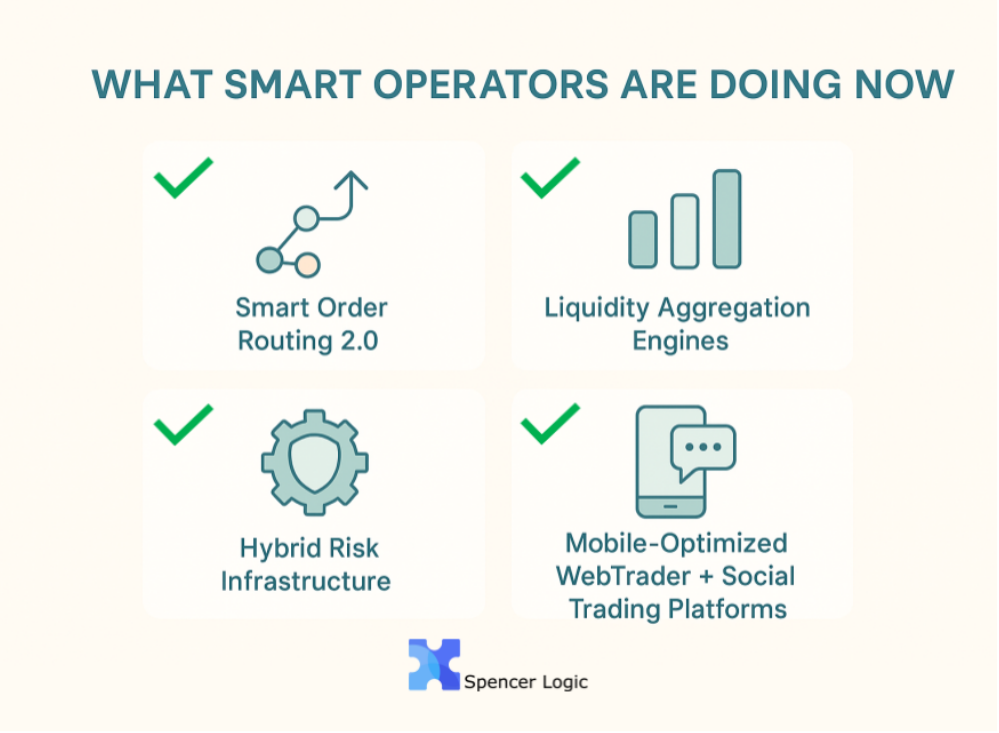
Forward-thinking brokers are already retooling their backend stack:

Smart Order Routing 2.0
Routing logic that dynamically prioritizes based on latency, fee structure, and depth — across centralized and decentralized exchanges.

Liquidity Aggregation Engines
One-click access to consolidated crypto book liquidity, with automatic failover and price smoothing to reduce slippage.

Hybrid Risk Infrastructure
FX + Crypto books monitored on the same screen, same system, with customizable margin thresholds and instant liquidation triggers.

Mobile-Optimized WebTrader + Social Trading Platforms
Because if you don’t own the retail UI, someone else will.


This Is Bigger Than Bull Market FOMO

This isn’t just about riding the crypto wave. It’s about surviving the next round of user expectations.

The Genius Act opens the door for legacy finance to re-enter the space. That means more competition — not just from other brokers, but from full-stack fintechs with Silicon Valley-grade infrastructure.

To win this round, you need infrastructure that doesn’t just scale. It needs to preempt risk, self-optimize routing, and empower your clients to trade across any asset with confidence.


The Spencer Logic Take

At Spencer Logic, we see this for what it is: a regulatory unlock, not just for the U.S., but for the entire crypto brokerage ecosystem.

Our core mission is helping brokers future-proof their backend — whether you’re FX-native expanding into crypto, or a crypto exchange looking to add derivatives and margin trading.

Our solutions include:

  • Smart Order Router & Aggregator for crypto and FX
  • Real-Time Risk Management across hybrid books
  • Custom WebTrader & Broker Portal for mobile-first execution
  • Social Trading & Invest Platforms to retain the new generation

Final Thought

If you’re still operating like it’s 2020, you’re going to drown in 2025.

This isn’t just a rally — it’s a paradigm shift, and the winners will be the brokers who saw it coming.


Want to see how your current stack performs under bull-market conditions?
Book a Free Infrastructure Stress Test with Spencer Logic