The Future of Liquidity Bridging: AI, Crypto Derivatives, and Tokenized Assets
Posted on
TL;DR
Liquidity bridges are evolving from static routers into AI-driven execution engines.
Future systems will unify FX/CFD liquidity with crypto derivatives, DeFi AMMs, and tokenized-asset venues.
Tokenized collateral will enable cross-asset margining and greater capital efficiency.
AI-powered compliance and transparency will become mandatory for regulatory trust.
Spencer Logic is developing next-gen, multi-asset, intelligence-driven bridging technology.
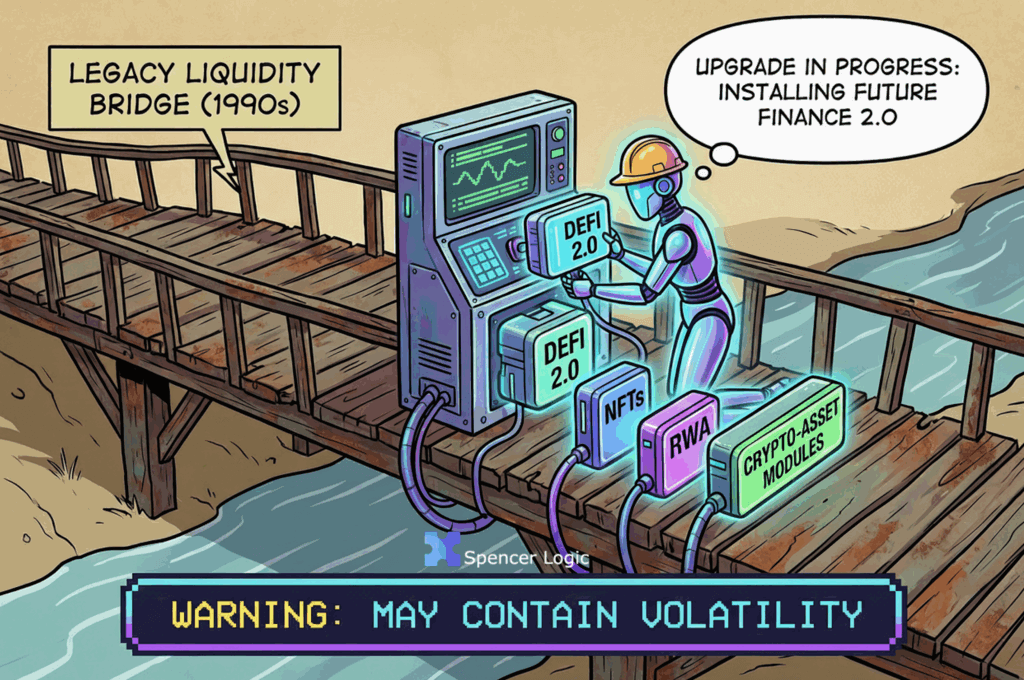
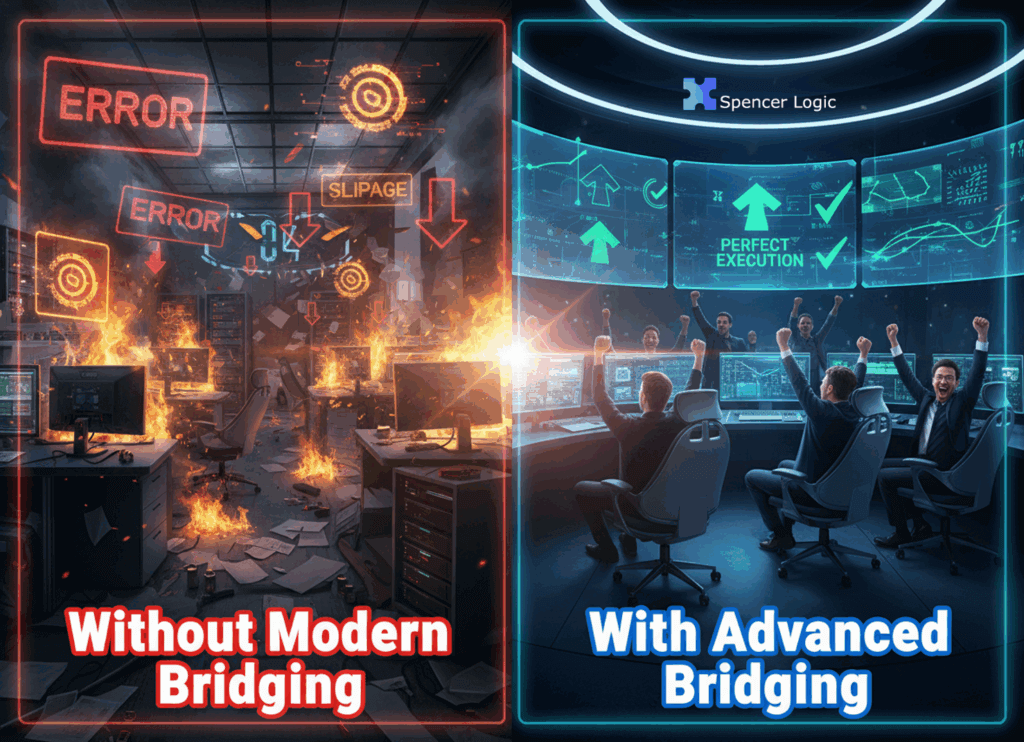
Financial markets are in the midst of a structural transformation. The boundaries between traditional finance and digital assets are dissolving, and with them, the technology that connects brokers to liquidity must evolve. The next generation of liquidity bridges will not simply route orders — they will think, learn, and adapt in real time.
This final article in our bridging series explores the future of bridging technology: the rise of AI-driven routing, the integration of crypto derivatives and tokenized assets, and the convergence of decentralized and centralized liquidity.
AI-Driven Execution Intelligence
Machine learning is already reshaping liquidity management. Future bridges will incorporate predictive analytics that evaluate liquidity provider performance continuously, adjusting routing decisions before issues arise.
Imagine a bridge that identifies patterns — such as LPs whose latency spikes during news events — and reroutes flow proactively. Over time, the bridge builds a performance model for every liquidity venue, creating a self-optimizing execution ecosystem.
Spencer Logic’s research team is pioneering this evolution. Our prototype systems leverage real-time data to score liquidity providers, enabling brokers to allocate order flow dynamically based on historical reliability, not static rules.
Bridging Into the Digital Asset Ecosystem
Crypto derivatives, perpetual swaps, and tokenized instruments are becoming mainstream trading products. Yet, most legacy bridges were designed exclusively for FX and CFDs, with rigid data structures unsuitable for on-chain or exchange-based liquidity.
The next generation of bridging will unify these worlds. A broker’s bridge will connect not only to Tier-1 liquidity providers but also to crypto exchanges, on-chain AMMs, and tokenized-asset venues. It will standardize APIs across centralized and decentralized liquidity, allowing traders to access both from the same interface.
This multi-venue architecture requires new risk models, especially for custody and settlement. Bridges will integrate wallet management, margin synchronization, and real-time collateral tracking to ensure secure, compliant operation across all asset types.
Tokenization and the Rise of Universal Collateral
Tokenized assets are redefining how capital moves. Whether tokenized U.S. Treasuries, equities, or commodities, each introduces new liquidity dimensions that brokers can access through enhanced bridging.
Future bridges will support tokenized collateral management — allowing brokers to post, receive, and track margin in digital assets. This will improve capital efficiency and enable cross-asset trading where crypto holdings can collateralize FX or CFD positions.
Spencer Logic envisions bridges as liquidity gateways rather than simple connectors: platforms that abstract away the complexity of blockchain settlement while maintaining institutional execution quality.
Regulation and Transparency
As asset classes converge, regulatory frameworks will evolve to demand even greater transparency. AI-enhanced bridges will automate compliance by generating real-time audit logs, trade attestations, and market surveillance reports.
The capacity to demonstrate best execution across centralized and decentralized venues will become a defining competitive advantage. Brokers using intelligent bridges will not only meet compliance standards but exceed them, offering institutional investors unprecedented trust in execution integrity.
The Human Element Remains
Despite automation, one principle remains unchanged: trust. The bridge will continue to serve as the technological manifestation of that trust between brokers, clients, and liquidity partners. Technology can replace friction, not relationships.
For brokers, success in the future market will depend on choosing partners who combine engineering expertise with market understanding — those capable of navigating both traditional and digital ecosystems with equal precision.
Conclusion
Liquidity bridging is entering a new era — one defined by intelligence, interoperability, and transparency. The brokers who embrace this evolution early will define the standards of tomorrow’s markets.Spencer Logic is committed to leading that transition. Our bridging technology is evolving into an AI-driven, multi-asset platform built to connect the liquidity of the future. To learn how we can prepare your brokerage for the next generation of markets, visit Bridging Solution.
Risk Management and A/B Book Execution in Liquidity Bridging
Posted on
TL;DR
A-book, B-book, and hybrid models depend on smart routing — and bridging makes that automation possible.
Real-time exposure dashboards enhance capital efficiency and hedging precision.
Bridges provide audit trails essential for regulatory compliance and dispute protection.
Spencer Logic’s bridging engine unifies execution, risk, and transparency into a single intelligent framework.
Risk is at the core of every brokerage operation. How a broker manages exposure — whether by internalizing trades (B-book), passing them to liquidity providers (A-book), or blending both (hybrid) — defines not just profitability but also stability. Liquidity bridging technology is the infrastructure that makes this balance possible.
This article examines how modern bridges empower brokers to control risk dynamically, achieve regulatory compliance, and protect both client trust and capital efficiency.
The Foundations of A-Book and B-Book Models
An A-book broker routes all client trades directly to liquidity providers or the open market. The broker earns revenue from commissions or markups but carries minimal exposure. In contrast, a B-book broker internalizes client trades, effectively acting as counterparty and profiting from client losses — but also assuming risk when clients win.
A hybrid model blends the two: smaller, less sophisticated trades might stay internal, while larger or profitable traders are hedged externally.
Without bridging, managing these models efficiently is nearly impossible. A liquidity bridge provides the routing logic, order tracking, and execution feedback necessary to automate decisions about which trades go where — all in real time.
Dynamic Risk Allocation Through Bridging
Modern bridges allow brokers to define risk rules at granular levels — per account, symbol, or trade size. For example, a broker can route EUR/USD orders over 1 lot to external liquidity while keeping smaller ones internal. The bridge executes this logic automatically, ensuring consistent risk exposure without manual intervention.
This dynamic risk allocation minimizes hedging costs while maintaining execution quality. It also prevents over-hedging, a common problem for brokers relying on manual risk transfers.
Real-Time Exposure Monitoring
Transparency is essential in risk management. Bridges like Spencer Logic’s include live dashboards that display total exposure by symbol, LP, or client segment. Brokers can monitor hedging efficiency, analyze open positions, and rebalance exposure dynamically throughout the day.
This continuous monitoring enables better capital management. Instead of waiting for end-of-day reports, brokers make decisions based on live market data, maintaining tighter control over margin requirements and liquidity usage.
Bridging and Compliance Alignment
Regulatory bodies increasingly require brokers to demonstrate best execution and fair dealing, even within B-book structures. A bridge creates the audit trail regulators expect — time-stamped order data, routing destinations, and fill confirmations.
These records also protect brokers from disputes. When a client questions an execution, the bridge’s detailed log provides irrefutable evidence of timing and pricing, minimizing reputational and legal risk.
The Strategic Role of Hybrid Execution
Pure A-book or B-book models rarely remain static. As brokers scale, they often transition toward hybrid execution to optimize profitability and client experience.
The bridge serves as the orchestrator of this hybrid model. It analyzes trader profiles, evaluates risk exposure, and automatically reassigns order flow between internal and external paths as conditions evolve.
Spencer Logic’s system employs advanced routing rules that account for client behavior and volatility, giving brokers the flexibility to fine-tune profitability without sacrificing transparency.
Conclusion
Risk management in modern brokerage is not about eliminating exposure but managing it intelligently. Liquidity bridging transforms risk control from a manual, reactive process into an automated, data-driven discipline.
Spencer Logic empowers brokers to strike the perfect balance between performance and protection — integrating A-book, B-book, and hybrid models into one seamless framework. To learn how bridging can elevate your risk strategy, explore our Bridging Solution.
The Economics of Bridging: Cost, ROI, and Broker Profitability
Posted on
TL;DR
A modern bridging system is a revenue amplifier, not just a technical cost.
Operational automation lowers staffing needs, errors, and support overhead.
Better execution quality boosts trader retention and lifetime trading volume.
Spencer Logic’s bridge delivers measurable ROI with improved fill rates, latency cuts, and seamless integrations.
Behind every thriving brokerage lies a careful balance between technology investment and operational efficiency. The pursuit of faster execution, tighter spreads, and stable infrastructure often comes with tangible costs — but when implemented strategically, these costs transform into measurable returns. Liquidity bridging is a textbook example: it requires initial setup, maintenance, and integration, yet its impact on execution quality, trader retention, and overall profitability is exponential.
Understanding the economics of bridging means understanding how technology drives revenue at every stage of the broker lifecycle. This article breaks down the financial logic behind modern bridge infrastructure — why it pays for itself, how it scales, and how brokers can quantify its ROI in clear, actionable terms.
Bridging as a Profit Center
Most new brokers view a bridge as an expense — an unavoidable piece of middleware necessary to connect to liquidity providers. But that perspective is incomplete. The bridge is not a cost center; it is a profit amplifier. Each improvement it introduces — tighter pricing, faster fills, reduced rejections — ripples through the broker’s P&L.
Consider slippage reduction alone. If your brokerage executes 100,000 trades per day and the average slippage decreases by just 0.3 pips due to better bridging, the impact is substantial. Over a month, that marginal improvement can translate into tens of thousands of dollars in retained spread or reduced hedging losses. Multiply that by growing trade volume, and the ROI compounds naturally.
In short, bridging is an investment that scales with success. The more volume you handle, the greater the return.
Cost Structure and Hidden Efficiencies
The direct costs of a bridging system include licensing, setup, hosting, and ongoing support. But the hidden costs of not having an advanced bridge are much larger. Without efficient routing, brokers face higher rejection ratios, manual trade corrections, client disputes, and increased staff time spent on reconciliation.
In financial terms, the bridge automates what would otherwise require a larger dealing desk. It minimizes operational errors and support overhead, freeing staff to focus on strategy and growth rather than troubleshooting.
Furthermore, a modern bridge like Spencer Logic’s integrates seamlessly with CRM, risk management, and reporting tools — eliminating the need for multiple vendors and redundant systems. When evaluating ROI, brokers should calculate the total cost of ownership (TCO), not just the license fee.
Revenue Impact Through Execution Quality
Execution quality directly correlates with trader retention. Numerous studies show that traders who experience consistent fills and predictable spreads are more likely to increase their trading volume. Each millisecond of reduced latency, each fraction of a pip saved, enhances the perceived reliability of the broker.
This reliability turns into recurring revenue. Traders who trust their broker’s infrastructure don’t just stay longer; they trade more. That compounding activity increases commission income for ECN brokers and spread-derived revenue for market makers.
Therefore, the ROI of bridging extends beyond technical metrics. It influences brand perception, client satisfaction, and ultimately lifetime customer value (LTV).
Reducing Risk Costs
Bridging also protects profitability by improving risk management efficiency. With clear visibility into order routing and exposure, brokers can manage their A-book and B-book balance dynamically. This reduces unhedged positions and prevents slippage-based losses during volatile periods.
When execution becomes faster and more predictable, the broker’s hedging process aligns more closely with client execution, minimizing exposure mismatch. This synchronization not only safeguards capital but also allows more flexible hedging strategies — translating into better capital utilization and higher margins.
Quantifying ROI: A Simple Framework
To measure the return on bridging technology, brokers can analyze three core indicators:
Execution Speed: Average latency reduction (in milliseconds) and its impact on slippage.
Operational Efficiency: Reduction in manual interventions, support tickets, and reconciliation tasks.
Client Retention & Volume Growth: Increase in active trader lifetime and average monthly trading volume post-bridge implementation.
When these data points are tracked consistently, the ROI calculation becomes clear: bridging not only reduces costs but amplifies revenue streams.
The Spencer Logic Advantage
Spencer Logic’s bridging architecture was built from the ground up to deliver measurable economic value. Our partners report improvements in fill rates exceeding 10–15%, latency reductions of over 30%, and a consistent decrease in client support overhead within months of deployment.
By combining speed, transparency, and automation, Spencer Logic transforms bridging from a technical utility into a strategic asset that directly drives profitability.
Conclusion
The economics of bridging are straightforward: every improvement in execution precision, latency, and transparency compounds into long-term financial gain. In a market where spreads are shrinking and competition intensifies, brokers can no longer afford inefficiencies hidden within their technology stack.A modern bridge is not a luxury; it’s the engine of profit optimization. Spencer Logic delivers that engine — a low-latency, data-driven bridge that turns connectivity into a measurable ROI advantage. Learn more about how our Bridging Solution can improve your bottom line through superior execution and operational efficiency.
Integrating a Liquidity Bridge With MT4 and MT5: A Broker’s Technical Roadmap
Unified system for liquidity, risk, and compliance.
Multi-asset scalability with 24/7 operational support.
Future-ready: connects to traditional & digital markets.
For brokers, the quality of execution defines the brand. Clients may initially choose a broker for spreads or promotions, but they stay for speed, stability, and trust. The backbone of that performance lies in the seamless connection between the trading platform and external liquidity. And at the center of that connection stands one critical piece of infrastructure: the liquidity bridge.
Among the most widely used platforms in the industry — MetaTrader 4 and MetaTrader 5 — each offers unique strengths, architectures, and integration challenges. Successfully connecting them to institutional liquidity through a bridge requires not only technical knowledge but also a clear operational strategy. This article provides a deep dive into how bridge integration works for each platform, the challenges brokers encounter, and how a modern bridging system like Spencer Logic’s resolves them.
Why Integration Quality Matters
Every trading platform provides an interface for order execution, charting, and client management. But these interfaces were never meant to handle direct institutional routing on their own. They rely on an external connector — the bridge — to communicate with liquidity providers, prime-of-prime partners, or aggregators.
Poor integration creates hidden costs. Latency increases when the bridge and platform exchange data inefficiently. Order mismatches appear when symbol mapping or pricing precision is inconsistent. Reporting gaps emerge when trade confirmations fail to synchronize correctly between the two systems. The result is an experience where traders sense something “off” — delayed confirmations, inconsistent slippage, or inaccurate account metrics.
In contrast, a properly integrated bridge functions invisibly. Orders move in milliseconds, trade histories align perfectly, and pricing remains stable across instruments. The technical challenge for brokers is to make that invisibility consistent across all platforms they support.
Integrating a Bridge With MT4
MetaTrader 4 remains one of the most popular retail trading platforms, largely due to its simplicity and vast EA ecosystem. However, it was designed in an era when most brokers operated as market makers rather than true liquidity intermediaries. Connecting MT4 to external liquidity requires bridging technology to fill that structural gap.
The bridge communicates between the MT4 Server and liquidity providers through FIX API or proprietary protocols. Integration typically involves the following key components:
Server Plug-in: Installed on the MT4 server, the plug-in captures incoming orders and passes them to the bridge.
Bridge Core Engine: Processes these orders, translates them into FIX messages, and sends them to the designated liquidity venue.
Execution Response: Once filled, trade details return through the same path and update the MT4 client terminal in real time.
This process seems straightforward but requires precise calibration. Each liquidity provider has unique symbol naming conventions, pricing decimal structures, and minimum trade sizes. The bridge must harmonize all of this data to prevent rejections or misquoted prices.
A professional-grade bridge also handles partial fills, requotes, and order aggregation, ensuring that MT4’s internal representation of open positions remains synchronized with external execution results.
Spencer Logic’s bridge architecture was specifically designed to simplify these integrations. Automated symbol mapping, dynamic price precision adjustment, and intelligent reconciliation algorithms eliminate the manual labor and risk that plagued earlier-generation connectors.
Integrating a Bridge With MT5
MetaTrader 5 (MT5) was developed as the evolution of MT4, adding multi-asset capability, hedging/netting modes, and an updated API. Yet, for all its modern features, MT5 integration presents a different set of challenges.
Unlike MT4, which relies heavily on plug-ins, MT5 offers a native gateway interface for liquidity connection. A bridge can communicate through the MetaTrader Gateway API, which allows external systems to act as liquidity endpoints.
Integration with MT5 typically follows this flow:
Orders from the MT5 Server are passed to the Gateway Plug-in, customized for the broker’s liquidity configuration.
The gateway interacts directly with the bridge engine, converting MT5 orders into FIX or API calls compatible with liquidity providers.
Fill confirmations are transmitted back, updating MT5 positions, balance, and exposure data.
Because MT5 is multi-asset by design, the bridge must manage instruments with varying tick sizes, contract specifications, and price feeds. Crypto pairs, metals, and indices can coexist within the same environment, each requiring its own liquidity source.
Spencer Logic’s bridge supports MT5 through a dedicated gateway module built for multi-asset routing. It automatically classifies order types, applies symbol-specific routing rules, and normalizes P&L reporting across instruments. The system also offers real-time risk dashboards, allowing brokers to visualize their A-book and B-book exposures directly from the bridge interface.
The combination of MT5’s flexibility and a robust bridging layer gives brokers institutional-grade control over both execution and risk management.
See the integration in action
Spencer Logic’s bridge connects MT4 and MT5 to institutional liquidity out of the box.
Symbol mapping · Sub-ms execution · Compliance-ready audit logs
Integrating a bridge across MT4 and MT5 introduces technical complexity beyond simple connectivity. Each platform has unique data models, order types, and reporting structures. For brokers running multi-platform operations, maintaining consistency becomes a constant challenge.
Symbol Mapping: Each platform may represent the same instrument differently — for example, “EURUSD.” vs “EUR/USD.pro.” Without automated mapping, trades can be rejected or misrouted.
Latency Coordination: Different platforms handle network communication asynchronously, creating micro-delays that can affect execution fairness.
Risk Consolidation: Exposure across platforms must be aggregated accurately to maintain proper hedging ratios.
Reporting Harmonization: Account histories, balance updates, and swaps need to remain synchronized across systems to avoid client confusion.
Spencer Logic addresses these issues through an abstraction layer that standardizes data before it enters the bridge’s routing engine. All platforms communicate through a unified schema, ensuring that trades look and behave identically regardless of origin.
Security and Compliance in Bridge Integration
Bridging is not just about speed — it’s about trust. Every order passing through the bridge carries financial data that must be protected. Modern bridge integrations employ end-to-end encryption, TLS-secured FIX sessions, and IP whitelisting to prevent unauthorized access.
For regulated brokers, compliance auditing is equally vital. Bridges must generate immutable execution logs, record timestamps with microsecond precision, and archive trade data for years as required by MiFID II, ASIC, or FCA standards. Spencer Logic’s compliance engine automates this process, creating tamper-proof audit trails that satisfy both internal reviews and external regulators.
This level of transparency transforms the bridge from a technical connector into a compliance ally, ensuring that every trade meets not only performance standards but also legal obligations.
Operational Considerations During Deployment
Bridge integration is not a one-time installation; it is an operational process involving configuration, testing, and continuous optimization.
The most successful integrations follow a structured roadmap:
Assessment: Define which liquidity sources and execution models (A-book, B-book, hybrid) the broker will use.
Configuration: Map instruments, establish routing logic, and synchronize account parameters.
Testing: Execute latency benchmarking, rejection analysis, and reconciliation tests under load.
Deployment: Roll out the live bridge with monitoring dashboards active from day one.
Iteration: Continuously refine routing and aggregation rules based on live performance metrics.
Spencer Logic supports brokers throughout this lifecycle. Our deployment team provides sandbox environments for pre-launch testing, ensuring that by the time the bridge goes live, performance metrics already meet institutional benchmarks.
Multi-Asset, Multi-Platform Scalability
The true challenge for modern brokers is not just connecting one platform but scaling across multiple. A broker may start with MT4, expand to MT5, and later add proprietary web terminals. Without a flexible bridging layer, each expansion becomes a new integration project — costly and time-consuming.
Spencer Logic’s architecture was designed to prevent this scenario. Once connected to our bridge, additional platforms or liquidity providers can be added modularly, with no downtime or data migration. The same routing engine and performance analytics apply universally.
This scalability allows brokers to evolve their business without technical disruption — a vital advantage in an industry where new asset classes and trading technologies emerge constantly.
The Human Element: Support and Monitoring
Even the most advanced bridge architecture requires skilled oversight. A broker’s dealing desk and technical team must understand the bridge’s dashboards, routing logic, and alerts. Real-time monitoring enables them to detect anomalies before they affect clients.
Spencer Logic provides 24/7 operational support with access to latency reports, liquidity performance scoring, and execution diagnostics. These insights empower brokers to maintain institutional standards of uptime and transparency, even with lean internal teams.
Why Unified Integration Matters for Clients
To traders, all that matters is whether the platform performs consistently. They don’t care which bridge is in use or where liquidity comes from — but they immediately notice inconsistencies. A properly unified bridge integration eliminates those inconsistencies entirely.
When latency, symbol mapping, and reporting align across MT4 and MT5, the client experience becomes seamless. Spreads remain predictable, slippage minimal, and trade histories accurate. This consistency not only retains traders but also reduces support costs, as fewer clients contact the help desk about execution discrepancies.
Integration quality, in other words, is invisible success — noticed only when it’s missing.
The next generation of trading infrastructure is moving toward universal API-based platforms, where bridges won’t merely connect to MT4 or MT5 but to any venue supporting standardized protocols. Spencer Logic’s roadmap already anticipates this shift, with connectors for REST, WebSocket, and emerging decentralized exchange protocols.
In the near future, brokers will be able to extend their liquidity networks beyond traditional FX and CFD markets to include tokenized assets, on-chain derivatives, and synthetic instruments — all routed through the same bridge interface. Integration will remain the foundation, but its scope will broaden to encompass the entire spectrum of digital markets.
Conclusion
Integrating a liquidity bridge with MT4 and MT5 is far more than a technical exercise — it is the process of aligning your brokerage’s technology, risk management, and client experience into one cohesive ecosystem. Done correctly, it delivers not only faster execution but also consistency, transparency, and scalability across all platforms.
Spencer Logic’s bridging architecture was engineered for exactly this challenge. With native connectors for all major platforms, multi-asset support, and institutional-grade compliance and monitoring, it provides brokers with a unified foundation for growth.
Whether you operate on MT4, MT5, or multiple platforms, your success depends on the same principle: seamless, intelligent connectivity.
Prime-of-Prime Liquidity Bridging: A Practical Playbook for Emerging Brokers
Posted on
TL;DR
Core Takeaway: Emerging and mid-tier brokers access institutional markets through Prime-of-Prime (PoP) providers, and the key technology enabling this connection is the Liquidity Bridge.
The Bridge as the Access Gateway: The liquidity bridge forms the technical link between a broker’s trading servers and the PoP’s infrastructure, enabling seamless and secure order transmission and execution management.
Building a Multi-PoP Strategy: Brokers should connect to at least two PoP providers, routed intelligently through their bridge, to ensure price competitiveness, risk diversification, and operational continuity.
Execution Quality and Transparency: The bridge provides detailed logs and time-stamped reports necessary for best-execution reporting and reinforces trust with the PoP provider through mutual transparency.
Managing Credit and Exposure: A sophisticated bridge integrates pre-trade risk controls (margin checks, exposure limits) to protect both the broker and the PoP from over-leveraging and credit breaches.
Conclusion: For emerging brokers, Prime-of-Prime liquidity is the gateway to institutional markets—but technology determines how effectively that gateway operates. A robust liquidity bridge is the key enabler that transforms access into performance.
Every broker wants access to deep liquidity — the kind that allows tight spreads, instant execution, and smooth hedging. Yet few realize that this level of liquidity is not sourced directly from Tier-1 banks or major exchanges. Most retail and mid-tier brokers obtain institutional market access through Prime-of-Prime (PoP) providers, and the technology that enables this connection is the liquidity bridge.
Understanding how bridging interacts with Prime-of-Prime relationships is crucial for any broker aspiring to scale. This article serves as a practical playbook: how PoP liquidity works, how bridging facilitates it, and how emerging brokers can build a reliable, scalable infrastructure around it.
From Prime Brokerage to Prime-of-Prime
Traditional prime brokerage relationships were reserved for large financial institutions capable of maintaining multi-million-dollar balances. Smaller brokers, even if technologically advanced, could not meet those credit and collateral requirements. The rise of the Prime-of-Prime model changed that landscape.
PoPs act as intermediaries. They maintain direct relationships with Tier-1 banks and major liquidity venues, then extend that access to smaller brokers under their own credit umbrella. Brokers effectively “borrow” institutional access through the PoP, executing trades at near-institutional prices without needing Tier-1 scale.
This arrangement requires sophisticated connectivity — and that is where bridging technology enters the picture.
The Bridge as the Access Gateway
The liquidity bridge forms the technical link between a broker’s trading servers and the PoP’s liquidity infrastructure. It transmits trade requests via FIX or proprietary APIs, manages order acknowledgments, and synchronizes execution results back to the platform.
A well-designed bridge ensures that these transactions occur seamlessly and securely. It maintains session persistence, encrypts order flow, and supports multiple PoP connections simultaneously. This multi-PoP capability gives brokers redundancy and access diversity, which in turn protects them from pricing gaps or provider downtime.
Without bridging, brokers would require custom integrations for every PoP relationship — a complexity that quickly becomes unsustainable as they scale.
Building a Multi-PoP Strategy
Relying on a single liquidity provider creates dependency risk. Prices can widen, connections can fail, and fill ratios can deteriorate. Emerging brokers should design their infrastructure with at least two PoP connections from the outset, routed intelligently through their bridge.
This multi-PoP approach brings several advantages:
Price Competitiveness: Aggregating quotes from multiple PoPs results in tighter spreads and better execution.
Risk Diversification: Exposure to one counterparty is reduced.
Operational Continuity: If one PoP experiences latency or outages, the bridge instantly reroutes to another.
In Spencer Logic’s architecture, brokers can define routing priorities, allocate order flow percentages, or apply dynamic rules based on live performance metrics — ensuring the system always selects the optimal liquidity path.
Onboarding and Integration
Working with a PoP provider typically involves technical onboarding — FIX session setup, symbol mapping, and routing configuration. A flexible bridge simplifies this process dramatically. Instead of editing multiple configuration files, brokers manage integrations through a centralized dashboard.
Spencer Logic’s bridging environment allows quick onboarding of new PoPs with minimal downtime. The system validates symbol consistency, synchronizes account parameters, and performs latency benchmarking before going live. This structured onboarding process shortens the time between signing a liquidity agreement and offering improved execution to clients.
Execution Quality and Transparency
PoP relationships thrive on transparency. Brokers must be able to demonstrate to both regulators and clients that orders are routed and executed fairly. The bridge provides this transparency through detailed logs, time-stamped at each stage of the order lifecycle.
Execution reports include route selection, response time, fill price, and any partial executions. This data supports best-execution reporting and internal analytics while reinforcing trust with the PoP provider, which can also monitor performance on its end.
Such mutual visibility turns the PoP-broker relationship from a black box into a measurable partnership.
Managing Credit and Exposure
One of the defining features of a Prime-of-Prime arrangement is that the PoP extends its institutional credit to the broker. This introduces risk management considerations that the bridge must respect.
A sophisticated bridge integrates pre-trade risk controls: margin checks, exposure limits, and credit line validation. Before an order routes to the PoP, the bridge confirms that sufficient collateral exists. These controls protect both parties — preventing over-leveraging by the broker and avoiding credit breaches that could strain the relationship.
In Spencer Logic’s system, credit controls are configurable at the account or group level, allowing brokers to tailor limits based on client segment, strategy type, or time of day.
How Bridging Strengthens PoP Relationships
A reliable bridge does more than connect to a PoP; it enhances the overall quality of the partnership. When execution data shows stable latency, low rejection rates, and consistent fill quality, PoPs gain confidence in the broker’s order flow. That confidence can translate into preferential spreads, faster onboarding for new instruments, or higher credit thresholds.
In this way, the bridge indirectly increases the broker’s negotiating power. The more predictable and transparent your flow, the more valuable you become to liquidity providers.
Compliance and Reporting
Regulatory frameworks such as MiFID II, ASIC RG 227, and FCA’s best-execution standards all emphasize transparency and auditability. When your brokerage operates through a PoP, regulators expect you to maintain clear records of how orders were routed and executed.
Modern bridges automatically log every FIX message, acknowledgment, and execution report. These records feed directly into transaction cost analysis (TCA) dashboards, enabling compliance teams to verify that client orders consistently achieved the best available price.
Such reporting capability turns regulatory compliance from a manual burden into an automated by-product of daily operations.
Preparing for Institutional Partnerships
Many retail brokers aim eventually to evolve into institutional service providers or white-label hosts. Building that capability starts with demonstrating robust infrastructure. A proven Prime-of-Prime bridging setup — audited, stable, and scalable — is often the first requirement institutional partners evaluate.
By investing early in professional bridging architecture, emerging brokers create a foundation that satisfies institutional expectations later. The same technology that connects to PoPs today can support direct clearing relationships or liquidity redistribution in the future.
The Spencer Logic Advantage
Spencer Logic’s bridging stack was designed with the Prime-of-Prime ecosystem in mind. It provides native multi-PoP connectivity, per-route latency monitoring, and credit-aware routing — all wrapped in a low-latency architecture that supports FX, metals, indices, and crypto instruments simultaneously.
Our solution reduces integration time, simplifies reporting, and enhances liquidity relationships through transparency and automation. Whether you manage one PoP or ten, the system scales effortlessly while maintaining microsecond-level execution fidelity.
Conclusion
For emerging brokers, Prime-of-Prime liquidity is the gateway to institutional markets — but technology determines how effectively that gateway operates. A robust liquidity bridge is the key enabler that transforms access into performance.
By investing in modern bridging architecture, brokers gain not just connectivity but control: the ability to manage multiple PoPs, monitor execution quality, and comply with increasingly complex regulations. More importantly, they position themselves as credible, scalable participants in the institutional ecosystem.
Spencer Logic empowers brokers to build that foundation from day one. Our bridging solutions deliver the speed, transparency, and flexibility needed to thrive in the Prime-of-Prime era. Explore the full capabilities of our Bridging Solution and learn how it can accelerate your path to institutional-grade performance.
Reducing Slippage and Latency for FX Brokers With a Modern MT4/MT5 Bridge Architecture
Posted on
TL;DR
Speed = Trust: In modern trading, milliseconds decide client loyalty — low latency and minimal slippage are core to broker credibility and profitability.
Modern Architecture: Multi-threaded, co-located, and intelligently routed bridges eliminate bottlenecks, delivering near-zero execution delay.
Continuous Optimization: Real-time analytics and adaptive routing automatically detect and fix latency sources, ensuring consistent fill quality.
Spencer Logic Advantage: Sub-millisecond performance, 99.99% uptime, and self-learning optimization make it an institutional-grade bridging solution.
In electronic trading, milliseconds define competitiveness. A few years ago, traders tolerated modest delays or price deviations; today, they abandon brokers the moment execution feels inconsistent. As algorithmic and high-frequency trading continue to dominate, execution speed and stability have become the most measurable expressions of trust. The infrastructure that governs these micro-moments is the liquidity bridge — the unseen yet decisive layer between a broker’s trading platform and the world’s liquidity venues.
Modern bridge architecture has evolved from a simple connector to a performance engine capable of reducing latency, minimizing slippage, and maximizing fill quality. For brokers, understanding how bridge design affects these outcomes is no longer a purely technical issue; it is a business imperative that directly determines retention, spreads, and brand reputation.
The Cost of Delay
Latency refers to the time taken for an order to travel from a trader’s platform to a liquidity provider and back again. Even a few extra milliseconds can lead to execution at less favorable prices, particularly during volatile market events. When the market moves before an order is filled, the result is slippage — the difference between the expected price and the actual execution price.
For market makers and A-book brokers alike, slippage is expensive. It distorts P&L, increases hedging costs, and frustrates clients. In an environment where spreads are razor-thin, controlling latency becomes synonymous with protecting profit margins.
For forex and CFD brokers running MT4 or MT5, the liquidity bridge is the single most consequential piece of trading infrastructure most traders never see.
Why Traditional Bridge Architectures Fall Short
Legacy bridges were often designed when trading volumes were lower and infrastructure simpler. They relied on single-threaded processing and generic network protocols that introduced unnecessary delay. Data compression, logging, and translation layers were frequently placed in the execution path, slowing down order transmission.
Moreover, these systems lacked intelligent monitoring. When latency spiked due to network congestion or provider issues, there was no real-time adaptation. Orders queued, fills delayed, and brokers absorbed the reputational cost.
In contrast, modern bridges are purpose-built for distributed execution environments. They combine multi-threaded processing, proximity hosting, and asynchronous communication to ensure that the bridge adds almost no measurable latency to the trading cycle.
Anatomy of a Low-Latency Bridge
A high-performance bridge architecture rests on three pillars: connectivity, processing, and routing intelligence.
Connectivity begins with colocation. The bridge should be physically hosted near major liquidity venues — London (LD4), New York (NY4), Tokyo (TY3), or Singapore (SG1) — to reduce round-trip time. Direct cross-connects to liquidity providers avoid the unpredictable hops of public internet routes.
Processing involves efficient data handling. Orders must bypass unnecessary layers of abstraction. Memory-resident message queues, kernel-bypass networking, and optimized FIX engines allow the bridge to process thousands of messages per second without bottlenecks.
Routing intelligence ensures that once data moves quickly, it also moves wisely. A bridge with built-in smart order routing constantly evaluates which LP offers the fastest and most stable execution path, dynamically adjusting during volatility or outages.
Together, these components form an infrastructure where order execution happens not only fast but predictably — a distinction that defines institutional-grade performance.
LOW-LATENCY BRIDGING FOR FX BROKERS
See how Spencer Logic’s sub-millisecond bridge architecture can cut your slippage — in a 30-min walkthrough.
Reducing slippage is not only about speed; it is about precision and feedback. A well-engineered bridge collects granular data on every transaction: timestamp at order receipt, routing destination, time-to-acknowledgment, and final fill price. By analyzing this data in real time, brokers can pinpoint the sources of slippage — whether it arises from LP performance, network latency, or internal routing logic.
Bridges designed by Spencer Logic include performance dashboards that display these metrics in microsecond resolution. This level of visibility allows brokers to make informed adjustments: replacing underperforming LPs, refining routing rules, or rebalancing aggregation priorities. Over time, this closed feedback loop transforms execution optimization into a continuous process rather than a reactive one.
Adaptive Routing and Latency Compensation
Modern bridge architecture goes beyond static routing tables. Adaptive routing uses machine learning and predictive modeling to anticipate which venues are likely to respond fastest given current market conditions. If one LP’s latency increases by 30%, the bridge reroutes orders automatically without human intervention.
Latency compensation mechanisms also help synchronize execution timing between geographically distant venues. By timestamping every order event, the bridge can adjust routing to equalize latency across regions, ensuring fair fills for all traders regardless of server location.
Infrastructure Redundancy and Uptime
Reducing latency is meaningless without reliability. A true low-latency bridge must maintain uptime above 99.99%, achieved through redundant routing nodes, failover clusters, and automated heartbeat monitoring. In the Spencer Logic architecture, multiple regional servers replicate state data in near real time. If one environment fails, orders automatically reroute through the next-closest hub without user disruption.
This architectural redundancy not only prevents outages but also distributes network load, keeping latency consistently low during peak trading hours.
Business Outcomes of Low-Latency Execution
Latency reduction yields tangible commercial benefits. Traders who experience predictable fills trade more frequently and with larger volumes. Support tickets decline, operational risk drops, and marketing costs per active client decrease as retention improves.
For brokers running hybrid or A-book models, consistent execution also improves hedging efficiency. Orders reach counterparties fast enough to maintain exposure balance, reducing risk and increasing profitability.
At the institutional level, superior latency metrics become a sales argument of their own. Prime-of-prime partners, introducing brokers, and white-label clients evaluate execution infrastructure as part of their due diligence. A bridge that demonstrates measurable latency advantage enhances a broker’s credibility in every negotiation.
The Spencer Logic Approach
Spencer Logic’s bridge architecture was designed specifically to address the twin challenges of latency and slippage in multi-asset environments. By combining colocation, smart order routing, and continuous performance analytics, it maintains sub-millisecond routing efficiency even during volatile conditions.
Our monitoring layer provides brokers with full transparency over latency sources, while automated optimization ensures that routing adjusts dynamically — without manual configuration or downtime. The result is a system that not only executes fast but learns to execute faster over time.
Conclusion
Latency and slippage are not abstract technical concerns; they are the hidden costs that separate brokers who scale from those who stagnate. In an era where traders can measure execution quality themselves, only a modern bridge architecture can provide the speed, reliability, and transparency that competitive markets demand.
Spencer Logic continues to push the frontier of low-latency trading infrastructure, delivering bridging solutions that combine intelligent routing with institutional-grade performance monitoring. To learn how our architecture can strengthen your execution quality and client trust, explore our Bridging Solution.
Smart Order Routing in Bridging: How It Maximizes Fill Rates
Posted on
TL;DR
The Challenge: Financial markets are fragmented; relying on a single liquidity source guarantees suboptimal pricing and poor fills (slippage/rejections) for traders.
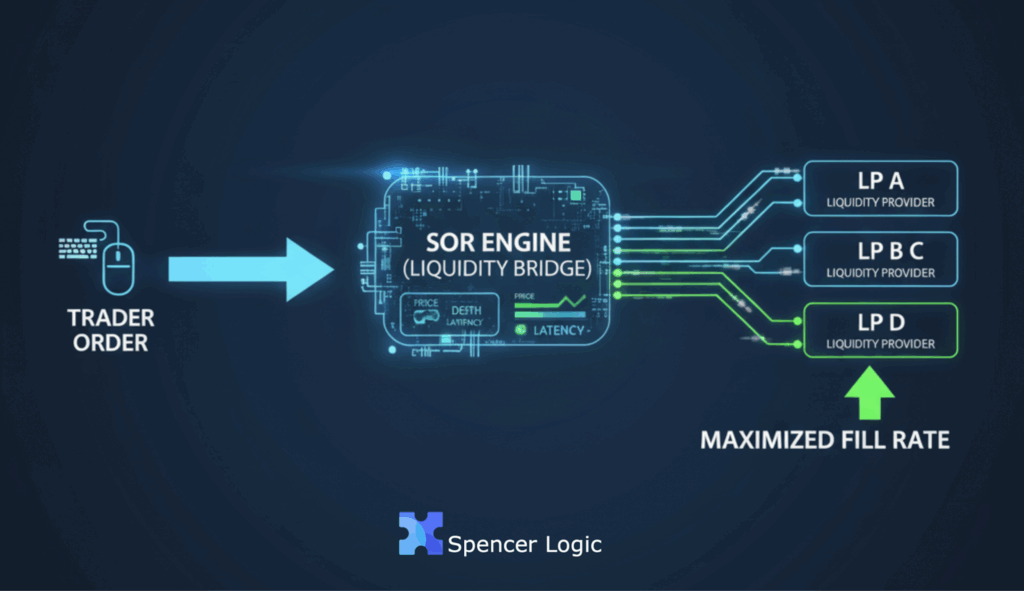
The Solution:Smart Order Routing (SOR), integrated within a modern Liquidity Bridge, instantly compares all connected liquidity feeds (price, depth, latency) to find the absolute best execution path.
Key Functionality: SOR acts as an intelligent traffic controller. It can split large orders across multiple LPs, reroute partially filled trades, and dynamically avoid venues with stale quotes or high latency.
The Benefit: SOR maximizes fill rates, drastically reduces negative slippage, and allows brokers to offer better spreads by optimizing execution, directly boosting client retention and profitability.
Spencer Logic: Our bridge embeds SOR deeply, using real-time execution statistics to adapt and learn, transforming the bridge from a passive connector into an adaptive best-execution engine.
Smart Order Routing in Bridging: How It Maximizes Fill Rates
In today’s fiercely competitive and fragmented financial markets, the difference between a successful trade and a frustrated client often comes down to milliseconds and a fraction of a pip. Price and liquidity are not static; they can vary dramatically from one trading venue to another within the blink of an eye. Brokers that remain reliant on a single liquidity source are actively risking giving their clients inconsistent fills, wider spreads, and frustrating trade rejections.
The solution to this critical infrastructure challenge is Smart Order Routing (SOR). This technology is no longer a luxury for institutional firms; it is one of the most powerful, non-negotiable features built into modern retail liquidity bridges. SOR is the intelligence layer that guarantees a broker’s commitment to “best execution.”
The Challenge of Fragmented Liquidity
The foreign-exchange (FX), CFDs, and cryptocurrency markets are decentralized ecosystems. Prices flow continuously from dozens of liquidity providers (LPs), prime-of-primes, ECNs, and market makers. Each of these venues quotes slightly different bid and ask prices at any given moment.
A broker connected to only one source is like viewing the entire market through a narrow pinhole. During periods of high volatility, major news events, or thin market hours, this limitation is severely exposed. The result is often detrimental to the trader:
Slippage: The execution price differs negatively from the requested price.
Rejected Orders: Orders cannot be filled quickly enough at the quoted price.
Trader Frustration: Inconsistent and poor execution quality erodes trust and encourages clients to seek rival brokers.
To survive and thrive, brokers must access and manage this fragmentation effectively.
What Smart Order Routing Actually Does
At its core, Smart Order Routing is the decision-making engine residing inside the liquidity bridge. It is a sophisticated set of algorithms designed to execute one primary goal: to find the absolute optimal path for every single order, every single time.
When a trader initiates a ‘Buy’ or ‘Sell’ order on their platform (MT4, MT5, WebTrader), the SOR module instantly springs into action. Its process involves:
Real-Time Data Aggregation: It simultaneously compares all connected liquidity feeds, evaluating key metrics for each LP: price (the best bid/ask), depth (how much volume is available at that price), and latency (how quickly the LP typically responds).
Best Path Determination: It applies pre-set or dynamic routing logic to determine the most beneficial execution path. This ensures orders are sent to the LP offering the best combination of price and speed.
Order Slicing (Sweeping): For large orders that exceed the available volume at the best price, the SOR can intelligently split (slice) the order across several LPs to ensure maximum fill at the best possible weighted average price.
Quote Health Monitoring: SOR continuously monitors the health of the connection and the quality of quotes from each LP. It will instantly reroute an order if a venue shows unusually high latency, stale quotes, or a high rejection ratio.
In essence, SOR transcends the role of a passive connection tool. It behaves like an air-traffic controller—continuously monitoring the financial skies, selecting the safest, fastest, and most profitable route for every trade.
Core Benefits of SOR for Brokers and Traders
Implementing effective SOR functionality translates directly into measurable commercial advantages for the broker and superior execution for the client, creating a powerful win-win solution.
Benefit
Description
Business Impact
Maximized Fill Rates
Routing logic looks deep into the order book and across all LPs, ensuring orders find execution even when market liquidity is thin or fragmented.
Higher trading volumes, more revenue, and fewer abandoned trades.
Reduced Negative Slippage
By continuously monitoring latency and avoiding venues with quotes that lag the true market price, SOR minimizes the chance of executing at a worse price.
Protects client capital, builds trader confidence, and supports algorithmic trading.
Better Overall Pricing
SOR compiles the absolute top-of-book quotes from all sources, allowing the broker to deliver tighter, more competitive spreads without cutting into their own markups.
The SOR logic can be configured to manage the broker’s risk exposure by directing certain order types (e.g., large volume) to specific hedging LPs.
Provides control and stability, particularly during major volatility.
The Spencer Logic Bridge: An Adaptive Execution Engine
A truly modern liquidity bridge, such as those offered by Spencer Logic, doesn’t just incorporate SOR—it embeds this intelligence deeply into its core architecture. This means the system is not static; it is adaptive.
Spencer Logic’s SOR engine monitors a rich array of real-time execution statistics: average latency per LP, instrument-specific rejection ratios, and overall quote quality consistency. Based on this data, the system automatically adjusts its routing rules.
Learning Capability: The system effectively learns which LPs perform optimally for specific instruments (e.g., LP ‘X’ is best for EURUSD during European hours, while LP ‘Y’ is best for Crypto on weekends).
Dynamic Re-optimization: If a previously reliable LP begins to degrade in performance (e.g., latency spikes), the SOR instantly de-weights that LP and redirects traffic until performance recovers.
This intelligence transforms the bridge from a simple data connector into a protective, adaptive execution engine that maximizes trade success for clients while shielding the broker from the high costs associated with poor execution quality.
Business Impact: The ROI of Best Execution
For a broker like the one you operate at Spencer Logic, efficient SOR translates directly into quantifiable business gains:
Stronger Client Retention: Consistent, fast, and fair fills are the single biggest driver of trader satisfaction and loyalty. Fewer rejections mean fewer support tickets and fewer complaints.
Market Share Gains: By offering demonstrable best execution, the broker gains a powerful marketing narrative—moving beyond simple price wars to competing on the quality of service.
Lower Operational Cost: Automated, intelligent routing reduces the need for manual intervention and oversight of execution feeds, lowering personnel costs.
Scalability: A robust SOR can easily incorporate new LPs and asset classes (FX, metals, crypto, indices) without disrupting existing infrastructure, making expansion seamless.
In an environment where traders can effortlessly switch brokers with a single click, these micro-advantages of superior execution compound into significant market share gains and long-term profitability.
Conclusion
Smart Order Routing is not an optional add-on; it is the silent, strategic engine of best execution in the modern brokerage world. Integrated within a state-of-the-art liquidity bridge, SOR ensures that every client trade finds its optimal destination, maximizing fill rates, minimizing slippage, and protecting the integrity of both sides of the order book.
Spencer Logic’s integrated bridging stack leverages these advanced routing algorithms to deliver consistently fast, reliable execution. For any broker looking to solidify client trust and gain a definitive competitive edge in the market, investing in SOR is the clearest path to success.
Liquidity Bridge vs. Aggregator for Forex Brokers: Key Differences and Use Cases (MT4/MT5)
Posted on
By Logic Pulse | Spencer Logic Insights Series
TL;DR: Liquidity Bridge vs. Aggregator
Bridge = Connectivity: The Liquidity Bridge is the essential gateway connecting the trading platform (MT4/MT5) to LPs, handling order routing and risk management (A/B/Hybrid).
Aggregator = Optimization: The Liquidity Aggregator is the engine that combines multiple LP price feeds to create the tightest spreads and ensure best execution (essential for scale and competitiveness).
Relationship: The Bridge is the foundational infrastructure, and the Aggregator is the optimizer; you need the Bridge to function, and the Aggregator to win on pricing.
Spencer Logic Advantage: We offer an integrated Bridging & Aggregation Stack, providing both superior connectivity and optimal execution from a single, streamlined platform.
In the world of electronic trading, few terms are as frequently misunderstood as liquidity bridge and liquidity aggregator. Both are critical components in a broker’s technology stack, yet they serve different purposes. Many brokers use them interchangeably, which can lead to poor infrastructure decisions, higher costs, or suboptimal execution.
To scale successfully — whether you’re a startup broker or an established firm expanding into multi-asset markets — it’s essential to understand how these two systems differ, how they interact, and when each becomes necessary.
This article clarifies the relationship between liquidity bridges and aggregators, explores their key differences, and explains how brokers can leverage both strategically to improve execution, reduce costs, and enhance competitiveness.
The Role of Connectivity in Modern Brokerage
Electronic trading is built on connectivity. A broker’s success depends on how efficiently orders flow between traders, trading platforms, and liquidity providers (LPs). When traders click “Buy” or “Sell,” they expect an instant, fair, and transparent fill. Behind that simplicity lies a complex network of systems that route, match, and confirm each trade in milliseconds.
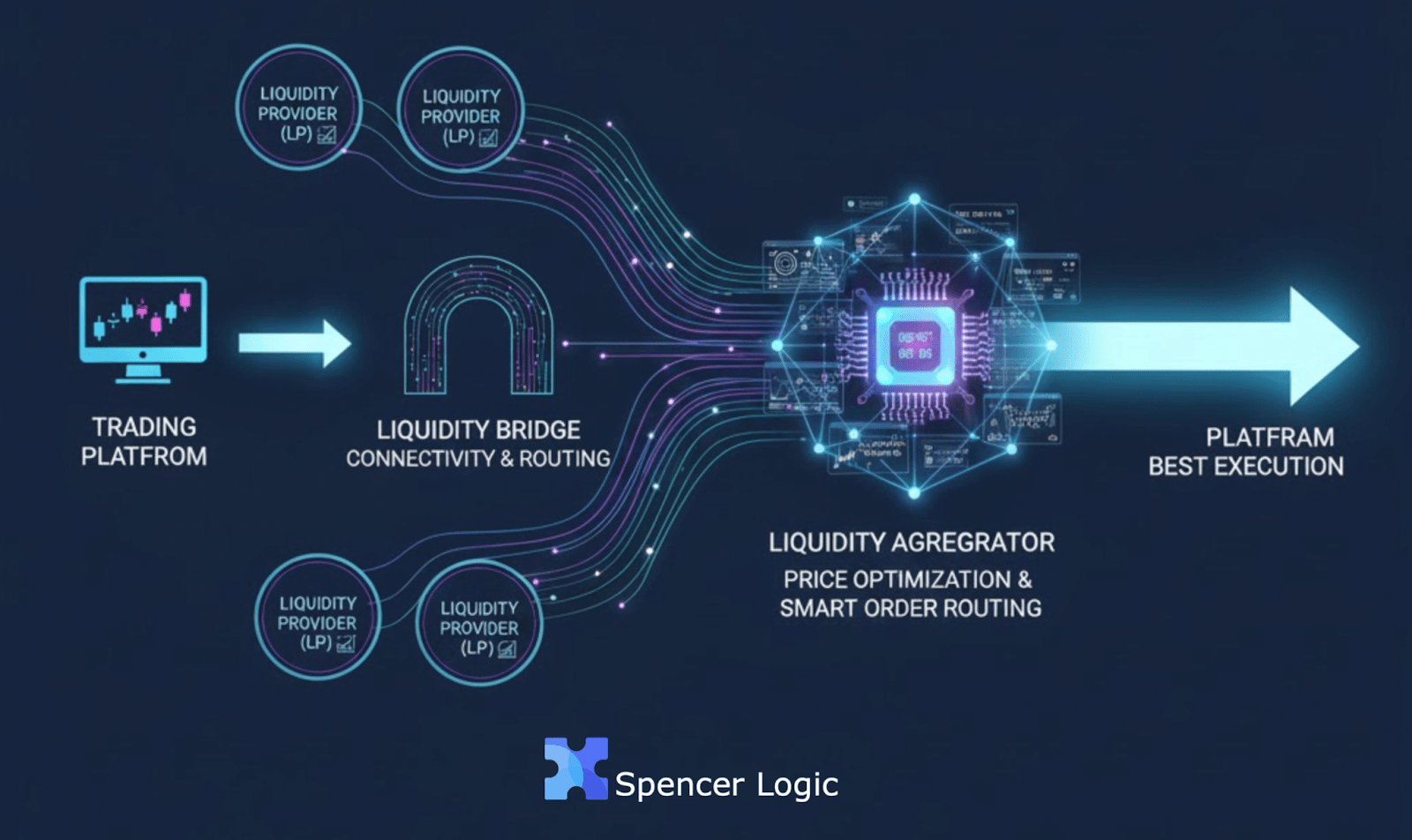
Two of the most critical systems in this process are the liquidity bridge and the liquidity aggregator. They are often developed as part of the same ecosystem, but their core functions differ. The bridge ensures communication between the trading platform and external liquidity venues, while the aggregator optimizes how prices are compiled and orders are executed across multiple liquidity sources.
Think of it this way: the bridge is the road that connects your brokerage to the market, and the aggregator is the traffic controller that manages which lane each order should take for the best result. Both are necessary, but they handle distinct parts of the execution journey.
What Is a Liquidity Bridge?
A liquidity bridge is middleware that connects your trading platform — such as MT4, MT5, or cTrader — to one or more external liquidity providers. It translates and routes trading instructions using standard financial communication protocols like FIX API.
The bridge’s job is to ensure that every trade initiated on your platform is transmitted, filled, and confirmed as efficiently as possible. It handles order routing, manages risk exposure, and supports A-book, B-book, or hybrid execution models.
A well-designed bridge acts as a broker’s control center, offering visibility into execution quality, latency, and slippage. It also provides tools to monitor order flow, set markups, and define routing logic based on volume, instrument, or client group.
In short, the bridge is the broker’s gateway to liquidity — the infrastructure that makes external execution possible.
What Is a Liquidity Aggregator?
While the bridge connects systems, the aggregator enhances execution efficiency by combining price feeds from multiple liquidity providers into a single, optimized stream. Instead of relying on one LP’s quotes, an aggregator compares all incoming bids and asks, identifies the best combination, and constructs a synthetic order book that delivers the tightest possible spreads.
This process, known as price aggregation, directly impacts how competitive your pricing appears to traders. For example, one LP might offer the best bid, while another offers the best ask. The aggregator merges these into a composite quote that your platform displays to clients.
Beyond price construction, aggregators can split large orders across several LPs to minimize market impact — a process known as order slicing or sweeping. They can also apply smart order routing (SOR) logic to ensure each order is executed at the best available price with minimal slippage.
In other words, the aggregator optimizes liquidity, ensuring that the connection provided by the bridge is not only functional but also efficient.
Bridge vs. Aggregator: The Core Differences
While both systems are part of the same execution flow, their functions are distinct. The easiest way to understand the difference is to compare their roles side by side:
Feature
Liquidity Bridge
Liquidity Aggregator
Primary Role
Connects trading platforms to liquidity providers
Combines and optimizes prices from multiple LPs
Focus
Connectivity, routing, and risk management
Price construction and execution optimization
Protocols
FIX API, proprietary APIs
FIX API, market data feeds
Execution Models
Supports A-book, B-book, hybrid setups
Focuses on best-execution logic for A-book orders
Users
Brokers managing connectivity
Brokers or institutional desks managing pricing and execution quality
Key Benefit
Enables external execution and control
Ensures best pricing and deeper liquidity access
A bridge can exist without an aggregator — for example, if a broker connects to a single LP or prime-of-prime. However, an aggregator cannot function without a bridge or another form of connectivity to transmit its orders.
The bridge is the foundation. The aggregator is the optimizer. Together, they define a broker’s ability to compete on both speed and pricing.
How the Two Work Together in Practice
In a modern brokerage environment, bridging and aggregation typically operate as part of a single workflow:
Trader places an order on MT4 or MT5.
The bridge receives the order and routes it to the aggregator or directly to a designated LP.
The aggregator compares prices from connected LPs, selects the best available combination, and executes the trade.
The bridge confirms the fill, applies markups or commissions, and returns the confirmation to the trading platform.
This workflow happens in milliseconds, ensuring seamless execution from the trader’s perspective.
In Spencer Logic’s architecture, the bridge and aggregator components are tightly integrated. This allows brokers to enjoy both connectivity and optimization without juggling multiple vendors or complex integrations.
Why the Distinction Matters for Emerging Brokers
For new or scaling brokers, understanding the difference between a bridge and an aggregator is not just technical — it’s strategic. Early infrastructure decisions determine how scalable, profitable, and compliant your brokerage can become.
A broker that only installs a basic bridge may be able to execute trades but might offer uncompetitive spreads compared to rivals using aggregation. Conversely, investing in an aggregator without a stable bridge can lead to execution delays, data mismatches, or liquidity disconnects.
Getting the combination right from the start ensures that your brokerage can:
Offer institutional-grade execution to retail clients.
Compete on pricing without compressing your margins.
Expand seamlessly across multiple liquidity providers and asset classes.
Maintain transparency and control over every trade.
In a market where traders can switch brokers in seconds, infrastructure quality becomes a major differentiator.
Bridge + Aggregation, unified
Not sure which one you need? Let’s map your exact stack in a 30-min walkthrough.
Connectivity · Best-execution pricing · One integrated platform
The Evolution of Bridging and Aggregation Technology
Historically, liquidity bridges were simple connectors — software layers that relayed orders from MT4 to a liquidity provider. Aggregation, if it existed at all, was manual or limited to a few price feeds.
Today, both have evolved dramatically. Modern bridging systems integrate advanced risk engines, dynamic routing, and even real-time analytics. Aggregators now include algorithmic execution features, multi-asset support, and customizable order slicing strategies.
This evolution reflects the changing nature of trading. As clients demand access to FX, metals, indices, crypto, and derivatives under a single account, brokers must build systems capable of handling complex execution scenarios. Bridging and aggregation have become inseparable parts of that solution.
At Spencer Logic, this philosophy is embedded into our design: a multi-asset bridging stack that combines deep connectivity, smart order routing, and liquidity optimization in one unified platform.
When You Need a Bridge (But Not Yet an Aggregator)
If you are a small or newly launched broker connecting to a single LP or prime-of-prime, a liquidity bridge alone may be sufficient in the beginning. It will allow you to execute trades externally, manage markups, and monitor risk efficiently.
This setup is especially suitable when:
You have limited trading volume.
Your client base trades mainly major FX pairs.
Your goal is to establish operational stability before scaling liquidity sources.
However, once trading volume increases and client expectations rise, the absence of aggregation will begin to show — typically in the form of wider spreads, occasional slippage, and inconsistent fills during high volatility. At that point, adding aggregation capabilities becomes the natural next step.
When an Aggregator Becomes Essential
As your brokerage grows, offering competitive spreads and stable execution across multiple liquidity providers becomes essential. This is where a liquidity aggregator transitions from a “nice to have” to a “must have.”
You’ll know it’s time to integrate aggregation when:
You’re connected to three or more LPs.
You’re competing on tight spreads or ECN-style execution.
Your traders include algorithmic or high-frequency users.
You notice inconsistent fills across different market conditions.
An aggregator ensures you’re making the most of your liquidity relationships. It not only improves the prices you display but also increases execution speed and fill ratio — all of which translate directly into trader satisfaction and retention.
Cost and Complexity Considerations
While the technical concepts are straightforward, the implementation can vary widely depending on architecture and vendor. Some brokers prefer modular setups — separate bridge and aggregator vendors — while others choose integrated solutions like Spencer Logic’s all-in-one stack.
Modular setups offer flexibility but can introduce complexity, requiring multiple support teams, version synchronization, and separate monitoring tools. Integrated solutions, on the other hand, streamline operations, provide unified reporting, and simplify maintenance.
From a cost perspective, integrated systems typically reduce total cost of ownership (TCO) because they eliminate redundant licenses and infrastructure overhead. For emerging brokers with limited IT resources, this simplicity often outweighs the perceived flexibility of separate systems.
The Business Impact: Beyond Technology
Choosing between a bridge, an aggregator, or both isn’t only about technology — it directly affects your business metrics.
Spreads and Pricing: Aggregation tightens spreads, improving your market competitiveness.
Execution Quality: A stable bridge ensures orders are filled consistently.
Client Retention: Traders stay with brokers that execute efficiently.
Regulatory Readiness: Accurate routing and reporting simplify compliance.
Ultimately, the right configuration creates a virtuous cycle — better execution drives higher trading volume, which attracts more liquidity and allows even better pricing.
Case Example: From Single LP to Aggregated Infrastructure
Consider a mid-sized FX broker that initially connected to one prime-of-prime via a simple bridge. As the client base grew, so did complaints about inconsistent spreads and slippage during major news events.
The broker integrated an aggregation layer capable of sourcing quotes from five LPs and applying smart order routing. Within weeks:
Average spreads narrowed by 18%.
Fill ratio improved by 9%.
Client retention increased noticeably among active traders.
The infrastructure upgrade paid for itself within a few months, not through additional marketing, but through better execution — proof that technology decisions can have direct commercial impact.
The Future: AI-Assisted Bridging and Aggregation
The next evolution in liquidity infrastructure lies in automation and intelligence. AI-driven bridging systems can analyze execution data in real time, detect latency anomalies, and adjust routing dynamically. Aggregators are beginning to use predictive algorithms to forecast quote stability, helping brokers minimize slippage before it happens.
Spencer Logic’s R&D roadmap already integrates elements of this future — adaptive routing, performance scoring of liquidity providers, and machine-learning–based optimization to enhance execution efficiency across markets.
In the coming years, brokers who embrace intelligent bridging and aggregation will be able to deliver a trading experience indistinguishable from institutional-grade platforms — even for retail clients.
Conclusion
Liquidity bridges and aggregators are not rivals; they are partners in delivering world-class execution. The bridge connects your platform to the global liquidity network, while the aggregator refines that connection into competitive, optimized pricing.
For emerging brokers, the path forward is clear: start with a solid bridging foundation, and evolve into aggregation as your liquidity relationships and trading volume grow. Together, these systems form the infrastructure that determines whether your brokerage can scale sustainably in an increasingly demanding market.At Spencer Logic, we provide an integrated Bridging & Aggregation Stack designed specifically for multi-asset brokers. Our technology delivers low-latency connectivity, real-time optimization, and flexible execution control — all from a single, unified platform. If you’re ready to enhance your execution and pricing architecture, explore our Bridging Solution and see how Spencer Logic helps brokers build faster, smarter, and more scalable infrastructures.
What is Liquidity Bridging? A Broker’s Guide to Faster Execution and Tighter Spreads
Posted on
By Logic Pulse | Spencer Logic Insights Series
TL;DR
Liquidity Bridging is the essential middleware that connects your trading platform () to multiple institutional liquidity providers, acting as the core of modern execution.
It’s no longer optional: In today’s market, clients demand instant execution and tight spreads—a bridge is the price of entry to attract and retain serious traders.
The core benefits are tangible: Achieve tighter spreads (via quote aggregation) and lower latency (via Smart Order Routing), directly boosting your competitiveness.
A bridge enables sophisticated risk management (A-book, B-book, Hybrid models) and ensures scalability for integrating new asset classes like crypto.
Spencer Logic offers a turnkey bridging solution designed specifically for emerging and scaling brokers, providing institutional-grade performance without the complexity.
In today’s trading environment, clients expect brokers to provide more than just access to the markets. They demand near-instant execution, spreads that remain competitive even in volatile conditions, and the ability to trade across multiple asset classes without friction. Meeting these expectations is no longer optional — it is the price of entry for brokers who want to attract and retain serious traders. Yet, achieving this level of performance is not possible with trading platforms alone. This is where liquidity bridging comes into play.
A liquidity bridge is more than a piece of technical infrastructure; it is the invisible backbone that connects brokers to the global markets. By linking trading platforms like MT4 and MT5 directly to liquidity providers or prime-of-prime brokers, a bridge enables brokers to deliver faster, more reliable, and more cost-effective execution to their clients. Understanding what liquidity bridging is, how it works, and why it matters can help emerging brokers make smarter technology decisions and build a stronger competitive edge.
Understanding Liquidity Bridging
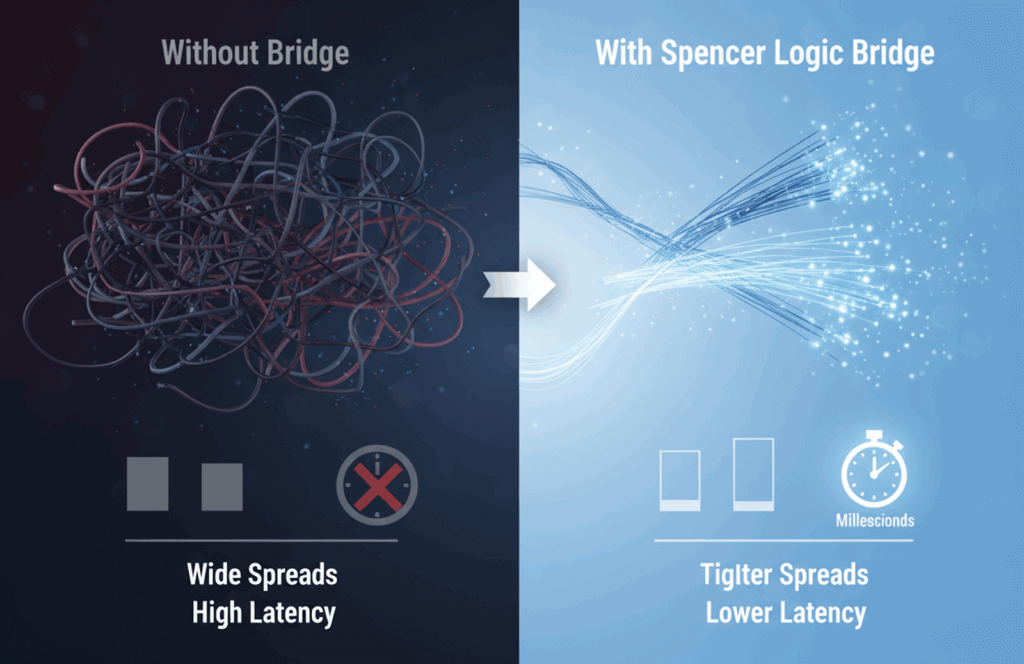
At its simplest, liquidity bridging is middleware that acts as a gateway between a broker’s trading platform and the broader liquidity ecosystem. Instead of relying on limited in-house liquidity or a single external provider, the bridge makes it possible to connect to multiple sources of institutional-grade liquidity. Orders placed by traders on the platform are seamlessly transmitted through the bridge, routed to the most suitable liquidity provider, and then executed at the best available market conditions.
Think of the bridge as the financial markets equivalent of a highway interchange. Without it, traffic would be forced to bottleneck through a single road, slowing down execution and limiting capacity. With the bridge, order flow can be distributed across multiple lanes, ensuring faster throughput, smoother traffic, and less risk of costly congestion. This technical role is critical because, in electronic trading, every millisecond counts. Even small delays in execution can translate into slippage, wider spreads, or missed opportunities, particularly for high-frequency or scalping strategies.
Why Brokers Need a Bridge
For brokers, the question is not whether liquidity bridging is useful but whether they can realistically operate without it. Retail trading has grown more sophisticated in recent years, with clients demanding performance once reserved for institutional traders. Without a bridge, brokers are left with limited routing options and minimal control over how orders are executed. This creates risks not only for client satisfaction but also for the broker’s own profitability and long-term competitiveness.
A liquidity bridge addresses several critical needs. It reduces latency by ensuring orders travel the most direct route possible to liquidity providers. It optimizes spreads by aggregating quotes from multiple sources, giving brokers the ability to offer better bid/ask pricing. It also scales with the broker’s business, supporting the addition of new asset classes such as crypto or CFDs without requiring a full rebuild of infrastructure. Finally, it enables sophisticated risk management strategies, including A-book, B-book, or hybrid execution models, helping brokers balance profitability with client outcomes.
How a Liquidity Bridge Works
While the internal mechanics can be complex, the logic behind a liquidity bridge is straightforward. When a client places an order in MT4, MT5, or another platform, the order does not go directly to the market. Instead, it is transmitted to the bridge, which acts as the broker’s decision-making hub. From there, the bridge evaluates available liquidity sources and determines how best to execute the order. In many cases, it uses smart order routing (SOR) algorithms to compare quotes from multiple providers and automatically select the optimal match.
Once the order is routed and filled by the liquidity provider, the confirmation is sent back through the bridge and recorded in the trading platform. All of this occurs in milliseconds, invisible to the trader but vital for the broker’s infrastructure. Beyond order execution, modern bridges also provide features such as monitoring dashboards, risk controls, and detailed transaction cost analysis, giving brokers real-time visibility into their execution quality. This ability to both manage and measure execution is increasingly important in markets where regulators emphasize best execution and transparency.
The Tangible Benefits of Bridging
The true power of liquidity bridging lies in the tangible advantages it delivers to both brokers and their clients. First and foremost, bridging reduces slippage by ensuring that executed prices align as closely as possible with the prices quoted on screen. In volatile markets, this difference can make or break a trading strategy, and traders notice quickly when execution quality is poor.
Bridging also lowers latency, with leading solutions capable of completing execution cycles in a few milliseconds. For brokers targeting active traders — scalpers, algorithmic traders, and professionals using automated strategies — low latency is not just an advantage but a necessity. Beyond speed, bridging provides access to deeper liquidity by aggregating quotes from multiple sources, which translates directly into tighter spreads. Better spreads not only attract traders but also improve the broker’s competitive positioning in a crowded marketplace.
Finally, a bridge enables transparency and regulatory alignment by giving brokers tools to track and report on execution quality. This supports compliance with best-execution obligations while also offering brokers insights into how their order flow behaves, which providers perform best, and where hidden costs might be creeping in.
Clearing Up Misconceptions
Because bridging is highly technical, misconceptions are common. One of the most frequent is the belief that a liquidity bridge and a liquidity aggregator are the same. While both play a role in connecting brokers to external liquidity, an aggregator focuses primarily on combining price feeds from multiple sources to provide the best quote. A bridge, in contrast, serves as the broader infrastructure that handles not only pricing but also order routing, risk management, and execution reporting. In other words, the aggregator is often a component within the bridge, but the bridge itself delivers the complete connectivity package.
Another misconception is that only large, established brokers require bridging. In reality, emerging brokers benefit just as much, if not more, from bridging technology. Without it, they cannot realistically compete with better-funded competitors that already offer fast execution and institutional-grade pricing. Modern bridging solutions are designed to be scalable and cost-effective, making them accessible to brokers at any stage of growth.
A final myth is that bridging is overly complex or expensive to implement. While it is true that early-generation bridges required heavy customization and technical expertise, today’s turnkey bridging platforms have dramatically lowered the barriers to entry. Brokers can onboard quickly, integrate with their existing platforms, and immediately access advanced execution capabilities without building custom infrastructure.
How to Choose the Right Bridge Provider
Selecting the right liquidity bridge is a strategic decision that can shape a broker’s ability to compete and scale. Compatibility is a critical factor: the bridge must integrate seamlessly with the broker’s existing trading platforms, whether MT4, MT5, cTrader, or others. Stability is equally important, as even minor downtime can erode client trust and cause financial losses.
Another key consideration is customization. Brokers should look for providers that allow them to define routing rules, manage risk, and access detailed reporting dashboards tailored to their needs. Transparency in pricing models and ongoing technical support should also weigh heavily in the decision, as a strong support partner can make the difference between smooth operations and constant firefighting.
Finally, brokers should evaluate how the bridge provider approaches innovation. With the trading landscape evolving rapidly — from crypto derivatives to tokenized assets — working with a forward-looking provider ensures that the bridge remains an asset for the long term rather than a bottleneck that needs replacement after a few years.
Conclusion
Liquidity bridging is not a luxury or a niche tool; it is the fundamental infrastructure that allows brokers to meet modern client expectations. By delivering faster execution, tighter spreads, and deeper access to liquidity, a bridge enables brokers to stay competitive in a market where milliseconds and basis points matter. It also provides the transparency, scalability, and risk management capabilities that underpin sustainable growth.
For brokers weighing their next move, investing in a reliable liquidity bridge is one of the most impactful steps they can take. It unlocks immediate benefits in execution quality while also preparing the business to expand into new asset classes and client segments.At Spencer Logic, we specialize in bridging solutions designed for emerging and scaling brokers. Our technology delivers institutional-grade liquidity access, customizable execution models, and real-time monitoring, all in a turnkey package. If you are ready to provide your clients with the execution they demand while positioning your brokerage for long-term growth, we invite you to explore our Bridging Solution.