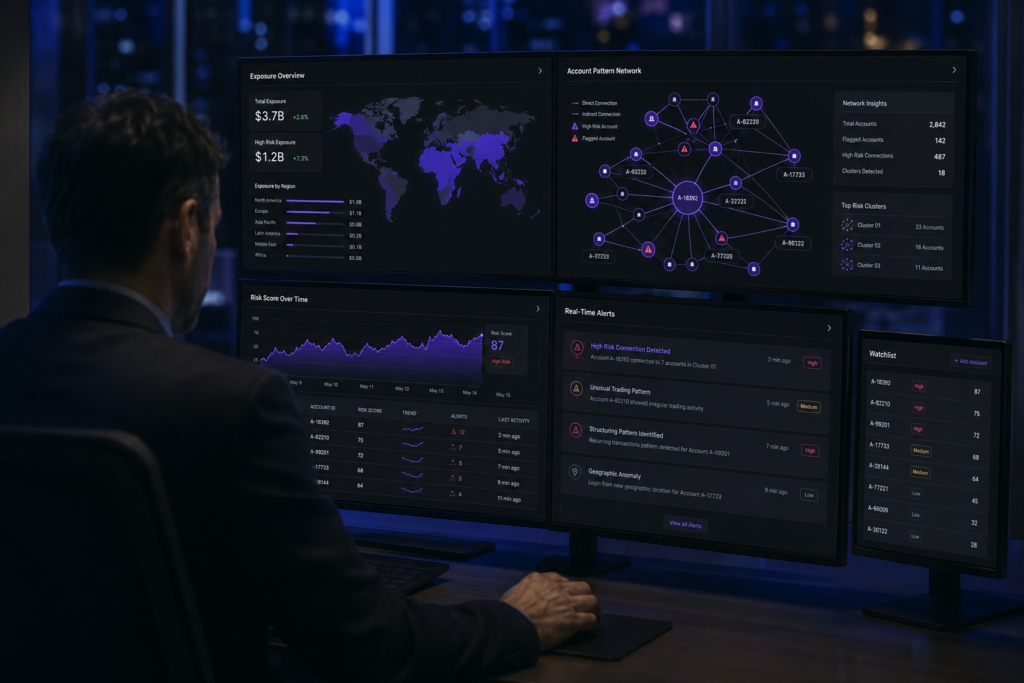
Most brokerage technology stacks still treat “AI” as a single bolt-on feature — a chatbot on the client portal, maybe a fraud flag on KYC. That framing understates what is actually happening at the infrastructure level. The brokerages pulling ahead on cost-per-account and exposure control are not adding an AI feature. They are replacing rule-based decision layers — in risk, in onboarding, in compliance — with models that adapt to pattern shifts a static rule set cannot see coming.
The gap this creates is measurable, and it is not closing on its own.
The Financial Impact of Static Decision Layers
Consider a mid-size brokerage running a $60M ADV book across FX and CFDs, with a risk desk of three analysts monitoring exposure through threshold-based alerts — fixed drawdown percentages, static per-instrument caps, manual escalation for anything outside the band.
The problem with fixed thresholds is that they are calibrated for the market regime that existed when someone set them. A volatility spike that doubles correlated exposure across a client cohort within an hour does not trip a static per-account limit until damage has already compounded across dozens of positions simultaneously. Industry-reported figures put the average cost of a single undetected toxic-flow event, from first breach to manual containment, in the $40,000–$120,000 range for a book this size — spread compression, hedge slippage, and the manual hours spent reconstructing what happened after the fact.
Run that same exposure event through a model trained on the desk’s own historical fill and rejection data, and the picture changes. Pattern-based systems flag correlated risk-building in minutes rather than after threshold breach, because they are not waiting for a fixed number to be crossed — they are comparing the current pattern against thousands of prior sequences that preceded past blowups. The realistic reduction in containment time reported by desks that have made this shift is 70–85%, which on a book this size translates to $28,000–$100,000 in avoided cost per material event, several times a year.
Onboarding tells a similar story from the opposite direction — not risk avoided, but revenue delayed. A brokerage processing 200 new accounts per month with manual KYC review averaging 18–36 hours per file is not just slow; it is bleeding conversion. Every additional day between application and first funded trade measurably lowers the odds the client ever funds at all. Automated document verification and risk-scoring can compress that window to under two hours for the majority of straightforward applications, routing only genuine edge cases to a human reviewer.
Compliance monitoring sits between these two functions and often absorbs the cost of both being disconnected. A brokerage running quarterly manual KYC refresh cycles, transaction monitoring based on static rule thresholds, and a compliance team that reviews flagged accounts in batches is structurally always looking backward — reconstructing what happened after a regulator or an internal audit asks the question, rather than catching drift as it occurs. Firms that have moved to continuous, pattern-based transaction monitoring report a reduction in the average time between suspicious activity onset and internal flag from weeks to same-day, which matters both for regulatory posture and for limiting the financial exposure a slow-moving compliance process allows to accumulate.
Why Most Brokers Miss This
The reason most operators have not made this shift is not skepticism about AI — it is that the three domains where it matters most (risk, onboarding, compliance) sit in different parts of the tech stack, run by different teams, on different timelines. Risk model deployment gets treated as a data science project. Onboarding automation gets treated as a KYC vendor swap. Compliance monitoring gets treated as a regulatory checkbox. Each gets evaluated and purchased in isolation, which means none of them share data with the others — and the value of pattern-based decisioning compounds specifically when the systems share signal.
A client who trips a soft compliance flag during onboarding and later shows unusual position-sizing behavior on the risk desk is a single pattern across two systems that were never designed to talk to each other. Most brokerages never see that connection because the systems live in separate vendor silos with separate data models.
The Opportunity: A Shared Signal Layer, Not Three Separate Tools
The reframe that matters here: AI in brokerage operations is not three separate purchase decisions. It is one signal layer — client behavior, position data, and document verification results feeding a shared model — that gets applied across risk, onboarding, and compliance simultaneously. Brokers who build or buy this as a unified layer report materially lower false-positive rates on every one of the three functions individually, because each model is trained on a richer, cross-domain dataset rather than its own narrow slice.
This is also where the revenue case gets stronger than the cost-avoidance case. A risk desk that can distinguish a genuine toxic-flow pattern from a legitimate high-conviction trader can afford to widen limits for the clients worth keeping, rather than applying the same conservative cap to everyone. That is margin recovered, not just risk avoided.
Practical Breakdown: Where to Start
Operators evaluating this shift typically sequence it in three phases rather than attempting a full-stack replacement at once.
Phase 1 — Risk desk pattern detection (2–4 weeks to calibrate). Layer a pattern-recognition model over existing exposure monitoring rather than replacing the rules outright. The model runs in parallel with static thresholds initially, surfacing anomalies for analyst review before the desk trusts it to auto-escalate. This calibration period is where the false-positive rate gets tuned against the desk’s actual historical data.
AI Risk Management, Live in Weeks
Ready to see pattern-based detection running against your own book’s data?
Toxic flow detection · Exposure monitoring · Same-stack deployment
Phase 2 — Onboarding automation with human-in-the-loop routing (2–3 weeks). Automated document verification and identity risk scoring handle the volume; anything scoring outside a defined confidence band routes to a human reviewer instead of auto-approving. This is the phase most operators underestimate the value of — not because automation replaces the reviewer, but because it means the reviewer only ever sees the files that actually need a human judgment call.
Phase 3 — Cross-domain signal sharing (4–6 weeks). Once risk and onboarding are running independently, connect the data. A client’s onboarding risk score becomes an input to the risk desk’s position monitoring; unusual position behavior becomes a signal that feeds back into ongoing KYC refresh cycles rather than sitting isolated in the risk system. This is the phase that generates the compounding value described above.
Phase 4 — Continuous compliance monitoring (ongoing, layered on top of Phases 1–3). Once risk and onboarding share signal, extend the same pattern-recognition layer to transaction monitoring rather than running compliance on a separate quarterly-review cadence. This is the phase that converts the operational gains from Phases 1–3 into a defensible audit trail — every flagged pattern, every escalation, and every resolution is timestamped and traceable to a specific model decision rather than a manual judgment call reconstructed after the fact. Regulators and auditors increasingly expect this level of traceability from AI-assisted decisioning, and building it in from the start avoids a retrofit later.
Each phase is deliberately sized to be evaluated on its own merits before committing to the next. A desk that stops after Phase 1 still captures the risk-detection gains; a brokerage that never reaches Phase 4 still has a materially better onboarding and risk posture than one running purely static rules across the board. The compounding case for going all the way through Phase 4 is real, but no phase requires the ones after it to justify its own cost.
Brokers already running SpencerLogic’s Liquidity Aggregation and risk infrastructure can layer AI Risk Management directly onto the existing exposure feed without a parallel data pipeline — the pattern models train on data the stack already generates. For a brokerage building this out for the first time, it is one component inside an all-in-one white label brokerage solution that includes trading platform, bridge, risk management, developer tooling, and client portals under a single data model, rather than three disconnected vendor integrations that never share signal.
Reducing the Fear: Start Narrow, Expand the Signal
None of this requires a wholesale infrastructure replacement in month one. The lowest-risk entry point is layering pattern detection over an existing risk desk in parallel with current thresholds, proving the false-positive rate down before anyone trusts it with auto-escalation authority. Onboarding automation follows the same logic — human review stays in the loop for edge cases from day one. The cross-domain signal sharing that generates the largest compounding return is a phase-three step, not a prerequisite.
Ready to map what AI-based risk and onboarding would look like against your current book? Book a demo and we’ll walk through where the highest-leverage entry point is for your specific stack.
FAQ
Does AI risk management replace the human risk desk?
No. It changes what the desk spends its attention on. Static threshold monitoring still catches the obvious cases; pattern detection surfaces the correlated, slow-building exposure that a fixed rule set is structurally unable to see until after the threshold is breached. Analysts review flagged patterns rather than scanning every account manually.
How long does it take to calibrate a risk model against our own book?
Most desks run a 2–4 week parallel period where the model surfaces anomalies for review without auto-escalating, using that window to tune sensitivity against the desk’s actual historical fill and rejection data before granting escalation authority.
Can this integrate with our existing MT4/MT5 environment?
Yes. Pattern-based risk monitoring layers on top of existing position and exposure data rather than requiring a separate parallel feed, and integrates through the same bridge and aggregation layer already routing order flow.
What’s the realistic cost of not doing this?
For a $60M ADV book, industry-reported figures put the cost of a single undetected toxic-flow event at $40,000–$120,000 in spread compression, hedge slippage, and manual containment hours. Several such events per year is not unusual for desks running purely static thresholds.
Does onboarding automation increase fraud risk?
Properly configured, it reduces it. Automated document verification and risk scoring catch document tampering and identity mismatch patterns more consistently than manual review at volume, while routing genuinely ambiguous cases to a human reviewer rather than auto-approving them.
Do risk, onboarding, and compliance need to be the same vendor to share signal?
Not necessarily, but they need to share a data model. Disconnected point solutions with incompatible data structures cannot meaningfully exchange signal even with API integration. This is why unified infrastructure captures more of the cross-domain value than a best-of-breed assembly of separate vendors.
Where should a broker with limited engineering resources start?
Risk desk pattern detection layered over existing thresholds, since it requires no client-facing changes and generates measurable results within the calibration window alone — before any cross-domain integration work begins.