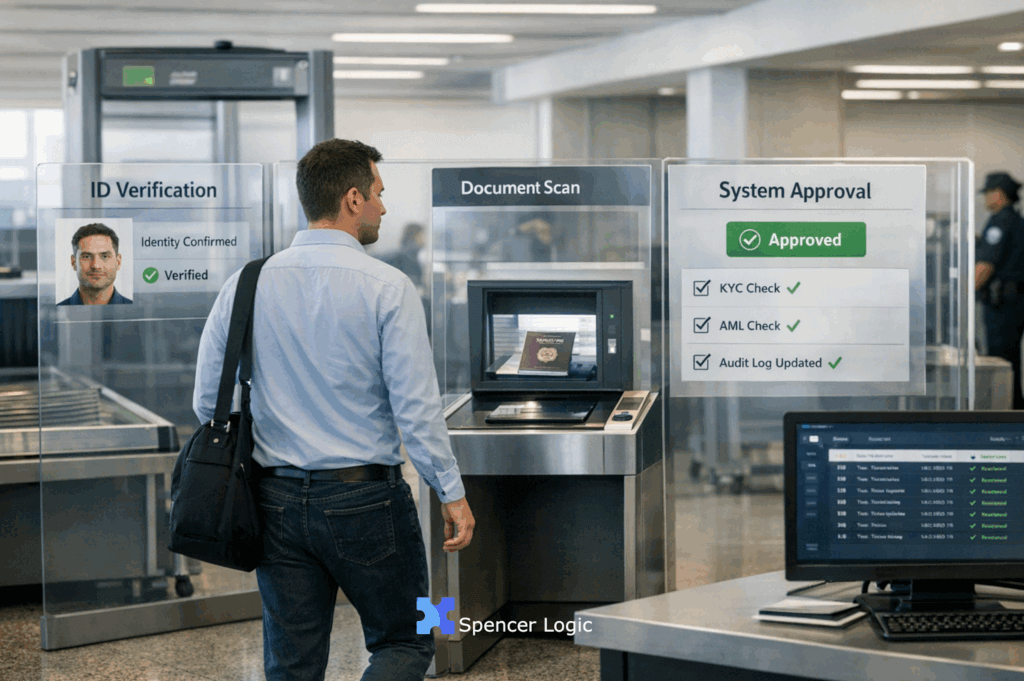
TL;DR
- Trust in brokerage is built through systems, not marketing claims.
- Spencer Logic embeds compliance, security, and audit readiness directly into its turnkey architecture.
- Unified KYC, AML, onboarding, execution, and reporting create regulator-friendly operations from day one.
- Security is enforced through hardened infrastructure, secure defaults, and layered defenses.
- Regulatory-ready infrastructure allows brokers to scale, partner, and pursue licensing without costly rebuilds.
In the brokerage industry, trust is more than a marketing message; it is an operational discipline. Every successful brokerage—large or small—relies on a foundation of compliance rigor, robust security, transparent execution, and regulatory alignment. Without this foundation, no amount of branding or acquisition strategy can compensate. Traders are more educated, regulators are more assertive, and technology is more interconnected than ever. A brokerage that cannot prove its integrity will not survive long, regardless of how attractive its spreads or promotions might be.
This reality is why the backbone of Spencer Logic’s turnkey system is not speed, or convenience, or even platform quality—it is trust by design. The architecture is engineered so that compliance, security, and regulatory readiness are not optional layers added later; they are inherent properties of the system itself. The goal is to launch brokerages that can withstand due diligence, audit scrutiny, partner assessment, and risk evaluation from day one.
Trust is not built through marketing statements; it is built through systems. This article explains how Spencer Logic embeds trust into every component of its turnkey ecosystem, and why this approach gives brokers a structural advantage over competitors relying on white labels, minimal compliance setups, or under-engineered platforms.
Compliance as an Architectural Layer, Not a Post-Launch Patch
Most new brokers misunderstand compliance. They assume it is a process attached to onboarding—document collection, identity verification, maybe some AML checks. In reality, compliance is a system-wide discipline involving data flows, decision logic, storage rules, reporting obligations, and internal controls. When compliance is treated as an afterthought, brokers face regulatory penalties, frozen PSP relationships, rejected license applications, and loss of client trust.
Spencer Logic reverses this industry mistake by embedding compliance into the architecture from the first week of deployment. Before the platform even goes live, the brokerage receives:
- a KYC structure aligned with global verification standards
- AML screening and PEP checks integrated at onboarding
- a data governance model that meets multi-jurisdiction requirements
- automated workflows that produce auditable trails
- reporting structures consistent with licensing expectations
But most importantly, Spencer Logic ensures that compliance flows are coherent. In many brokerages, KYC logic lives in one system, transaction monitoring in another, exposure logs in another, and customer records in yet another. Spencer Logic eliminates fragmentation. All layers communicate under a unified logic, which is what auditors expect and what regulators increasingly require.
When compliance is architectural, the brokerage behaves predictably.
When compliance is an add-on, it becomes a liability.
Security: The Invisible Infrastructure That Protects the Business
Security is often invisible until it fails. When it does fail, it destroys trust instantly. A breach, a data leak, or even a poorly configured server can damage a brokerage in ways that marketing campaigns cannot recover. Security in brokerage environments is particularly sensitive: client financial data, trading patterns, KYC documents, payment information, and internal risk logic all pass through technical systems that must be protected at every layer.
Spencer Logic treats security not as a checklist, but as a continuous infrastructure requirement. The hosting environment is hardened from day one, with strict access controls, intrusion detection, firewalls, and encrypted communication between every major service. Distributed access server architecture minimizes single points of failure. Automated monitoring ensures unusual behaviors—whether internal or external—are detected early.
More importantly, Spencer Logic enforces operational security discipline.
A brokerage’s biggest risk often isn’t external—it’s internal misconfiguration:
- inconsistent permissions
- unsecured CRM fields
- unencrypted client submissions
- unrestricted access to platform admin tools
- poorly isolated environments
Instead of leaving these to the founder’s discretion, Spencer Logic configures secure defaults based on institutional-grade standards. The result is infrastructure capable of resisting both opportunistic attacks and sophisticated attempts to exploit vulnerabilities.
Security is not about preventing every threat; it is about engineering a system where the cost of successful intrusion becomes prohibitively high. Spencer Logic achieves this through layered defense and disciplined architecture.
Regulatory Readiness: Preparing a Brokerage for the Future, Not Only the Present
A brokerage that launches without regulatory alignment will eventually face a structural ceiling. PSPs will request additional documents. Banks will restrict onboarding. Jurisdictions will tighten rules. Client segments will require specific disclosures. The broker will find that “market entry” and “market sustainability” are two very different challenges.
Spencer Logic solves this by designing infrastructure that is compatible with future licensing—not just present operations. Brokers who plan to grow often underestimate how difficult it is to retrofit a compliance-ready structure after launch. Spencer Logic avoids this problem by building a system that already conforms to the expectations of auditors.
This includes:
- audit-ready onboarding
- verifiable identity and document trails
- structured AML logic
- reconciled financial flows
- data retention aligned with regulatory periods
- exportable logs for external auditors
- reporting frameworks consistent with CySEC, FSC, and similar bodies
Spencer Logic’s turnkey environment does not grant a license, but it gives brokers the infrastructure credibility to apply for one.
A brokerage with regulatory alignment built in from day one gains optionality. It can operate unregulated at first, then transition to regulated status without rewriting its systems. Competitors without such alignment face costly rebuilds, migrations, and re-audits.
The Role of Client Onboarding in Building Trust
Onboarding is the client’s first real interaction with the brokerage. It shapes perceptions of professionalism, security, and legitimacy. A clumsy onboarding process—slow verification, unclear instructions, inconsistent feedback—signals operational immaturity. Traders instantly interpret this as a risk indicator, even if the spreads or trading conditions look attractive.
Spencer Logic’s onboarding experience is designed to signal institutional quality. Document submission is structured, verification is automated where possible, and compliance checks occur behind the scenes in a unified workflow. Clients receive clear communication. Support teams see organized logs. Compliance officers access streamlined dashboards.
When onboarding is fast yet rigorous, trust is created.
When onboarding is slow and fragmented, doubt appears.
This is especially important for high-value clients, who expect professional-grade onboarding. In the brokerage world, the path to trust begins before a trade is ever placed.
Execution Transparency and Its Link to Credibility
Trust is also earned through execution quality. Slippage patterns, latency, spreads, and order routing behavior influence whether traders perceive the broker as fair and reliable. Spencer Logic’s turnkey model gives brokers direct control over liquidity relationships, bridge logic, and execution paths. This control is what distinguishes credible brokers from “cheap white label” setups where everything is opaque.
Execution transparency builds trust by allowing brokers to:
- select reputable LPs
- refine routing rules
- analyze fill patterns
- adjust slippage models
- track toxic flow
- monitor exposure
The structure reduces disputes, eliminates surprise behaviors, and provides the data trail needed if a regulator or liquidity provider questions any part of the execution environment.
Trust is not built merely through fast execution; it is built through predictable execution. Predictability comes from control. Spencer Logic ensures brokers have the structural control they need.
Internal Governance: The Often-Ignored Pillar of Brokerage Trust
Many brokers focus on external compliance—KYC, AML, verification—while ignoring internal governance. Yet internal governance is what determines the quality of operational decisions. Without clear access policies, reporting structures, operational logs, and escalation frameworks, even a technically strong brokerage can fail during periods of pressure.
Spencer Logic includes internal governance tools and structures such as:
- role-based access permissions
- audit logs for operational actions
- segregation of duties across teams
- reporting dashboards
- escalation procedures for suspicious activity
- secure handling of sensitive data
Although these features may seem secondary to founders, they are essential for trust. Investors, regulators, liquidity providers, and strategic partners evaluate not only what a brokerage offers, but how it operates internally. Spencer Logic ensures that internal governance supports, rather than undermines, operational integrity.
Why a Turnkey Stack Builds More Trust Than Any Other Model
There are three reasons turnkey infrastructure produces higher trust than white labels or early-stage custom builds:
1. Turnkey systems are coherent.
All critical operations are unified—compliance, KYC, execution, risk, and onboarding follow a single logic.
2. Turnkey systems are secure by default.
Security weaknesses often emerge from misconfiguration. Turnkey eliminates this by enforcing strong defaults.
3. Turnkey systems are regulator-friendly.
Because compliance flows are structured, brokers can pursue licensing later without major restructuring.
A white-label broker cannot achieve this level of trust because their infrastructure is rented and opaque.
An in-house broker can, but only if they spend seven figures and years refining systems.
Turnkey solutions deliver trust at a fraction of the cost and in a fraction of the time.
Conclusion — Trust Is a System, Not a Slogan
A modern brokerage cannot rely on marketing claims of safety, transparency, or compliance. Traders do not trust slogans; they trust systems. Regulators do not trust promises; they trust evidence. Liquidity providers do not trust branding; they trust architecture.
Spencer Logic’s turnkey model builds trust by embedding security, compliance, and regulatory readiness into the brokerage’s very structure. It ensures that when the brokerage launches, it is not just operational—it is credible.
Trust is not something a broker can add later—it must be engineered from the start. Spencer Logic ensures it is.